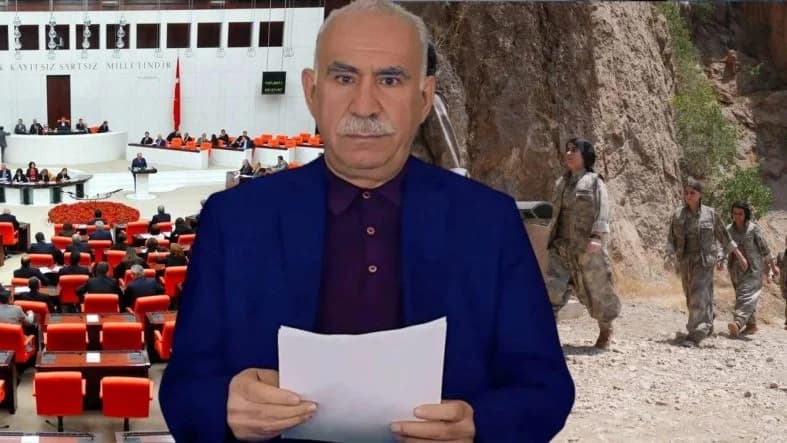
Filiz Deniz speaks for the first time: Why did I publish those notes?

RastinewsWhy did I publish those notes?
Filiz Deniz speaks for the first time
For days, people have been speaking in my name. Speaking in the name of Rastî. Everyone has their own theory about who sent us the notes from the İmralı-Kandil meeting we published, and about why we published them.
Until now, I have not spoken.
Because I do not think that, in order to stand behind our work, we need to defend ourselves on social media every day. For a journalist, what matters most is the story itself. But what has happened in recent days has gone beyond the bounds of a professional debate about whether a story is accurate or not.
That is why I want to explain some things, for the first time, in my own words.
When the notes said to be from the meeting held between İmralı and Kandil reached me, I did not publish them immediately. I worked on them for days. I read them, and read them again. I examined the names and dates in the text, the language used, and their connection to developments taking place at the time. I compared them with other information.
Only then did I conclude that what lay before me was a document of very high news value.
That is how the decision to publish was reached.
Rastî presented this to the public in three parts. Moreover, we did not describe the text as a finalized state document or an indisputably verified official record. We stated clearly that these were notes from a meeting said to have taken place.
What came after that was no longer the journalist's domain, but the public's.
Because in my understanding of journalism, the reader is not a child whose ability to handle a given piece of information is for others to decide.
People read, compare, question, listen to the parties' statements, and form their own opinion.
Journalism is, in part, about being able to show the reader that respect.
Who benefits from a document
After publication, much of the debate revolved not around the content of the document but around questions of "who leaked it, why was it leaked, who benefits from it?"
Of course a journalist considers why material handed to them was given to them. They question whether the source has a motive. They factor in the possibility of manipulation.
But none of this negates the news value of the document.
A journalist's real job is to investigate, as far as possible, the veracity of the information in hand, to consider whether there is a public interest, and not to hide from readers the points that could not be verified.
The identity of the source is a separate matter for journalism. A journalist protecting their source is one of the fundamental principles of the profession everywhere in the world.
Something else has troubled me more.
When it is not the journalist but the needs of political processes that begin to decide whether a document is published, where does journalism stand?
Because one of the words we heard most after publication was "sabotage."
We were told we had damaged the process.
I believe this leads somewhere dangerous.
A journalist is not an official of a negotiation.
Nor of the state.
Nor of a party or an organization.
A journalist's responsibility is, above all, to the public.
When this distinction disappears, so does the distance between journalism and political communication.
"We had it too, but we didn't publish it"
During this process I heard some interesting statements from certain journalists.
"This information had reached us too."
"We had it too."
"We didn't publish it."
That may be so.
A journalist can also decide not to publish a document in their possession.
But your decision not to publish does not make another journalist's decision to publish illegitimate.
On the contrary, what should be discussed here are two different journalistic choices.
Why didn't you publish it?
Why did we publish it?
What verification methods were used?
Where was a mistake made?
Which part is problematic?
We can discuss these things.
But when the debate reaches the point of "this should not have been published because it damages the process," we are moving away from journalism.
For this reason, Ruşen Çakır's assessment of Rastî's publication as an attempt to sabotage the process was also striking to me. Because he himself had previously described how İmralı notes leaked earlier had been used by journalists.
I am not pursuing a personal polemic here.
I am simply asking a professional question:
Under what circumstances is a leak journalistic material, and under what circumstances is it sabotage?
Who is to set that standard?
We also published the objections
Various statements followed regarding the notes we published.
Mithat Sancar, a member of the DEM Parti İmralı Delegation, said that no such meeting took place in the form published by Rastî.
We reported this statement as well.
Statements from Kandil also became news. As did statements from other actors.
Because that is precisely what journalism requires.
Standing behind a story you have published does not mean hiding the objections raised against it.
If it is concretely established tomorrow that any part of these notes is inaccurate, that too must be written. For a journalist to close their eyes to the truth in order to defend their own story is one of the greatest mistakes they can make.
But unfortunately, much of the debate up to now has not proceeded on the basis of the document's content.
It has proceeded on the basis of me.
First the journalists spoke, then the crowd came
This was one of the things that troubled me most during this process.
Instead of a journalist's story being debated, the journalist herself began to be debated.
A lynching campaign that lasted for days began on social media. Insults, humiliation, insinuations, accounts repeating the same sentences…
After a while the story disappeared, and the journalist became the target.
What was more painful was that the first signs of this came from journalists.
I am not talking about a journalist criticizing another journalist. Criticism is part of journalism. You may find my story wrong, criticize my verification method, or heavily question my editorial decision.
None of that bothers me.
But when a journalist begins to pass judgment on what another journalist can or cannot publish, based on the sensitivities of political actors, there is a serious problem.
This episode has also shown me, more starkly, another matter I have long thought about.
How truly possible is independent journalism in the Kurdish press?
I am not asking this question of someone else, but of all of us.
We have known about state pressure for years. We know about journalists being taken into custody, arrested, newspapers being shut down, websites being blocked.
But we cannot explain the problem of a free press by speaking only of state pressure.
We also have to talk about the power relations within our own ranks.
We cannot speak of free journalism without discussing the visible or invisible influence of political movements, parties, organizations, and circles over the press.
If a journalist is independent of the state but not independent of their own political neighborhood, there is still a deficient freedom.
Perhaps this is one of the harshest things this episode has taught me.
If a woman did it, who is behind her?
There is also the gendered side of the matter.
It is not easy for me to write this.
Because we are talking about a society from which one of the strongest slogans of women's liberation has risen for years.
Jin, Jiyan, Azadî.
We speak of women's will, of the women's revolution, of the dismantling of the male-dominated system.
Yet when a female journalist made an independent decision that some people did not like, the first thing some in those same circles did was look for a man behind her.
"Who made her do this?"
"Who is behind her?"
"On whose behalf is she acting?"
Beneath these questions lies a very old mindset.
A mindset that does not believe a woman can decide on her own.
Can a woman not develop a source?
Can a woman not obtain an important document?
Can a woman not think it over for three days, investigate, weigh it, and in the end say, alone, "I will publish this"?
Why must there necessarily be an unseen man, an organization, a state, a center behind her?
You cannot turn a woman into a symbol of the freedom struggle and then strip her of her will the moment she makes a decision you did not want.
A woman is not free only when she thinks the same way you do.
The real test begins when she decides in spite of you.
I have seen this very closely during this process.
So where does the journalist go?
In recent days I have asked myself another question.
When an independent Kurdish journalist comes under pressure, where do they go?
Which institution can they trust?
Which professional body can defend the right to journalism alone, without regard to political affiliation?
Over the years, it was not only political structures that became organized. Strong networks of affiliation also formed within civil society, professional bodies, and the public sphere.
This may not always have been done with bad intent.
But we have to face its consequences.
When a journalist wants to act without leaning on any political center, they can find themselves in an extremely isolated space.
This isolation is not only my issue.
It happens to me today, to another journalist tomorrow.
And a free press is tested precisely at times like these.
Defending your own journalist is easy.
Defending a journalist who stands on the same political line as you is also easy.
The real test is being able to defend the right to journalism of a journalist whose story you dislike.
If those notes were handed to me today, would I publish them again?
I have asked myself this question many times.
My answer is yes.
I would investigate again.
I would wait again.
I would try to verify again.
And if I reached the same conclusion, I would publish again.
Because looking back today, I see that the real debate is much bigger than the İmralı-Kandil notes.
The issue is no longer those three parts.
The issue is who gets to decide what the Kurdish public may and may not know.
The state?
The political parties?
The organizations?
The journalists?
I believe society is mature enough to confront its own reality.
A journalist's job is not to sift the truth for society and say, "there is no harm in you knowing this, but it is not appropriate for you to know that for now."
Of course journalism has its limits. We carry heavy responsibilities such as human life, security, privacy, verification, and source protection.
But political comfort is not one of them.
A story is not withheld because it will disturb someone's peace of mind.
A journalist does not fall silent because a political process will be strained.
A document is not shelved because an organization will be uncomfortable.
Public interest does not disappear because a state does not want it to exist.
I am not avoiding criticism of the publication I made.
If there is a journalistic error, let it be shown.
If false information is uncovered, let it come to light.
If there is inadequate verification, let us discuss it.
I will sit down and face all of these.
But I also know that I must defend my journalism against insult, against a lynching campaign, and against conspiracy theories that erase a female journalist's will.
Perhaps this is the most important record of what has happened today.
One day, another journalist too will be handed a document that society needs to know but that powerful actors do not want published.
On that day, the same sentences will be placed before them as well:
"Now is not the time."
"It will damage the process."
"Who benefits from publishing this?"
"Wait a little."
That is exactly the moment when journalism sometimes begins.
I made my own decision.
Rastî published those notes.
Right or wrong, and with all the debate it has caused, I am not placing the responsibility for this decision on anyone else.
I made it.
And I stand behind it.
Filiz Deniz