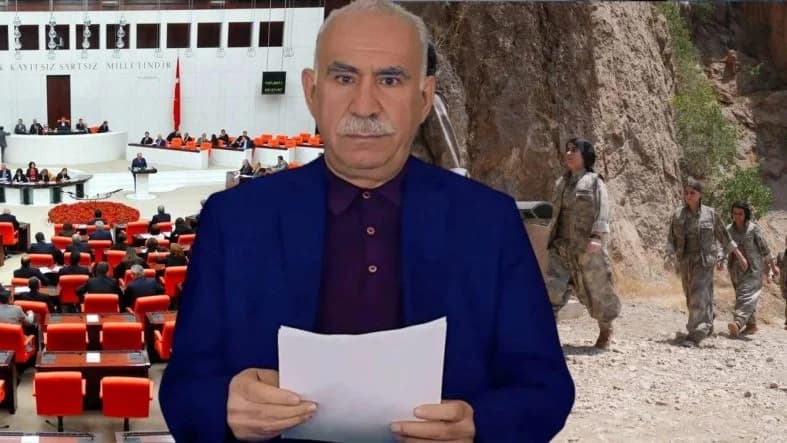
Notes surface from meeting between Öcalan and Kandil delegation
Dear Rastî followers and readers, on the meeting alleged to have taken place between Abdullah Öcalan, state officials and a Kandil delegation on February 1-2, 2026

RastinewsDear Rastî followers and readers, we will share with you in three parts notes from a meeting alleged to have taken place between Abdullah Öcalan, state officials and a Kandil delegation on February 1-2, 2026. According to information that has reached us, this alleged meeting included senior PKK figures such as Helin Ümit, Duran Kalkan, Sabri Ok and Raperin. We are publishing the notes in three parts, exactly as received, without altering a single word.
Here is PART 1
MEETING NOTE DATED FEBRUARY 1-2
President: Welcome. Let's do the greeting this way. You know about Baba İshak and Baba İlyas. Looking at where the two of you stand in PKK history, this fits you well. I looked into the Baba İshak revolt. Sabri belongs there. Abbas is a Turkmen's son, a man of that same tradition. They too were men of that era. When I work through historical sociology, I trace things back to their origin and ask who they resemble today. All of the past flows into the present. I once said history is hidden in the present, and we are hidden at the beginning of history.
You've long been dead. On the teleconference I told Sabri that neither of you knows how to live or how to fight. I have harsh criticisms to make. How right is it to criticize the dead? I say this philosophically.
The Baba İshak revolt was the last Turkmen revolt along the Adıyaman-Amasya line. It ended in Kırşehir. And it was crushed, as you know. They hung Baba İlyas's head from the walls of Amasya Castle. The Seljuks did this. Alongside them, between 500 and 1,000 Frankish knights delivered the final, fatal blow. These were mercenaries. They were also the ones who saved the Seljuks. It was a final revolt. What is the connection between this historical event and you? It follows the same pattern as the PKK. You may reject this. I don't know how right it is to criticize those who lost everything in a revolt. I made a historical comparison. While I subject the PKK's 40 years to criticism, you too can criticize, you can defend yourselves. I have some criticisms, take them with understanding. Let me greet the two of you this way.
As for Helin, I have two memories that stayed with me. I don't know whether she remembers. We had a villa-like house in Damascus, on the flat ground. It had a pool. The water in the pool had almost dried up. There was very little left. I said, come, let's swim. But you gave me a look that made clear this was pointless.
Helin: I remember, President. I must have been trying to make sense of it.
President: You warned me. You asked how anyone could swim in so little water. Of course my request seemed pointless to you. That attitude of yours was meaningful. The second memory is from volleyball. Back then, I'd catch the ball and throw it my way. That was against the rules. I still do the same thing today when I play ball with friends here. Mine was actually cheating. But Helin played by the rules. She played well. You were from Kastamonu, weren't you? Where exactly?
Helin: Yes, President, Kastamonu, Taşköprü.
President: Do you have relatives there?
Helin: Yes, I have uncles there.
President: I remember thinking at the time, why did this composed Turkish girl come to us. Not distrust exactly, but I did wonder whether it might be infiltration. I never actually felt distrust about it, though. Mr. H. had said something about this before. He'd diagnosed me as "skeptical." I am somewhat of a skeptical person. But I never accuse anyone out of suspicion. I still wonder whether Kesire was an infiltrator or a leftist intellectual. Her father was close enough to the state to correspond with Mustafa Kemal and İnönü. Our relationship had a political side too, I won't go into detail. I loved her, there were feelings too. We don't judge anyone by who their father was. With Helin as well, I wondered the same when she arrived looking so composed. Then I heard that the Turkish girl Helin was still alive. How many years have you been in the mountains?
Helin: I joined in '95. I've been in the mountains since 2001. I grew up alongside you, President.
President: There you have it, a Turkish girl. Standing before us. A Turkish girl in our ranks under the harshest conditions, right in front of you. (Turning to the officials) Go ahead, speak as freely as you like. You know my mother was also a Turkmen woman. My grandmother once said to me, "lawe te benamus derket." That mattered. I wrote to Bahçeli about this too, that if there is to be a concept of honor, it must be a social one. In fact, my grandmother's words made me a socialist. That saying of hers was decisive for me. It was that attitude of hers that first made me feel I had to live an honorable life. She shaped me with that saying. When she said "benamus," it felt like boiling water pouring over my head. I tried to explain this on the plane too, but they twisted it afterward. I had a relationship with Hasan Bindal, a childhood friend from the family across from ours. I loved him very much. He was killed in Beka'a in my place. He gave his life for me. As children we used to pick crocuses together. Helin coming here matters in this sense. She's been in the mountains for 25 years. So where are you from? You're Kurdish, I take it?
Raperin Ark: I'm from Dersim, President.
President: I don't want to make distinctions, of course. There is nothing negative Helin could hold against herself. She is like this from head to toe. She is a person of truth. Some call me the number one enemy of Turks. But here before me is a Turkish girl who came to the mountains following me. Abbas, in the end, is a Turkmen's son too. There's Turkmen heritage there, isn't there?
Abbas Ark: There's some Caucasian heritage too, but it's true, I'm Turkmen.
President: You resemble Baba İlyas, if you had a beard you'd be his spitting image. Here we will discuss Turkish-Kurdish relations. We already achieved the Turkish-Kurdish alliance ourselves. There's Hâkî Karer, Kemal Pir and others. There was Canda too, I won't forget, there are many people.
Helin: There was Özgür too…
President: We resolved this matter among ourselves, together with you. I read some of your writings. We will now carry this resolved matter beyond ourselves. We brought it to this day in keeping with Haki Karer's testament. We never abandoned the Kurdish-Turkish relationship. Ours was a rebellion. We wanted to turn it into a modern people's war. But you did not succeed. In Demirel's words, the greatest rebellion. They call it the last Kurdish rebellion. Comrade Duran has been part of it from the very start. That's why it cannot be counted a purely Kurdish rebellion — it is a Turkmen rebellion too, at the same time. As a front, Turkish socialist organizations are also part of it now. But now we are at this table. You may see this historic table as very ambitious. This table will resolve the mistakes of the Republic. The relations between the two peoples across the Republic's history will be corrected. This table will resolve two of its fundamental mistakes. For a century, the Republic's filth has been swept under the rug. This table can clean the sins and the filth of Turkish-Kurdish relations. That is why this table is valuable and important. Setting peoples against one another is the greatest crime. Driving it toward bloodshed, toward an abyss between two peoples, was more dangerous than murder. I have an approach with a social dimension. I have a saying: "insistence on socialism is insistence on humanity." Humanity faces the prospect of annihilation. That is why simply being human is enough to resolve these things. Despite every shortcoming and mistake, you devoted your lives to this. There is a great community of comrades behind you. There are thousands of martyrs. On this basis, I greet you. I don't know the other friend. (Turning to the friend named Raperin) Do I have a memory with you?
Raperin: I'm from Dersim, President. I joined in '98, from Istanbul University's law faculty. Around the time you were leaving Syria, I was at the academy in Greece — you connected by phone and addressed our group.
President: Where did I address you? Did I join directly? I never left a room in Greece.
Raperin: You joined by phone, President.
Helin: You used to speak by phone from Damascus to the groups in Greece. Comrade Raperin was in the Greece group at the time.
President: Yes, I understand. I entered Greece twice. It was like a cell, I couldn't go outside. From there I was taken to Moscow, and from there to Corfu. But they had taken great precautions. The departure from Damascus happened under CIA pressure.
Sabri Ark: Who besides the CIA could change a plane's route at the last minute?
Abbas Ark: Yes, President, the CIA was involved, it was in it from the start. In Moscow it was even more involved.
President: From there they took me on to Nairobi. It looked like a CIA operation, a conspiracy. It started after Damascus. I remember it well. He was different from Stavrakis. He came to Greece and met with me there. He asked questions. He handled it like an interrogation. I stayed closed off. He proposed Oslo as a destination. They planned to do to me what they did to Arafat. When I refused from the start, he vanished. It was clear he was a CIA operative. Then we went on to Nairobi. In the morning we were having breakfast at the embassy. The ambassador and Kalenderis spoke in a language we didn't understand. Then Kalenderis struck his head with both hands, said something, and ran downstairs. He did that right after the ambassador told him we would be handed over. Ecevit himself later said, 'I never understood why they gave us Apo.' They threw me at Turkey like a bomb with the pin pulled. A colonel was the first person to greet me here. He also brought a bowl of fruit. That's when I first told him we should turn this island into an Island of Peace. That was the first time I said it. I also remember a remark from someone on the team, on the plane. He said, 'Welcome to your country.'
Official: He said, 'Welcome to the homeland.'
President: Let me turn to you. Where in Dersim are you from? Do you have relatives there?
Raperin: There's comrade Kemal Zap.
Abbas ark: He's from the Haydaran tribe.
President: I don't know you, so I have no memory of you. (Turning to Bışar) Well, let me get to know you. Do we have a memory together?
Bışar: President, I have no memory with you. My brother İbrahim Yıldırım stayed with you. After he got out of prison, he attended the prison conference in the Beqaa. Then he was martyred.
President: Are you from Ömeryan?
Bışar: No, I'm from Kızıltepe.
President: I went to Kızıltepe. I have memories from Xurs. I stayed with Ferhat Kurtay. There was an operation, and soldiers came to the village. There was a village headman. He took us toward some rocks. He tried hard to protect us. After the soldiers left, we came back to the village. My memory of Ferhat Kurtay is very precious. He was one of four comrades who set themselves on fire. He was a very valuable comrade. There was strong participation from Kızıltepe. Mardin is a place that has taken heavy blows. I may know your brother, but it's hard for me to remember.
Bışar: He was captured wounded in the famous Biloka clash.
President: He got out again and rejoined, didn't he? You aren't from the M. Emin Aslanlar family, are you?
Bışar: No, President.
President: Good. Greetings are over. Now I'm listening to you. (Turning to the Official) You said to let the comrades speak too.
Helin: We have brought greetings, love and longing from the mountains, from our movement's leadership and all our comrades.
President: The women's?
Helin: The whole movement in general, President.
President: You're naturally more in command of PAJK.
Helin: The women comrades, that is the comrades from PAJK, send their warm greetings.
President: How is Bese?
Helin: Comrade Bese is working and in good spirits.
President: The matter of the women's revolution goes beyond all other matters. I put women's freedom in first place. I addressed it in half of the manifesto, and we answered many questions there. I say again, this subject is heavily exploited. Femicides happen every day, everywhere. But in Turkey they happen more. In Turkey the subject is handled superficially and in a distorted way. They talk about the killings and so on, as if that were just the visible tip of the iceberg. Being human, being a socialist, can be measured by one's approach to women. I reflected this in the manifesto. But it needed to go deeper. To find a solution, you need to be fifty times more socialist.
Helin: Yes, President, absolutely. That's how we approached it too.
President: My struggle against hardship is well known. No hardship can be more valuable than fighting a rape culture that goes back tens of thousands of years. As I went deeper into this, I developed a certain sociological outlook. If sociology is to be a discipline, its starting point should be defined as the problem of second nature. A form of socialism needs to be developed around this problem of woman. And this sociology must begin with the social relations built around woman. I took the concept of namus (honor) from my grandmother. Nomos means rule, science. There is no culture, no rule, no measure here. No man, no family, would allow you to go to the mountains. Achieving this kind of identity is important, but very difficult. There is unbearable pressure. In fact, because I opened this path for you, I too am under heavy attack. But it is extremely valuable. There is unbearable suffering, unbearable oppression, and economic exploitation of labor. Marx, the number one socialist — even his approach to his own wife is well known. He didn't count women's labor as labor. Lenin and Mao's record is even worse. I have not exploited women. I have not treated the subject with mere superficial values. Every man may have weaknesses he could fall into, but I have not made major mistakes, a fatal wrong. So I salute, on this basis, the women's group you mentioned.
Helin: In Iran there is Jin Jiyan Azadi, and in Rojava a hair-braiding movement has started. Let's call it the braid revolution. It isn't just symbolic. There is strong ownership of it. It has spread across the world. The practical politics of the women's line you built is plain to see. Women are embracing it strongly.
President: Yes, it has spread. I read about it. Quite interesting. I think it is increasingly developing on the international stage as well.
My mother used to say that if you go on like this, no woman will accept you. She meant it in the sense of having a wife. True, I never did. What kept me alive was the matter of women's freedom. Nazan Üstündağ wrote a letter — you must have read it. I have a letter she wrote to me. I'll give it to you, you can read it. She makes important observations about me. But despite their opportunities, they come from the left tradition, yet they can't even pass through the fringes of the left. A socialist should know how to live with a woman. Women's labor was left outside of labor. Knowing how to live with a woman matters to me. Men treat women as things, as objects. Hannah Arendt already touches on this a little. This is what I call, in my own terms, the Sociology of Freedom. It matters that PAJK, the women's group you mentioned, is leading this despite living under crushing conditions. Your coming here at a leadership level also carries symbolic meaning. Time is limited, otherwise the whole meeting would go like this. Eat something, we'll continue. There are four of us here, we talk from morning to evening.
Official: No one eats until you do.
President: I'm always the one talking. Please, eat something.
Raperin: We heard you had a severe flu, and we want to extend our get-well wishes on behalf of PAJK. Including women comrades at a table like this is very important and meaningful.
President: Because the state is masculine, it builds its system the same way. A meeting like this matters. It was hard to reach this decision. Its historical dimension is important.
Helin: Turkey is being turned into a very masculine society. Politics is masculine.
Raperin: Women are present throughout every social struggle, but they are left out of negotiation and resolution processes. Our inclusion at this table is very important, and we will try to prove worthy of it.
President: There's a saying by Olympe de Gouges. She says: 'Women are granted the right to be sent to the guillotine, so they should also be granted the right to mount the parliamentary rostrum.'
Raperin: There is the right to enter politics… We are discussing how we will lead in this process. We are making efforts to understand the manifesto. There is a need for deeper study and absorption. In the letter you sent to comrade Veysi, you also made certain criticisms. In this period we are also focusing broadly within that framework.
President: I wanted to bring this up in the letters. The current masculine condition must be overcome. Individualism, self-centeredness, kills. A tremendous mass of women has formed. This is the opposite of all conventional ways of living. That's also why my mother used to say no one would take you. This lies at the heart of A. Haydar Kaytan's loss. Ali Haydar got married. I also did something like a marriage. I dared to do that. There were other reasons too. It was badly misunderstood in the superficiality of Dersim. My aim was different. There was love and an emotional bond. But it turned into a matter of war. Without this ten-year struggle of mine, I could not have arrived at the ideology of women's liberation. Ali Haydar did not read it correctly. He could not free himself from the effect of the marriage he made. The same goes for Hamili, and for Sakine. They developed it wrongly. It's a very sensitive and delicate subject. They could not overcome the rupture they experienced.
Duran Kalkan has a dervish-like loyalty, but he never recognized, never grasped, never understood my way of doing politics. I told officials: when did you first notice us as a group and put us under surveillance? They said they noticed and tracked us four years later. That falls around '77. By then I had already formed the whole group. That's why I show one and carry three in my pocket. Now it isn't like that, don't misunderstand. We hold to a single strategy and we are sincere. Back then we had no choice. My way of waging war is very different.
Friend Duran is the most hardworking, the most diligent of the comrades. But no comrade is as dogmatic and as rigid as he is. Let me say last what I meant to say first, don't take offense, friend Duran. Special warfare works so hard against us. It wants to bring us down. I said: if special warfare wants to bring us down, the only person it could send us is someone as dogmatic and as rigid as friend Duran. Mihri Belli was with us the day we saw you off from Damascus. As you set out for the Zagros, we had written 'The Role of Force' together. Was it finished?
Abbas Ark: It was finished. I edited it on the typewriter. We had written it a year earlier.
President: I used to say he'd go and do it ten times better than me. Now I'm going to say something that may land hard. But let me say it as a sincere opening. August 15 need not have happened. That choice opened the door to defeat and losses. It flung the door wide open to defeat. It blocked the formation of a guerrilla method.
Then the wretch Hogir massacred everyone in Mardin without sparing women or children. Was it Çiçek village? Was it Pınarcık? These ran counter to my understanding. Faced with an act like that, I grew angrier than the state itself. I don't know for certain whether Hogir was a special-warfare operative. Your arrangement has no special-warfare link, but had I known the result would be this, I would certainly not have let you leave Syria. In '98 I reacted so strongly I said I would quit the PKK. But you never grasped it. The wretch Hogir attacked civilians. Here too I told Mr. Emre that 90 percent of that method of action was not my method. Ninety-five percent of it happened outside my will. That does not absolve me of responsibility. Had I known the result would be this, I would not have let the armed unit cross the border, nor you either. But let me repeat, this does not absolve me of responsibility. You worked hard, you made no small sacrifices. I don't know what your character is like now, how you have changed. Friend Duran owns his responsibility to the end, he never drops his load in the field. They call you the roof beam. I'm not saying anything by that. It may be so. Military strategy was never set on firm footing. Take Selahattin Çelik, Ebubekir, all that they did before they were gone. The results of this are unbearable. You are among those chiefly responsible for it. When I say you, I mean the entire war command. No leader can withstand the consequences of a war this heavy. Let me give the example of Mahir Çayan. While in prison, DHKPC makes its historic breakout. The moment Yusuf Küpeli gets out, he demands certain posts. Mahir expels him at once, pushes Yusuf aside. His reason: you diverge too far from the party I want to build. I have some sympathy for Mahir's character. My reason for drawing the parallel is this: given the practice you found yourselves in, would it have been better if I had gone to that post myself? It's debatable. Perhaps I would have produced a movement worse than yours. Perhaps I couldn't have taken a single step. My impression is that the line was damaged there. The action-understanding of those irresponsible groups broke the line. The method of action brought things to this state entirely. As leadership, our delay let the method of action become this.
My expectation was this: our numbers had reached 300. You were dug in at Xakurk. Your equipment was sufficient to take up a war footing. In terms of armed-propaganda method, there was a wish to turn Xakurk into a systematic war zone. The numbers were sufficient. Because of the Iran-Iraq war, there was a geopolitical situation resembling today's. The wretch of Botan ran wild with that method. Turkish generals were saying they could settle this in the '90s. Özal too had stepped in and begun working on it. Had the ceasefire line held, it could have been resolved in the '90s. But they toppled Özal, and the contras inside our own ranks remained, though there was no need for them to be inside us at all. The method of action of the wretch of Botan and the others set us back from a resolution. You had already died, you failed to make the first move. That is how I mark your date of death. The movement was at the peak of winning in '93; what came after led to decline. How much do you hold yourselves responsible? You had already gone to Europe, and you were held there too. Now, as if no officials were here at all, let's speak freely. (Turning to the officials) I did not start this with you, I started it first with Özal. In our eyes he is a martyr. I gave him my word, I will carry this process to its conclusion in his memory. We were to have met with Kaya Toper, and Özal fell on that very day. Now I ask, are the SDF, Kandil, Europe engaging in self-criticism? What does the Kandil front understand by self-criticism? Recently in Aleppo, Sheikh Maqsoud was encircled. Turkey said it would give support. The defense minister says we will help. Everything is built on annihilation. The plan and the preparations are to tear it out at the root. There will be resistance in the neighborhood, and the state of our forces and the outcome are plain. Total annihilation, that is the plan. My thanks to the officials, they came and spoke of this danger. I too wrote a letter. You too know of that letter. What would have happened had that letter not arrived? Bahoz had said: 'Resist with the Apoist spirit to your last man.' What would the result of that have been? Had I too said resist to the end, not one stone would have stood on another. Ten thousand people would have been massacred. Not one stone would have stood on another. Yes, it would have been like a Paris Commune and gone down in history, but even Marx wrote, before the uprising, 'If only there had been a chance for the Paris Commune to negotiate with the government before rising in revolt.' Marx says if only. In the end ten thousand died in Paris. The Paris Commune is exalted to the skies, but he does not praise it as having been done well. That history reaches down to our own day. The forces that set off the Sheikh Maqsoud affair would have turned Turkish-Kurdish relations into a bloody relation for the next hundred years. Neither Qamishlo nor Kobani would have been left standing. The Kurds would have resisted, who would win and who would lose is not clear, but I certainly caught the scent of Gaza in it. Yet the Kurds would have won only as much as Palestine won in Gaza. Indeed the whole world stood behind Gaza, whereas the Kurds would have been left alone, and there would have been nothing left called Kurdish in Syria. Say what you like, up in the mountains, that I am still there. It could have become a legend too. But what would the result have been? A revolutionary must also calculate the result. A revolutionary who does not calculate the gain cannot defend a people.
Here friend Ömer reminded me of a remark of yours. At the time of Cizre and Sur you had said, 'We did not expect the state to turn this cruel and this savage in Cizre.' Ömer criticizes this and says, how can you not think of it, not foresee it? How can a revolutionary not think of this? Are there no other paths? If a revolutionary does not think of this, a people perishes. The last word is yours, but in general all bear responsibility. I do not see myself as some towering leadership, but this is not my method. The officials met with the Şahins in Rojava. An agreement was reached. A Kurdish geopolitics worse than Dersim would have formed. In Rojava a Gaza-type scenario was blocked. It is not an ideal solution, but it is very valuable. I find it valuable because it forestalled a Gazafication. There is no wholesale loss there such as there was in Gaza. The Palestinians carried out a great action on October 7. That action brought about Gaza's end. We have no loss like Gaza's. Palestine is finished, while with us the hand still holds firm. What we call politics is this: the vanguard sees it coming and takes its precaution. You too built TÜSAŞ. You can defend that, I say nothing against it. I'm not taking a jab, don't misunderstand. You own it too. But there are those who define the action that finished off Gaza as heroism. In Turkey too there is such an Islamist tendency. There is no need to load all the blame onto Israel. The action that finishes you off cannot be defended as such. It is not heroism, it is murder, that is how I judge it. Whatever the good intention, the result speaks for itself. This is a reflection of that special war.
We have had meetings here with the officials. I believe in one of your assessments you described this somewhat as special warfare. I say nothing against that, and perhaps it deserves some weight. But I also told the officials at this table that at times you may be intertwined, both the normal and the extra-normal representatives of the state at once. I said this to the official at the time. I was even going to tell İ.K. that I see MOSSAD's shadow behind you, then I gave up on it. You called me a skeptic. Israel has thought this through. Turning the Kurds into Gaza, the danger is great. Sheikh Maqsoud proved this.
I'll talk if the Hawks come. From the start I said I sensed a whiff of Gaza in this. I always said this. Aleppo proved me right. A deadly trap had been set in Sheikh Maqsoud, and the trap continues. I've been renewing my analysis over the past few days. My latest conclusion is this: Zionist Israel has built its own rise on a dialectic in which the Kurds are laid in the grave. This is the English mind. This is very clear. London-centered Zionism is advancing. A Jewish homeland was calculated in advance as northern Iraq, meaning the area around Mosul. Abdulhamid accepts Mosul. But they say no, let it be in Palestine. When Abdulhamid refuses this, they depose him. After the 18th century, Barzani too is a Mosul convert. The Thessaloniki converts became Turkish, and the Mosul converts became Kurdish. Israel built this relationship in history. They are masters of both Turkish and Kurdish sociology. When they decided to found the Jewish state in Palestine, they said: as we Israelize Palestine, we must sacrifice something. They divide Kurdistan into four parts. One part is kept, the other parts are sacrificed. Turkey, and especially the foreign minister, worked hard on the SDF (Syrian Democratic Forces) issue and constantly spoke of an SDF under Israeli control, trying to create a perception. But you know my Mossad story. I was being followed from Damascus onward. They said, come to us, we'll give you whatever you want. They pointed to Oslo as the only route; I didn't go. Their contact in Moscow was Zhirinovsky. He is Jewish. In Rome too I was under incredible siege. Later, from Nairobi, they threw me to Turkey like a pulled pin. The target was large; they had figured us out. A Kurdish-Turkish war was the goal, and it was built on my elimination.
As for Sheikh Maqsoud, they wanted to drag us back into a major war and conflict. They had clearly reached an agreement. In Aleppo they wanted to overturn this table. Ibrahim Bey and the officials warned immediately; it was a serious situation. I wrote a letter, and Şahin reportedly took it seriously. It was of course a bad outburst, but it did not lead to a larger, mistaken war. Kandil was reportedly uneasy about it; in my view there's nothing to be uneasy about. Because for the first time, we did not enter a war of our own will. Had the recent clash gone this way, not just Syria but this whole process would have been blown apart. It would have become a war spanning a century. Tens of thousands would have died in Qamishlo, Hasakah and other cities. You already know the Arab way of war: wherever they move in, they kill all the men and carry off the women and children as captives. Didn't they do this in Shengal (Sinjar)? The Hawks apparently said, "help was going to come from Israel." We would have been finished. Aid goes to Gaza too, but wasn't it destroyed anyway? Trump stands at the head of that aid. Who do you expect help from. They're already goading Israel into attacking, too.
That's the introduction I gave. I don't dwell on the past. The past is in the past; what matters is that we look to the future. My criticisms of the PKK's dissolution and of the real-socialism style, and so on, are known. I had voiced these criticisms back in the '90s as well.
I must say again: if a solution is to develop, we need to understand this coup mechanism well. The coup mechanism has kicked in. In republican history, M. Kemal had a chief bodyguard, Topal Osman. Topal Osman acted exactly like an extra-normative state force. He stood right beside Atatürk and was responsible for his security, yet he even shot the deputy Ali Şükrü Bey, and many others besides. Atatürk knew it had gone out of control; he knew his own turn was coming, and so he took precautions. M. Kemal was the normative state, but the extra-normative state always existed alongside it. And at that time it was Topal Osman. On July 15, Mr. Erdoğan's closest aides turned out to be coup plotters. They are still active. They think they've been purged; that isn't so. The talk of them being purged is a fiction. Now their playing field is Syria.
You too may ask questions. I consider it important that officials are here. We are now continuing, at this table, the discussions that follow the dissolution. What and how will we resolve after the PKK. The weapons remain in place; we still haven't laid them down. The parliamentary commission holds no promise. No draft has been produced, and my status is still illegal. Your coming here through a bold operation matters a great deal. I have drafts in hand; you'll read them this evening. Tomorrow we'll discuss it in more depth. As a political institution, parliament holds no promise, but state reasoning is present here, and this is a threshold meeting. This threshold meeting could be an important beginning. History could take a different course. The culture of conflict could be abandoned. Law could come into play. But it doesn't happen with me alone. I'm tired. The parties must take responsibility. I'm not pleading. I've stated the threshold briefly. But you, too, are here. Comrade Duran is quite experienced, a comrade who can take on real responsibility despite such harsh criticism. Comrade Sabri is here. He has considerable experience. The ingredients are ready; all that's left is to make the aşure. Yes, the floor is yours…
Abbas Ark: With your permission, I'd like to say a few things. We are trying to understand what you've said. We've also read the Manifesto extensively and held discussions on it. Our coming here is meaningful. I can also say some things that support what you've said. The wording around August 15 could be phrased differently, but essentially the style of war developed as you describe. The village raids came right after August 15. It began with Ebubekir, and Hogır carried that line forward. He carried out contra-style acts, but it also developed as a style of war in its own right. So we don't take the approach of getting out of it by pinning it on the contras. Hogır wasn't a contra, but his style was contra-like. Our Leadership made assessments regarding the '93 ceasefire.
President: On that matter — do you have any new information about Özal's death?
Abbas Ark: We don't have any different information. The information is mostly here.
President: There are also a great many purges within the military.
Abbas Ark: Regarding the '93 process, we had assessed the state as if it were a single whole. The recent process has shown that this view of ours was mistaken. During this process, delegations and comrades came and went. Letters came and went. While we were trying to implement the letters, the opposite approach was taken in Aleppo. At first we were surprised, but once the Paris talks came to light, we understood what the matter was. While focus was placed on the three issues you set out in the letter — the crossings, oil, and mutual representation offices — how did the attacks that developed in and after Aleppo come about? Who organized this matters to us.
President: This clash reminded me of the '93 clash. Back then, right as we were trying to negotiate and find a solution, the coup trio stepped in — I call them the Talat Pasha provocation. Outside that trio (Talat, Cemal, Enver), no one in the cabinet knew about the First World War. The same happened with Özal. Nothing about his death was ever clarified. The soldiers loyal to him were purged, and those who carried out the purge grew stronger and seized more control of the state.
In Sheikh Maqsoud there is something so subtle it defies belief. Officials can't disclose their own share in it, because it's a professional secret. But they prevented something bigger. I believe this. So once this letter was discussed, who set this war in motion. I understood, and I saw, which coup dynamo was set in motion. Compared to '93, these were more organized forces with a firmer grip on the media. It has gnawed at the inside of the state like a worm. This isn't even a clique — it's something beyond that. When Mr. Erdoğan was interned on July 15, his entire circle turned out to be coup plotters. The evidence is there. The coup succeeded. When were these people ever really purged. Someone did this to destroy the initiative here, and this table. This was the target. This is certain. This is the conclusion I've drawn. Both Kandil's approach and comrade Bahoz's approach were also wrong. It would have led to the deaths of ten thousand people. It would have reached all the way to Kandil; everywhere would have been razed to the ground. Rojava was targeted at the Paris meeting, and Shengal had been targeted earlier, at the Amman meeting. At both meetings, a decree against the Kurds was issued. In Paris, ground was won for Israel. Economic space was opened up for the Druze. The Kurds were to be sacrificed in Sheikh Maqsoud. Turkey's foreign minister is part of this too. Because he was in Paris as well. The US is in it too; they told Sharaa to go in, and he went in. So it is Israel that pulled the trigger. For years they encouraged the SDF, telling them to resist, that they would win.
Abbas Ark: France is part of this too. It said nothing throughout the attacks. Once the agreement was made, they immediately jumped in saying they stood behind it.
President: Of course it was involved. Empire does this. This is an open massacre project. MOSSAD had Hamas carry out the attack. Israel wins by putting people in the grave. I'm not saying don't build ties with Israel. But watch your relationship closely. They played us a recording of comrade Bahoz's voice. He's honest, but I tell him: don't fall straight into the trap. The Arabs have a saying: once Basra is ruined, no one asks about Baghdad. Once it's ruined, there's nothing left to gain. A promise has been made to Israel — it will get half. Who lost? The Kurds. The officials approached this with good sense. They surely have information about the coup mechanics, but it's classified, they can't disclose it. Aleppo really was a very dangerous game. These officials stepped in as a soft power. They stopped it from going beyond Aleppo. At first Özal didn't believe he would bring such a thing upon the state. I asked Talabani what Özal was relying on to do such a thing. According to what Talabani told me, Özal put his hand on his heart and said, "I convinced Bitlis Pasha today, I'll convince the others too." He fell from power that very same day after saying that. The normal forces are here, at this table. But the opposing forces aren't small, and the consequences are disastrous. The matter is huge, and this table would have been razed to the ground. What would have happened? We would have clashed. The result would have been a Pyrrhic victory. If we fight for another hundred years, we shrink and Israel grows. It's good that there's state reason at work. It's not the way we want it. Its effects and powers are debatable. I said this in the letter too. I can't say the same things now. They brought this as far as it's come on their own initiative. Things aren't as you think. Nothing can be gained through war. There's no point running this war irrationally. If those madmen purge this team, the war will grow and spread. The February 27 declaration matters. Bahçeli has made the boldest move since Atatürk. (Turning to Abbas Ark) You had made a different assessment. You called Bahçeli the mouthpiece of the dirty war. Bahçeli certainly had that side to him, but I don't know how things turned out at this stage. But Bahçeli isn't someone who talks cheap. At this stage, there's no other initiative anyway. Your assessment doesn't matter much, but I regard Bahçeli's move as valuable. (He showed a newspaper clipping with the photo of the kilim gift.) Do you see this? This is very important.
Abbas Ark: It had also been given to the press. We saw it there.
President: In saying all this, I'm not saying the job is done. We're still at the beginning. Not even the smallest positive step has been taken yet. Both my situation and yours are plain to see. But I'm hopeful. Peace work is far harder than war work. I've taken part in many difficult efforts. I've never entered a process putting this much of my strength into it. I entered this process giving it enormous value and meaning. You know I don't get involved in things that lack value. I'd like it to move fast. But Turkish politics and its traditions don't allow for speed. We're waiting for the commission's report. But at this rate, politics isn't taking the initiative. So I have a proposal for a solution. Let there be a political coordinator. Davutoğlu had proposed this. On another matter, the political party leaders need to reach a consensus about me. Let the leaders come together and set out the limits of my executive activities. For instance, what do the Turkish people and society want from me? Mr. Emre used to say we don't even know what we want from Apo. He'd say the mistake and the fault are ours. Now Bahçeli has spoken of the right to hope. Do they accept or not that I take this on? In practice, my status outside the law must be ended. It's been proven — I have power. Your coming here shows that too. No one but me can carry out the execution. We've seen Kandil, the SDF, and DEM. Their contribution is extremely limited. I have things to do. No separation, no violence. Under my own responsibility, I'm trying to carry out democratic integration by myself. I'm the problem solver.
Abbas Ark: Our congress resolution says the same. That's exactly how we've been discussing it too. We said this process can only be carried out by you personally.
President: (Laughing) Comrade Duran is the last representative of real socialism. That's how I describe him.
Helin: Comrade Abbas changed a great deal after your book Bir Halkı Savunmak (In Defense of a People). That's been my impression.
President: I'm not saying Abbas's writings are wrong. He struggles to turn ideology into political practice. He doesn't fully grasp Kurdish sociology. He struggles to translate his great effort into practice. He doesn't know how to make it work. Is he leading penguins into battle in Patagonia? He has trouble understanding the people right beside him. I say a leading figure can't be like this. The practice is appalling — how can he not stop these destroyers?
Yet he's been walking this road since August 15. Everyone trusts him a great deal. I trust him a great deal too. I made the Kayseri-merchant comparison before. I said "don't paint the donkey and sell it to your own father" — don't misunderstand that. Honesty and loyalty alone aren't enough. Political style matters. If you can't be creative, it leads to the noose. Anyone who claims to be a Marxist must get past this. You'll stay in the mountains for 40 years, you'll resist, but you won't even be able to defend yourself. Ali Haydar, Kasım Engin, Koçero — there have been many cadre losses. This is drowning while crossing the stream. You can't take creative measures. You need to look at the outcome, not get lost in details. Your way of living and fighting is crippled. From the Zagros, you could have carried revolution to one or two countries. And what's with ISIS and the mullahs? They keep harassing you again and again. Iraq and Iran are your main revolutionary base. If you keep fighting and living this way, you'll be trapped. They'll corner you there. Every day you must rouse your historical consciousness. Every day you must discover the new life. That place is the cradle of the new life. There's a world of difference between what I hoped for and what I found. This may be an extreme assessment. I don't want to be unfair. I feel regret. Great suffering has been endured. I'm deeply troubled by these 40 years. If the right things had been done, we'd have finished this in the '90s. I regret this — it's been dragged out. I'm weary of you living like this too. We're trying to make up for this with a limited effort. When there's no solution, the dead end chokes you. My style of struggle wasn't armed, but I'm responsible for the outcome that resulted. If I'd known the results would turn out this way, I wouldn't have sent you in '83, nor those groups. If this solution doesn't reach an outcome, some side will certainly crush you. Comrade Sabri used to say, "We're not empty-handed either. We have connections and strength." But under these conditions, in this state, it's not possible for you to keep going. There are four comrades here — I'm telling them to go discuss until morning and bring back a reasonable solution. There are hundreds like this around you. They keep calling it Talabani's region, Barzani's region. But they too stand only thanks to us. Talabani used to say, "Without you, we couldn't stand for even 24 hours." We had made an agreement with Barzani and İdris. If it weren't for us, no one would recognize them. Our own shortcomings gave them this ground. Anyway, let's move past this. Without my presence here, your state would be miserable. Saying "we couldn't have thought of that, we couldn't have calculated it" means nothing. You will think it through. I also tell the officials: go bring a political coordinator, let me explain my concern, let them pass you a sound report. Politicians are an obstacle to the political solution. The state simply can't manage this. Some of them come out and say things like "not until the last weapon is laid down"... We have no business, no concern, with weapons. I don't rely on arms. We didn't start this process because Öcalan is under pressure or because the organization is on weak ground. They can't manage to live in the mountains. That's how the state is. Politicians came here in 2015 — if not for my self-respect, I could have smashed the table over their heads. Can there really be this much frivolity and irresponsibility? In parliament, they don't even listen to each other. I say, give me the means, let me carry out the work. I don't have these conditions. I work this hard, and even our proposal is left hanging. Every day I beg and plead: open the way ahead for me. If this process breaks down, there will be great destruction. I had said that if this process doesn't reach its conclusion, a 100,000-strong army would emerge — the process proved me right in Rojava. Now, if this process is squandered, as a result of the Iran-Iraq crisis, 500,000 Kurds will be put under arms. There's Iran, there's Iraq. The state of the Kurdish forces is plain to see. They'll direct this at Turkey and bring it down. This isn't a threat. I'm warning you. I'm informing you of a possible development. I want to put my signature on the solution you call our ideal. This matter needs to be settled. There are thousands of lives at stake. There's a saying: "My name is Hıdır, this is all I can do." There are so many soldiers, so much expense. These girls and young people are fighting under harsh conditions. A solution to this needs to be developed. War brings no solution. Those who fell as martyrs — it was like drowning while crossing the stream. We've worked for 33 years and haven't advanced so much as a barleycorn. Revolutions shouldn't bring about their own end like this. I think you understand, don't you?