
Was Ahmadinejad in Vienna on July 13, 1989?
The war in Iran has brought Mahmoud Ahmadinejad's name back into the headlines years after he last made news. On February 28, the war's first day, numerous reports said he had been killed in a strike near his home — but Iranian officials insist he is alive.
RastinewsThe war in Iran has put the name Mahmoud Ahmadinejad back on the agenda of Kurds and the world, years after he last made headlines. On February 28, 2026, the first day of the war, numerous reports said he had been killed in a strike near his home. Iranian state officials insist he is alive.
Last week, in a piece titled "Khamenei as the Code Name of an Assassination," I laid out a key detail of Dr. Sharafkandi's murder. Today I want to share the pages of another file I have worked on for years — the killing of Dr. Abdul Rahman Ghassemlou, another Kurdish leader murdered by the Iranian regime — where his story intersects with Ahmadinejad's.
In the early 1980s, as Khomeini's regime tightened its grip on the country, Kurdish Peshmerga forces retreated first to the mountains and then to the mountainous stretch along the Iran-Iraq border. The freedom struggle of the people of East Kurdistan (Rojhilat) entered a difficult phase as a result. Perhaps for that reason, after roughly eight years of silence, the Democratic Party of Iranian Kurdistan (PDKI), the region's dominant force, chose to reopen contact with the Iranian state — with the Patriotic Union of Kurdistan (PUK), led by Jalal Talabani, acting as intermediary.
The catalyst for the move toward dialogue with Tehran was Saddam Hussein's chemical attack on Halabja on March 16, 1988, which killed five thousand Kurds, followed by the end of the Iran-Iraq War in August 1988. These developments pushed PDKI Secretary-General Dr. Ghassemlou back toward a diplomatic solution.
After an initial exchange of messages, the two sides began discussing where to meet. Dr. Ghassemlou proposed Paris, home to his party's European office. Iran flatly rejected the idea, insisting on "either Berlin or Vienna." Tehran's insistence on those two cities was itself a sign of how much both had become its "backyard."
In the end, the first round of talks was set for Vienna. It took place in the city's 9th district, at the home of Xebat Maruf, a PUK member. Iran was represented by intelligence chief Jafar Sahraroodi. Dr. Ghassemlou would not budge on his core demands — chiefly recognition of Kurdish as a language of instruction and as a second official language — and the talks ended without result.
After the death of Iran's supreme leader, Ayatollah Khomeini, on June 4, 1989, the government under Rafsanjani's premiership again sent conciliatory signals to the Kurds. As a second search for common ground got underway, Dr. Ghassemlou was a strong advocate of dialogue with the Iranian state and welcomed the overture. He held that "negotiation, too, is a form of struggle," dismissing the possibility that his stance could cost him his life, or that the planned meeting could turn out to be a trap.
July 13, 1989: A bloody day in Vienna
Tehran moved to arrange a new round of talks with Dr. Ghassemlou and his party. This time the go-between was Fadil Resul, a Vienna resident born in Sulaymaniyah, in South Kurdistan. Resul, who was pursuing a doctorate in international relations in Vienna, was a skilled Kurdish lobbyist and the man who arranged meetings for Kurdish leaders visiting the city.
Through Resul, Dr. Ghassemlou again proposed Paris as the venue. When the Iranians pushed back — "Vienna or Berlin, never Paris" — his flight from Paris landed at Vienna-Schwechat Airport on July 11. He planned to spend the two days before the talks in a round of diplomatic meetings with Austrian politicians.
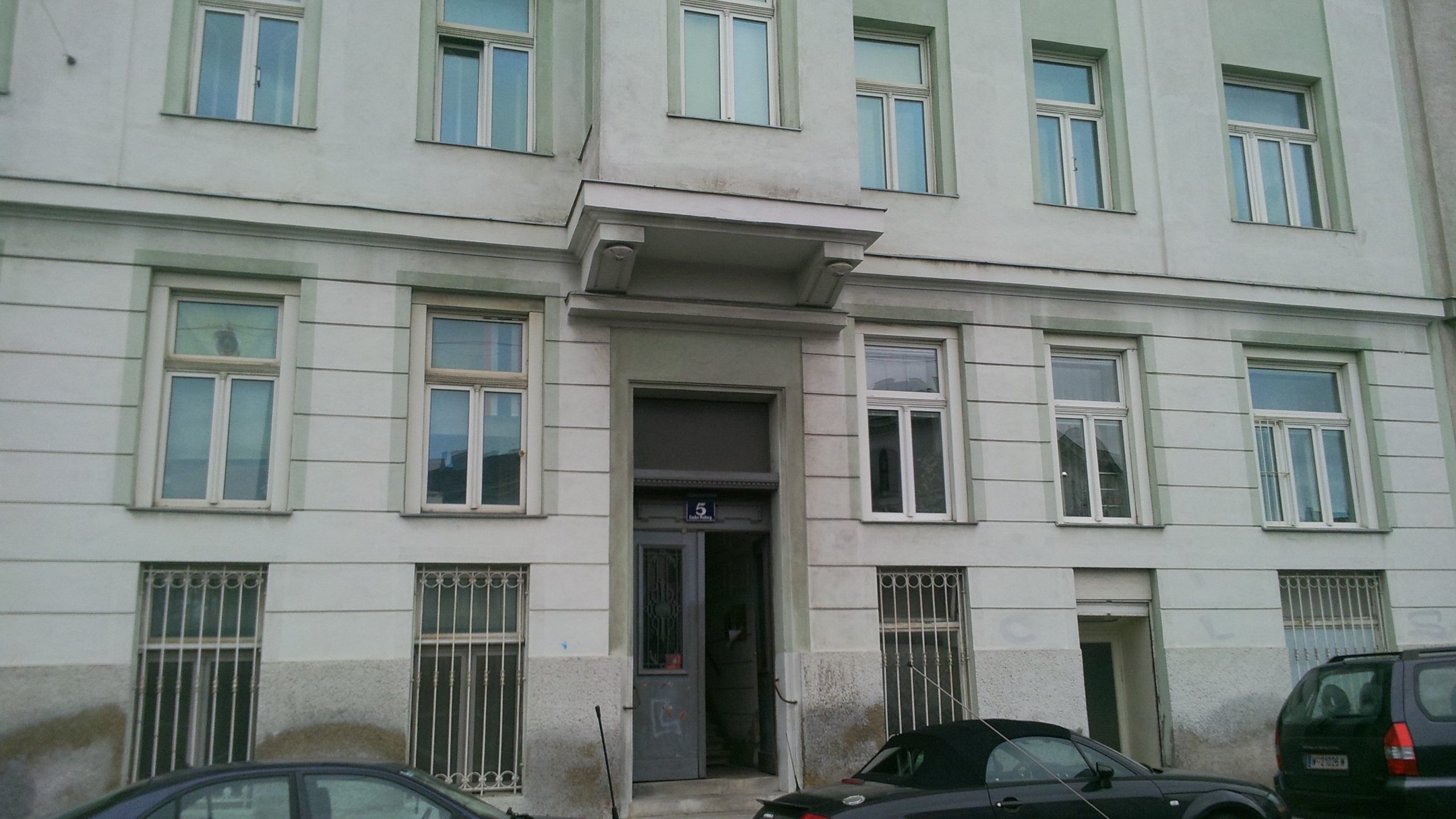
Following meetings on July 12 and 13, at around 5 p.m. on the evening of the 13th, Dr. Ghassemlou and his party's European representative, Abdulkadir Azeri, set out for the house previously designated as the meeting venue: No. 5 Linke Bahngasse, in Vienna's third district.
As Dr. Ghassemlou and his companion walked toward the address from the Hilton, three representatives of the Iranian state — Jafar Sahraroodi, Mustafa Ajvadi and Amir Mansour Bozorgian — had already left the hotel a few minutes earlier and reached the meeting place. They carried diplomatic passports and had arrived in Vienna on July 10. The Iranian team had booked separate hotels through July 14, but that morning they had all gathered at the Hilton. Sahraroodi, who had flown in via Frankfurt, was for some reason the only one who had not taken a direct Tehran-Vienna route like the others.
Resul had arranged the meeting place himself. The third-floor apartment belonged to his Austrian wife, to whom he was married in an Islamic religious ceremony. According to police records released later, Dr. Ghassemlou and his companion reached the apartment at exactly 5:30 p.m. Resul opened the door for both parties, who arrived minutes apart.
The two sides gathered around the table in the living room and the talks began. Only Amir Mansour stood watch in the anteroom, serving as security for the Iranian delegation. The meeting was being recorded on tape. On that recording, later released by Austrian police, gunfire erupted just as Dr. Ghassemlou could be heard saying, "I will go back empty-handed, and I cannot say Iran is working toward the autonomy it promised." Two guns opened fire: Dr. Ghassemlou was shot in the forehead, temples and neck; Resul was hit in the head and neck; and Abdulkadir Azeri's body was riddled with bullets — he died after being hit eight times.
Sent back to Tehran under police escort
The first police units reached the blood-soaked third-floor apartment at 7:37 p.m. Iranian official Jafar Sahraroodi was found bleeding on the stairs, most likely caught in crossfire from his own colleagues — the room where the two sides had met measured just 15 square meters. Three minutes later, his colleague Mansour Bozorgian was on a bridge a few meters down the street, shouting at approaching officers, "They shot him, they shot my friend, save him."
The assassination had been planned to leave no room for error, and Sahraroodi's wounding threw the getaway off course. He was taken to hospital under police guard, while Mansour Bozorgian was brought to Schottenring police station. An Iranian passport was found in his pocket, and the fluent English speaker told police, "I wasn't there when the murder happened — I'd gone to McDonald's around 7 p.m., and when I came back my friend was lying in blood." But none of the McDonald's staff on duty that evening could identify him, and at 5 a.m. the next morning, on instructions from above, he was handed over to the Iranian embassy, where he was to be hidden for several days. He later made his way back to Iran by means that remain unclear.
Two days after the assassination, on July 15, Sahraroodi — his condition now improved — gave a statement to police claiming, "I was in the anteroom, and a young man who opened the door pointed a gun at me and opened fire." Squeezed by pressure from the Iranian state, Vienna caved again on July 22, this time over Sahraroodi. He was discharged from hospital under police escort and put on a flight home that departed at 7 p.m.
The Austrian government recklessly shed all its legal and political responsibility and let Dr. Ghassemlou's killers go free. Back home, the killers were welcomed as "heroes" and rose swiftly through the ranks of the state. Mansour Bozorgian was made a general and put in command of the Revolutionary Guard headquarters in Urmia — Dr. Ghassemlou's own hometown and the base to which units across every Kurdish city reported. Jafar Sahraroodi became commander of the Quds Force, the branch running Iran's operations abroad, and in August 1996 personally led the raid on PDKI's headquarters in the South Kurdistan town of Koya.
2005: The 'shadow' in Vienna is unmasked
By 2005, sixteen years had passed since the Vienna assassination, one of the most traumatic events in Kurdish memory. As the name of Mahmoud Ahmadinejad — the front-runner for Iran's presidential election set for June 2005 — dominated the news, a witness came forward, prompting the Dr. Qasimlo file to be reopened.
At the Paris home of former Iranian President Bani Sadr, in the presence of a journalist from Austria's ORF television, a witness recorded as "Witness D" gave new information on 20 May 2005 about both the preparations for the murder and the assassination team. The witness had been a confidant of Pasdaran general Nasser Taghipoor inside Iran. According to this testimony, a team was formed in 1988 to assassinate Dr. Qasimlo, with the first planning meetings beginning that autumn. The witness named the team members and their roles as follows:
Negotiating Team: Hadji Ghafour Rarjazi (code name Bozorgian), Hadji Mostafavi (Mustafa Ajvadi), Djafari Schahroudi (Sahraroodi)
Execution Team: Nasser Taghipoor, Ali Reza Asgari and Mahmood Ahmadi Nejad (better known as Mahmoud Ahmadinejad)
According to "Witness D"'s statements, Mahmoud Ahmadinejad — then still a young intelligence officer — was one of the core members of the "execution team" specially chosen for this assassination. Ahmadinejad had trained within the Quds Force, Pasdaran's foreign-operations unit, at the Ramazan Military Base in the Kurdish city of Kermanshah. His purpose in coming to Vienna was to support the professional execution squad as "reserve backup" and to coordinate the logistics network behind Tehran's bloody plan. According to the same witness, Ahmadinejad entered Vienna on a diplomatic passport in the first days of July and served as the most critical link between the embassy and the assassination team.
One of the darkest chapters in the file was the process by which the assassination weapons were procured. A new witness came forward in 2006 — this time a German arms dealer, whose testimony again pointed to Ahmadinejad. Testifying in Trieste, the arms dealer exposed a secret meeting held at Iran's embassy in Vienna during the first week of July 1989.
According to the arms dealer, Ahmadinejad, one of those attending the meeting, acted like a weapons expert, closely examining the silenced pistols and machine guns to be handed over. In the room where a bundled payment of 50,000 dollars was made, Ahmadinejad personally inspected the weapons and completed the logistical preparations for the assassination.
So was Ahmadinejad there at the moment of the assassination? According to "Witness D"'s testimony, yes. On the evening of 13 July, as Dr. Qasimlo and his companion entered the house on Linke Bahngasse, Ahmadinejad was outside in "standby" position, holding a 9mm submachine gun and keeping watch on the street. The same witness stated that, immediately after the killing, one of the two men who sped away from the building on a motorcycle was Ahmadinejad himself. Eyewitnesses who saw the motorcycle rider flee the scene right after the assassination had already described his appearance and that night's movements — details that, years later, would match the accusations added to the file against Ahmadinejad.
In the days when Ahmadinejad was celebrating his election victory, Hassan Sharifi, Deputy Secretary-General of the Democratic Party of Iranian Kurdistan (KDP-I), told AFP on 5 July 2005 that the Vienna assassination had been organized by three separate committees, and that Ahmadinejad headed the second committee, responsible for "logistics and facilitation."
Although Iran's government at the time dismissed both the witnesses' and the KDP-I's statements as "Zionist propaganda" and "baseless accusations," these claims — which caused Ahmadinejad considerable trouble on the international stage — went on the record as serious evidence of his role in one of the most critical operations ever carried out against Kurds in the clerical regime's 47-year history.
According to the testimony of both witnesses and the KDP-I's own investigation into the assassination, Ahmadinejad was one of the operational members of the team that lured Dr. Qasimlo — one of the most symbolic figures in recent Kurdish history — into a "negotiating table" trap and killed him in the heart of Vienna.
The views expressed here are the author's own; they may or may not coincide with the editorial line of Rastinews. Rastinews is a free platform open to differing views.