
Ilham Ahmed: Turkey is a direct party to the Kurdish question, the doors should open
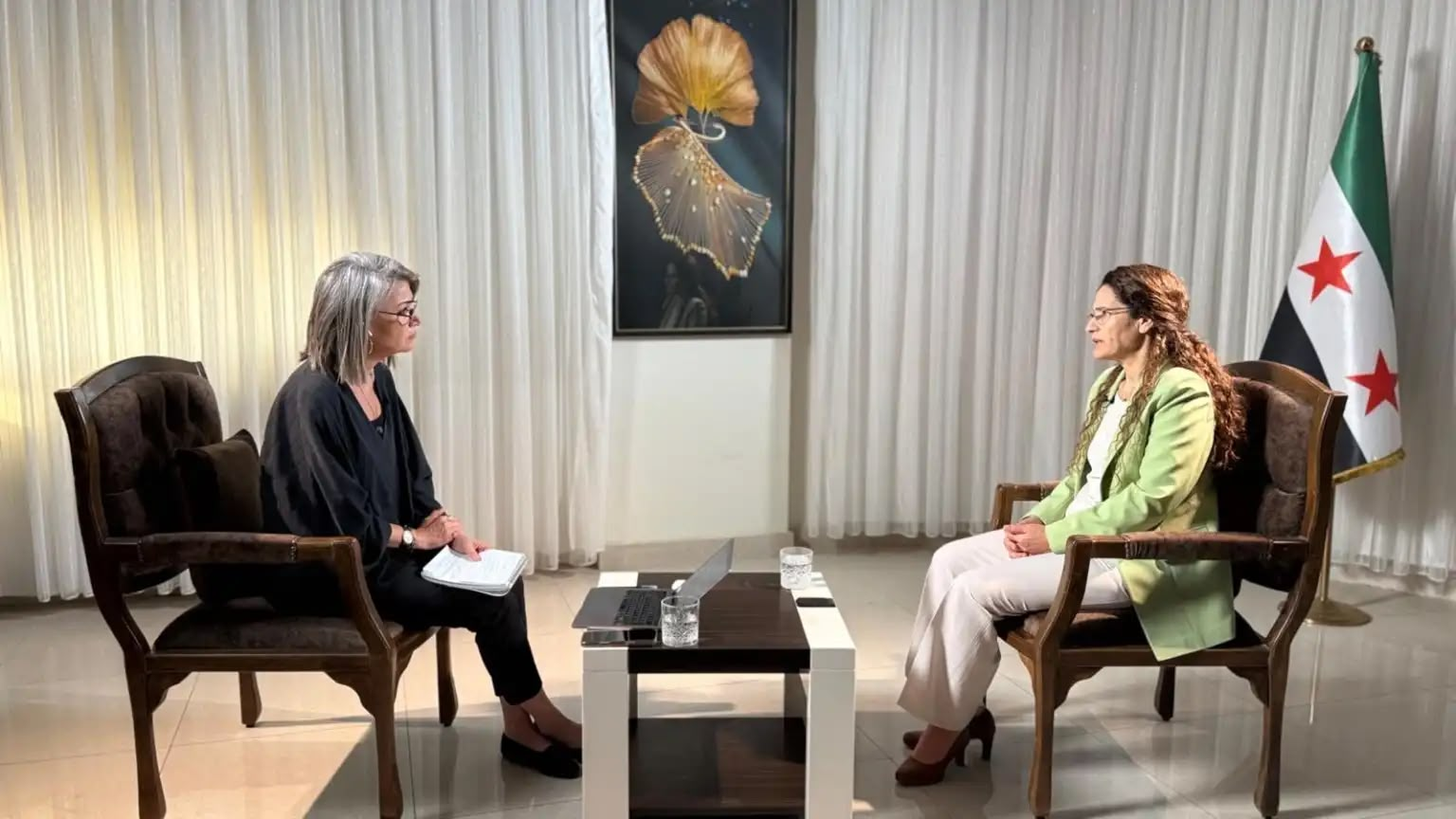
Ilham Ahmed, who entered the Syrian parliament after the SDF's integration into the army, gave her first interview to Turkish media, speaking in front of a Syrian flag. In her first sit-down with three Turkish journalists, she said she hopes visits to Ankara and İmralı will take place, and called her inclusion on Turkey's wanted list an injustice.

RastinewsFollowing the completion of the SDF's integration into the Syrian army, Ilham Ahmed entered the Syrian parliament and sat down for a wide-ranging conversation with three Turkish journalists. Ahmed spoke with Nezahat Doğan of Yeni Yaşam, Banu Güven of İlke TV and İrfan Aktan of Spot Basın Kooperatifi about the new period in Syria, the constitutional status of Kurds, education in Kurdish, the future of the YPJ, Abdullah Öcalan's role in the process, and relations with Turkey.
A desire for direct contact with Turkey stood out in Ahmed's remarks. "We are hopeful that the doors will open and that visits will take place," she said, adding that she and Mazlum Abdi support the possibility of traveling to Turkey and to İmralı. Objecting to Turkey's placement of her on its wanted list, Ahmed said: "I have practiced politics on my own soil, in my own country. I have fought for my people's rights. Putting me on a terror list over this is a grave injustice." In Syria, she said, integration has meant a shift "from armed struggle to political struggle," and the central task ahead is securing Kurdish rights in the new constitution.
NEZAHAT DOĞAN'S INTERVIEW FOR YENİ YAŞAM
The August 25 announcement that integration was complete triggered a range of debates. How has the process set out in the January 29 agreement actually played out?
First of all, the January 29 agreement laid important groundwork for a lasting ceasefire, essential to resolving the Kurdish question and to Syria's democratization. Steps toward integration then began on the basis of the agreement's provisions. A significant stage was reached with the SDF joining the Syrian army in battalion form. Registration of police forces for absorption into the internal security forces also began, and continues. The integration of autonomous administration institutions into state bodies is still ongoing. There remains a large, significant number of people whose names were submitted to the state but still have not been registered. After the steps taken and the practical implementation on the ground, the most recent talks with Damascus concluded with the announcement that integration was complete — that SDF forces are now formally part of the army and no longer positioned in the region as an independent force, as before. That was an important step toward a transition to the political stage.
Did the integration process move very quickly, or were fast steps taken after diplomatic groundwork had already been laid behind the scenes?
No, the period set for integration was actually shorter than this. The window originally set was one month. But once we got down to practicalities on the ground, we ran into difficulties.
What kind of difficulties?
The mechanism set up for communication and for registering names worked slowly. We needed to reach a joint understanding on which institution would be given responsibility for what. Negotiation was required on matters like this, because we proposed some names and they proposed others. Making sure integration proceeded correctly took some time for this reason.
Turkey is facing something of a parallel process — on one side integration and vetting, on the other democratic politics and the functioning of parliament. Will the change in Syria affect the change under way in Turkey too? Or will progress in Turkey feed into Syria? What is the connection between the two lines?
Each part has its own particular character. The Turkish state has its own distinct features, separate from the Syrian state, but there is a great deal of common ground in how each approaches the Kurdish question. Turkey has always foregrounded its own sensitivities regarding the Kurdish question — how it should be resolved, to what extent Kurds should hold rights, and how their constitutional rights should be framed. So it is following closely how a resolution to the Kurdish question develops in Syria as well. It would not be wrong to say the two processes are moving in tandem.
How was the decision reached to limit mother-tongue education to three hours, and why did the demand for mother-tongue education end up settled this way?
Our expectation was that Kurdish would become a language of instruction and learning. Under the decree that was issued, Kurdish was recognized not as an official state language but as a national language.
What does "national language" mean?
It means people can express themselves in it within a cultural framework. But it is also placed among the languages that may be chosen in education. It's treated as an enriching language. That wasn't sufficient recognition for Kurds. There were some changes — it was included in the official curriculum. But under the three-hour arrangement, Kurds will be able to study in their own language for three hours a week starting in first grade. As I said, it can be taken as an elective course. Compared with the gains we had already achieved, this falls short. In fact, more than a gain, this is a right — a natural right. The current administration was open to change up to a point, but the change made so far has stopped there. We said in every meeting that the language issue could not be handled this way. But there may be changes in future. Under the decision taken, it isn't just three hours — four more subjects will also be taught in Kurdish: an activities class, plus history, philosophy and geography, which will be taught in Kurdish this year. These national subjects, currently in Arabic, will be translated into Kurdish and taught in schools. But there are problems of time, translation and practicality in implementing this. Our people object to the decision — they say they do not deserve to learn their language this way, and are demanding that the language of education be entirely Kurdish.
Within its own distinct, autonomous structure, Rojava built a democratic system together with its peoples and with women. Looking at society's reaction and the Kurdish public's reaction, there is criticism that, with the restriction on Kurdish, the 11 years of gains achieved are now being rolled back. What has been achieved? What lies ahead?
We are not claiming to have secured our rights in full. Nor can it be said that we have lost everything. Today we are often asked what we have achieved. Above all, we should regard our people living in peace, free of conflict, as a major achievement in itself. Peace needs to be built in the shadow of the constitution. Peace isn't simply a matter of eating and living comfortably on our own soil. Unless peace is guaranteed by the constitution, it won't be lasting. We want to resolve our problems through dialogue, away from war. That matters a great deal.
Let's go back a little. In the period after the March 10 agreement, looking at the attacks on Kurds — Sheikh Maqsoud, Ashrafiyah and others — was that also part of an international plan? Was it meant to break Kurdish national unity and the people's cohesion there?
International powers were also present around the March 10 agreement. The United States in particular played a role in it. It had influence. This alliance actually blocked an attempt to push the Kurds back toward war. The March 10 agreement forestalled a slide toward a far more extensive war. There were further attempts after the agreement. The attacks that developed against Sheikh Maqsoud were once again attempts to drag us back into such a comprehensive war. Now, after so much war and so many precious losses, the time had come for us to deepen our position further on politics, law and the constitution. We needed to turn our struggle toward that. That led us to the conclusion that we also need to carry on an important political struggle for Syria's democratic future.
Syria still has a constitution belonging to the Assad regime. There will be a new constitutional process. What does your presence in parliament in this new period mean for Kurdish rights?
Entering the state, becoming part of it, is an important step. Before this, 12 Kurds had already served as members of the Syrian parliament. Some entered through elections, some through appointment. That too was a very important step. This creates the possibility of closer dialogue, of working out how to build a shared life, and of how Kurds will be defined in the constitution. Taking part in state institutions matters in this respect. At such a sensitive juncture, a new page has opened in taking a step into political life. That is how we define it.
Kurdish People's Leader Abdullah Öcalan has said there were attempts to foment both an Arab-Kurdish conflict in the region and a Turkish-Kurdish conflict in Turkey. Have these dangers now been averted? How can stability be secured in Syria?
Syria's stability matters enormously. We see that importance is being placed on ensuring Syria is not dragged back into war. But internal contradictions, a chauvinist mindset and hate speech still persist. There are actors stoking these chauvinist sentiments. The language used in the press and across social media is still very harsh. This constantly creates grounds for provocation. Against this, state law, authority and institution-building matter greatly. Society's reflexes against this language of hatred matter greatly too. This needs to be corrected. If the Syrian state insists on being a state, then it needs to put these provocations on its agenda and address them, so that the possibility of fresh wars and conflicts can be forestalled.
Does that mean a difficult struggle lies ahead? For years Kurds were an identity without a state, without status. Now they want equality within the state. Kurdish has entered the curriculum for the first time in Syrian history. What does the inclusion of Kurds within the machinery of the state mean?
Being a free citizen within the Syrian state is an important matter. Until now Kurds were always kept at a distance from the state. Kurds were always pushed outside Syrian society. Now the existence of Kurds, and the fact that they have a distinct identity, language and culture, has been acknowledged. Even their distinct social character has been acknowledged. But there is also pushback aimed at pulling Kurds back down from this level. Such voices exist, and they are not voices to be dismissed. What is needed here, first, is for the law to recognize that Syrian society, in all its colors — Kurdish, Arab, Assyrian, Turkmen, Armenian citizens — is equal. All should hold the same status and the same rights. Society needs to absorb this, and the laws need to enshrine it, so that the mindset that belittles Kurds can be eliminated. And of course this isn't only about Kurds, but about the other components too. Kurds have a different culture, a different language. So they have rights that flow from that.
What are these rights?
Just as an Arab can be educated in their own language, so can a Kurd. It isn't right to deny and suppress other identities by insisting that Syria is a single, unitary state. The existence of Kurdish language and culture does not fracture the Syrian state — on the contrary, it strengthens Syria. How does it strengthen it? When a Syrian Kurd says they are a Kurd, and says it sincerely, from the heart, with confidence, this strengthens both Syrian society and the Syrian state. It also matters greatly for citizens to be able to declare this with real confidence. Accepting this is a very, very important thing. Rather than treating these rights as some kind of favor, or having to force them to be accepted every single time, the state itself needs to say: "This is your right too, just as it is an Arab's, and you can exercise it." That would forestall the outbreak of fresh war, the fracturing of society, and the state falling once again.
Damascus's earlier decrees and statements suggested it would recognize Kurdish language and rights. Today there's debate over why that has receded, and question marks remain. Is the solution here tied to a resolution of the Kurdish question in Turkey? What role does Turkey play?
Turkey has a role and influence within Syria. We know the steps taken so far have been closely followed by Turkey. At the same time, a similar process is under way in Turkey itself. There is a peace process moving forward in Bakur too. Syrian society, and the Kurds living in Syria, have their own distinct character and features. There are similarities, but we cannot say they are entirely the same. Rather than constantly comparing the level of resolution between the two, or insisting that whatever happened here must happen there too, what's needed is a process in Syria capable of forestalling provocations and opening space for democratic politics. Turkey is following this and moving forward step by step alongside it. Turkey still hasn't convinced itself of how it will resolve the Kurdish question.
In what sense has Turkey not been convinced?
Let me put it this way: Turkey has an approach along the lines of, "Kurds can speak and live in their own culture and language without it being written into the constitution — there's no need for it to be constitutional." But we hope this thinking changes, because anything left outside the law and the constitution carries the risk of leading back to war. But once it is enshrined in law, there will no longer be any need at all for weapons. Even their very existence would come to be seen as a danger. In that sense, questions of constitution and law matter greatly. Another is the character of the solution — will it be centralized or not? Syria is currently moving toward centralization. Even Idlib, if you ask, would say it thinks differently and that excessive centralization isn't good. The same views exist in other provinces. We are no doubt passing through an interim period, but if, in the end, the provinces are not given the initiative to organize their own affairs, and everything remains centralized, someone within Syria will eventually stand up and say this cannot continue this way. That would create problems. It would reopen the path to war. Provocations would develop. The building of the new Syria requires fearless debate. If it is not going to be centralized, that needs to be openly discussed. These are constitutional matters, and once they come onto the agenda, serious debate on this front will follow.
Are Kurds indispensable to the Middle East in every sense?
This is plain to see. Kurdish society is a very rich, organized, powerful society, open to change and democracy. Because of this, it is aware of the role Kurdish society plays in the developments taking place in the region. This is why the existence of the Kurds, their organization, this dynamic strength, has such powerful effect whenever they mobilize for freedom and democracy.
In Kurdish People's Leader Abdullah Öcalan's assessments, a very strong emphasis on national unity stands out as essential for Kurds to become a powerful actor. What is the importance of Kurdish national unity?
Now, each part has its own particular character, because every state has its own Kurdish policy. Every state also has its own laws internally. Naturally, Kurds have rights in every part. You cannot draw distinctions between rights. But in this chaotic situation, alliance among Kurds, respecting each part's particular character, matters greatly. National unity matters enormously for Kurds in securing their rights and defending themselves. If a process is under way in Bakur, the support of Kurdish national unity for it matters enormously. For instance, when officials from Başûr send a positive message regarding the peace process, the state listens. And when a problem arises here, the position taken and the statements made carry weight. Broadly speaking, Kurdish alliance matters enormously in resolving the question.
Going forward, will Ilham Ahmed become a parliamentarian? Will she be responsible for foreign relations? Which commission will she sit on? Has this become clear?
There has still been no official announcement about what my role will be. Which commission I sit on within parliament is, to some extent, up to us. But there are two important commissions — one is the foreign relations commission, the other the constitutional drafting commission. Both matter, of course, but these are the two where more active work is possible. Beyond that, this country's laws need to be drafted for the future. Even though this is a transitional parliament, the ratification of the constitution that will be drafted during this period matters. So does attention to the laws that are passed. It has an important role in that sense.
Is diplomacy also under way toward securing Kurds' constitutional rights, language rights and so on?
Yes — the constitution and parliament will guarantee mother-tongue education. Beyond that, what role will women play in this country, what rights will they hold? These too will fall within parliament's broad areas of work.
There was a photograph of you in Damascus. Looking at Syria, in a place where women were absent, what kind of change might now be possible for women?
There is a history in Syria of women taking part in organized struggle. Many women's institutions and movements emerged. Some were formed with UN support, some with the support of civil society organizations, some independently. Syrian women have a certain consciousness. But the system has not yet opened its doors to women's participation. There is a rich experience in North and East Syria. From here on, women can play an important role in Syria's future too. That, of course, requires struggle.
One of the recent topics in Turkey is the question of whether Ilham Ahmed and Mazlum Abdi might meet with Ankara and with Abdullah Öcalan…
We hope this visit takes place. We have shared this with the Damascus administration too. It would be good if these meetings happened — both to develop relations, to find a way to resolve remaining problems through dialogue, and to see how we might support the process in Bakur. But nothing has been finalized yet.
Could the coming period move toward a faster process?
Time matters enormously. Using time well, taking bold, confidence-building steps quickly, matters. Just as the Turkish state has taken steps so far, we hope that from here it will take the remaining steps with even greater courage, moving toward a resolution. Just as a resolution was reached within Syria, we hope the same resolution, the same steps — even better steps — will be taken there too. Resolving problems matters greatly for women. Democratization matters greatly. Our hopes are very high. We believe in the strength of women. We believe in the strength of societies. I believe that in the new state system we will weave a shared life together.
BANU GÜVEN'S INTERVIEW FOR İLKE TV
'A new period of struggle is beginning'
Banu Güven: At what kind of historical turning point are Syrian Kurds?
Ilham Ahmed: The struggle carried on in Rojava, in North Syria, has reached a new stage. Armed struggle, armed resistance, has passed into a political phase. Particularly with the announcement in Damascus that integration is complete and with the SDF's dissolution, the struggle has shifted onto the political plane. This is a heavy period, a difficult period. A new period of struggle is also beginning in terms of securing Kurdish rights in the constitution.
Banu Güven: Of course, if a photograph were taken right now, there are significant gaps for Rojava Kurds especially, compared with their goals. As I understand from your remarks, today's picture won't stay fixed. But let's talk about the gaps. Perhaps one of the most important is education in the Kurdish mother tongue. There used to be one system for Kurdish-language education in Rojava, but now we see that in primary school, three hours can be elective, plus one hour of practice — a kind of three-plus-one formula. Middle school has a different formula. What exactly is envisioned as things stand? What came out of your talks in Damascus? What will happen in practice? Are you satisfied with this? Are you debating it right now? Is there a problem with it? And what outcome are you aiming for?
'Kurds have the right to be educated in their own language'
Ilham Ahmed: A new step has been taken in education. Previously, in the Rojava autonomous region, education could be conducted in Kurdish, Arabic and English. Our aim was this: every people should be educated in their own language. That remains our aim now. Kurds too are one of Syria's core communities. They have the right to be educated in their own language. What we have agreed on for now is a new stage.
Banu Güven: But are you satisfied with the outcome as it stands right now? Because it's confined to Rojava too. Kurds don't live only in Rojava. Has this outcome disappointed you?
Ilham Ahmed: Of course this wasn't what we wanted. In every meeting, in every round of negotiations, we insisted that Kurdish become the official language of instruction in schools. That is, we wanted education to be entirely in Kurdish. We fought for this. Our people are not satisfied with today's outcome, we know that. We aren't satisfied either. But the process is unfolding this way for now. Three courses will officially be taught in Kurdish in schools. In addition, four textbooks — philosophy, geography, history and an activities class — will be taught in Kurdish. Further steps will be taken on this in the coming period. What matters is for Kurdish to become an official language within the education system, within the school system.
Banu Güven: But you're not satisfied with this outcome — that comes through in what you're saying. What exactly was your demand? And what does the decree issued by the Damascus administration actually envisage in practice right now? Because Kurdish-language education already exists in Rojava. So this is a step back from that.
Ilham Ahmed: Yes, today's situation is a step back from before. What matters is for Kurdish to become an official language within the education system, within the school system. It isn't enough for it to be simply a rich language — it needs to become an official one. The problem isn't just whether one course is taught in Kurdish, Arabic or English. Those things can be resolved. But there is an important problem here. Right now four courses are given in Kurdish. Kurdish-language instruction is given for three hours. History, geography, philosophy and the practice class will be taught in Kurdish. But what's the problem? In our schools, every subject was taught in Kurdish for years. All the theoretical textbooks were in Kurdish. The system was entirely Kurdish. A student who has spoken Kurdish through to 11th or 12th grade cannot suddenly switch to Arabic. This is a serious problem. It creates real strain in the system. Children's grades and their education will unfairly suffer as a result. Our people have serious objections on this point. We aren't satisfied either. But this is the decision as it stands right now. It is a problem.
Banu Güven: There's also a university-level arrangement still ahead. Talks are continuing on the university's legal status. The university system hasn't been settled yet either.
Ilham Ahmed: No, the university system hasn't been settled. There is talk, there are discussions. University officials are in Damascus. Talks are under way there. We'll see the outcome.
Banu Güven: In middle school there can be three courses, three hours of Kurdish instruction. I think they made that elective too, is that right? There's also one hour of Kurdish activities. So three plus one. Then in middle school you mentioned philosophy, history. Yes, history, geography. Is that within those three courses? So social sciences can be taught in Kurdish. Is that elective too, or will those courses simply be given that way?
Ilham Ahmed: No, those are elective too. That is, Kurdish- and Arabic-language education will run side by side. Some schools will be Kurdish, some Arabic. As for university, as of September 1, 2026, no arrangement has been made yet. It's under discussion.
Banu Güven: So when does the new school year start? How will children, students, begin school? As I understand it, the curriculum isn't ready. There was supposed to be a six-month period to prepare the curriculum. Are you keeping this first six months, or this year, organized as before in Rojava? Because there's no time left.
Ilham Ahmed: Education is supposed to start between the 15th and 20th of this month. Actually, for this year too, we proposed continuing with the autonomous administration's education system in order to make the necessary preparations. But the ministry had already made its decision on this. They wanted to implement this new system across the whole of Syria at the same time. There is naturally a problem here. Preparations are inadequate, difficulties will arise. Students will suffer injustices because of this. Talks and negotiations are needed between the directorates and the ministry on this.
Banu Güven: So has a new curriculum actually been handed to you to implement?
Ilham Ahmed: They need to be translated. Syria's education curriculum needs to be translated. The textbooks need to be printed and distributed to schools.
'The YPJ will be included as a Special Operations Unit under the Interior Ministry'
Banu Güven: Another topic — a contentious and very important one. What will happen to the YPJ? There's talk of it operating in Rojava as a unit under the Interior Ministry. But on August 27 the YPJ issued a statement on this. Let me ask you about that too. It said talks are continuing. What exactly does Rojava, does the YPJ, want? Where do Damascus's proposals stand? Can the two meet?
Ilham Ahmed: Actually, our approach is for the YPJ — that is, women — to take their place within the army. There are examples of this around the world. This isn't something new. It wouldn't be wrong for something like this to exist in Syria either. But after months of talks and negotiations, they did not accept women serving within the army. Talks were held with the Interior Ministry. Their view, from the start, was for the YPJ to be brought under the Interior Ministry. This way it would preserve its own existence. In fact, the YPJ isn't an internal security force. It was previously a special women's unit that fought against terrorism. Now it will take its place as a Special Operations Unit under the Interior Ministry. It will remain within the ministry as a distinct defense force.
Banu Güven: Will it be under the Interior Ministry? Because that's how it's always reported in coverage that reaches Turkey.
Ilham Ahmed: It will be a special unit. Talks continue on this.
Banu Güven: There's talk of a unit that will be defined as under the Interior Ministry.
Ilham Ahmed: Yes, that's correct. It will operate under the Interior Ministry.
'Women are absent from decision-making bodies'
Banu Güven: You women, women politicians, women commanders — in Damascus, I believe almost everyone except Hind Kabawat in the administration you're dealing with is male. Do you see them able to look at you as equals? Because until recently this might not have been something they were used to — seeing women take such an active role in politics, in the struggle, in the armed struggle, or in the fight against terrorism. I want to ask whether they've grown a little accustomed to it. I'm curious what kind of situations you've encountered.
Ilham Ahmed: It seems this will take time. There is, of course, a different way of looking at women. That is, in their view, women can have a place in certain units. When they talk among themselves, they say women matter, that women should be part of governance. But in reality, women are absent from decision-making bodies. Or they're present only in a token way. But they're not in the decision-making mechanisms, unfortunately. This is a major gap. Even though some space has opened up for women within ministries, in subordinate units, they're not in significant positions.
Banu Güven: This brings us to a set of questions about the role you'll take on, but first I want to ask this. Is women's presence adequate in the parliament expected to draft the constitution? The share isn't even 10 percent. The number of women is very small. An important women's struggle is needed during the constitutional process to ensure women are written into the constitution and their place secured. We'll talk about the constitution too, but first, as the only Kurdish woman member of parliament, I want to ask about the role you're expected to take on. Reports say there's talk of a general parliamentary role or membership on the foreign relations committee. As of September 1, 2026, has there been any clarity on this? The presidential decree formalizing your membership hasn't been issued yet, I believe, as of September 1.
'My role will become clear once the decree is issued'
Ilham Ahmed: No, the decree hasn't been issued yet. We expect it soon. There are three Kurdish women in parliament. There's also a woman colleague from Afrin and one from Hasakah in parliament.
Banu Güven: When did they enter? At first, I believe, you didn't have a member in parliament, is that right? Because the current parliament was formed under Ahmed al-Sharaa's control.
Ilham Ahmed: An election was held. A vote was held by appointment. A woman colleague was selected from Afrin. There are three seats. A woman was also elected here, from Hasakah. That makes three Kurdish women in parliament.
Banu Güven: Will you be a member of the foreign relations committee? What does the agreement you signed — and I don't know if you actually shook hands — when you left Damascus say about your role? And how will this change your function going forward?
Ilham Ahmed: What my role will be will become clear once the decree is issued. There's a constitutional commission, there's a Foreign Ministry commission. These could be the roles. Being a parliamentarian is an important role in itself. All the laws concerning Syrian society are drafted there. Even though this parliamentary seat came through appointment, it is a role in which important service can be done for Syria's future.
Banu Güven: Which committee do you want to be on, which matters most to you?
Ilham Ahmed: I've worked continuously in the field of foreign relations. But a parliamentarian can serve on two commissions at once. The constitutional commission is also very important, and so is the foreign relations commission. Both together.
Banu Güven: Has there been agreement that you could sit on the constitutional commission?
Ilham Ahmed: Yes, there is an inclination in that direction.
Banu Güven: So we might see the decree place you on both commissions, both committees. Is that how I should understand it?
Ilham Ahmed: That could be the outcome from the decree. I could sit on both the constitutional commission and the foreign relations commission in the Syrian parliament. Yes, that's possible.
Banu Güven: When will we see this decree?
Ilham Ahmed: I don't know. We're waiting too. The president needs to issue this decree.
Banu Güven: Why is it taking this long? Is there some other meeting in between?
Ilham Ahmed: I don't know, because there's been no meeting since that day.
'The timetable for constitutional work isn't clear yet'
Banu Güven: So when will work on the constitution begin? When will the constitution be taken up? That matters a great deal. Do you think a democratic Syrian constitution can emerge from this parliament? You've also said the new regime, or new Syria, needs a new name. What do you envisage, what name are you calling for? And, as I said, I want to repeat the first part of the question. How confident are you that this parliament can produce a democratic constitution?
Ilham Ahmed: Well, the timetable for constitutional work isn't clear yet. We know some work is being done in parliament. Once the full parliament is seated and work begins, debate on it will start and it will come onto the agenda.
Banu Güven: What are the most important issues, the hardest ones to move forward, in your view? Kurdish hasn't been recognized as one of Syria's official languages as things stand. Take the status of Kurdish, for instance, or Rojava's separate status. The promises on Kurds' equal citizenship rights may have satisfied you, but beyond that, what areas need further improvement, what other guarantees, what are your demands?
Ilham Ahmed: We believe the new Syria needs to be open to democratic steps. We want a Syria that develops not just culturally but across every field. In cultural terms, a space of freedom has opened up for Kurds. Some steps have been taken in this period. Kurdish national days are now legally recognized and celebrated. Newroz is celebrated. Kurds can speak their language and sustain their culture everywhere. But Kurdish still hasn't been recognized as an official language in schools, in education.
Syrian society is a very colorful, rich society. There are Turkmens, Assyrians, Syriacs, Armenians. It's a society made up of many different colors. We want a climate of freedom to emerge in this area, so these peoples can study and be educated in their own languages. Beyond that, what's lacking now, and what will matter in the future, are political matters. That is, politics needs to be practiced freely, and the laws that are passed need to give Syrian society room to engage in politics freely. Society needs to be able to organize, to have a say in governing the country, for there to be democratic development. So it isn't clear yet what kind of political future Syria will have. This country doesn't yet have a political parties law. Syria isn't the state of a single people — Syria isn't inhabited only by Arabs. There are peoples in Syria with deeper roots than that. Recognizing only a single people has harmed Syria. It has caused crises in the past. This needs to be corrected now. It has to be accepted that different peoples live in this country. The way also needs to be open for women to take an active part in social life.
'We have no information on the fate of the missing'
Banu Güven: You've said detainees need to be released. As I understand it, this is a major item among what you're demanding as your talks with Damascus advance. You also said in your last statement that there should be a return to Afrin, and that there needs to be a return to Serekaniye (Ras al-Ain) as well. Where do things stand on these? How many detainees are you talking about? Who are they? And why hasn't the return to Serekaniye happened yet?
Ilham Ahmed: The fate of a great many people taken captive is unknown. Whether they are detained, or whether they were killed, is unclear. We know that close to 500 people from various groups who had joined the army during the war are missing.
Banu Güven: So there are missing people?
Ilham Ahmed: We know 500 people are missing. We have no information on their fate.
'All of it is happening through negotiation'
Banu Güven: Were all of these from the Syrian Democratic Forces, or are there civilians among them too?
Ilham Ahmed: There are civilians too. There are people from other groups too. Not all of them are SDF members — there are civilians among them. There are people who were taken while traveling, who went missing in various places. We've reported their names, we've submitted these lists. Our talks and our efforts to locate them continue. Important steps have been taken on integration. Not all of it, but our people in Afrin have returned to their land. 1,200 families from Deir ez-Zor and other cities are staying in the homes of Afrin residents, in the town center, and are not vacating them. This is a major problem. Even so, returns have happened. The people of Afrin are facing great difficulties in rebuilding. Still, the return of the Afrin community is an important step. In Serekaniye too, our people have wanted to return to their land. There have been problems.
Still, this return will continue. People from elsewhere need to vacate Serekaniye and Girê Spî (Tal Abyad). These matters are also on the agenda. Completing integration doesn't mean every file is closed. There are still unresolved problems. Work continues, and these need to be resolved.
Banu Güven: Integration has been achieved. The Syrian Democratic Forces have been dissolved. Since the YPJ hasn't been defined yet, its new role or new name still stands, as I understand it, as the YPJ for now. We see this is a process where something new happens every day. For instance, today there were people entering Hasakah for security from Damascus, from the central government. These are all steps of integration. Is it going well? Is it going smoothly? What does the public see? How are you experiencing this?
Ilham Ahmed: All the steps taken so far have come through talks and mutual agreement. Neither the state nor we are taking steps on our own. All of it is happening through negotiation. For instance, when officials came to Hasakah in connection with military integration, that came through negotiation and agreement. Where we stand right now is a process of joining the state. We will no longer remain outside this state. Kurds are now inside the state in Syria. We are ensuring this state isn't just the state of one people, but the Kurds' state too. Talks and negotiations proceed on this basis. So the work currently under way — officials arriving for integration and education — is a normal state of affairs.
Banu Güven: How many people in Syria didn't have Syrian citizenship? How many applied after these agreements?
Ilham Ahmed: This is a very important achievement. It really ought to be a right by birth, but of course it's still an important achievement, now formalized. There were around 360,000 people who previously had no identity documents. Under Assad, 200,000 of them met the conditions for citizenship. The rest have applied and been registered as well.
Banu Güven: Can you estimate the Kurdish population in Syria?
Ilham Ahmed: There are 3 million. But there has been very large-scale migration, a great many people have left.
Banu Güven: Of course, of course. But Kurds don't live only in Syria, in Rojava, do they? There are Kurds, there are Arabs, there are Syriacs. It's very mixed.
'Öcalan played an important, decisive role in resolving this issue through dialogue'
Banu Güven: The agreements you've reached in Syria — step by step, the eight-point agreement, then the broader agreement, and now today's integration announcement, today's talks — there are other actors that played a role in shaping the framework for these. That's how it looks. From outside, Syria's future doesn't look like something being decided purely by Syria, by Syrian citizens talking among themselves. We're talking about Turkey; the US is also talking about you. Israel has certain objectives in mind — what should and shouldn't happen. Who shaped this process, and how? Could you say a little about that? Because of course you're also talking with Turkey, and the process in Turkey, what Abdullah Öcalan first envisioned for resolving the Kurdish question in Turkey, doesn't look separate from what's happening here.
Ilham Ahmed: When the revolution began, Syria wasn't alone. There were factors exerting influence over Syria, and specific powers involved in the Syrian revolution. First and foremost we could name Iran and Russia. Now neither of these two countries has any influence left. Turkey too has had, both before and now, an important role in Syria. I can say Turkey will have a decisive influence on Syria's future. Other countries have played an important role too — the US, for instance. It has a serious influence now as well. We also see an important influence from Britain. These are the powers playing a role in resolving the Syrian question, and the ones we are also engaging with.
Banu Güven: Let me narrow this down a little: those who want to be decisive over Syrian Kurds' future. Now, in Turkey, after Abdullah Öcalan's call for the PKK to lay down arms and dissolve itself, Turkish officials' eyes turned here too. They said the Syrian Democratic Forces should also lay down arms — that is, the YPG and YPJ should lay down arms too. But Mazlum Abdi had said, "This is a different place, this is Syria. This call doesn't bind us." But then things moved toward integration, and you agreed to integrate. Clearly, messages went back and forth. During this process, were you able to receive direct messages from Abdullah Öcalan? How influential was it that he shared his outlook with you? I understand you've been in contact with senior officials from the Republic of Turkey. Can you describe your position, if possible? Since when have you been talking with them? And how much did all this shape the agreement you've now reached with Damascus?
Ilham Ahmed: This question is both important and sensitive. It's a subject that has drawn a great deal of speculation. But I can say this much: during the clashes in Manbij, before the March 10 agreement, there was an attack. We know that Mr. Öcalan played an important role in halting that attack. Öcalan has played an important, decisive role in resolving this issue through dialogue.
Banu Güven: By speaking with you indirectly, is that it?
Ilham Ahmed: Because Turkey was an important actor on the Syrian question, and had significant sensitivities regarding the SDF. It placed its sensitivities about the SDF laying down arms, about the SDF's dissolution, on the table. In its relations both with Syria and with other states, Turkey always foregrounded the SDF question.
Turkey had significant influence in establishing dialogue with Damascus, in the declaration of the ceasefire, in resolving our problems with Damascus. This was, in fact, our own approach too, because we never wanted to be in conflict with Damascus.
We wanted conflict neither with Damascus nor with other powers. But a perception was created as if we wanted to break Syria apart and remain outside the Syrian state. The negotiations Mr. Öcalan carried out had an important effect in halting the attacks against us. Afterward, the March 10 agreement was signed of our own will. But Mr. Öcalan's support was important. His influence on the signing of the agreements, on resolving problems through dialogue, on carrying out a peaceful integration process, is beyond dispute.
At the time, from the messages that reached us from Mr. Öcalan and from his approach, we could tell he supported the process. He did not want war — he wanted the process to move forward. He was concerned about a major war breaking out in the Middle East. He did not want the Kurds to become an instrument of this major war. He wanted the Kurdish question resolved within a democratic Syria. That was Mr. Öcalan's outlook and thinking.
Beyond that, the speculation that circulated — reports insisting he demanded arms be laid down, or the opposite — was not accurate. He believed that laying down arms, too, needed to come within a perspective of resolution, through Kurds being recognized and gaining their rights.
'Whether it wants to or not, Turkey is a party to the Kurdish question'
Banu Güven: You said you've been able to receive messages through various channels from Abdullah Öcalan, or perhaps there are many other actors who have spoken with Abdullah Öcalan on your behalf. At such an important historical turning point, you too have exchanged messages with him from here. As I understand it, you don't want to go into detail on the method. But everyone is also curious about this: will Ilham Ahmed and Mazlum Abdi one day be able to come to Turkey? Will they be able to make the statements they've made here directly in Ankara, say? Will they even go to İmralı and meet with Abdullah Öcalan? Will these things happen? What conditions are expected to be met for them to happen?
Ilham Ahmed: Of course we hope these visits and meetings take place. We've even discussed these matters with the administration in Damascus, shared them. Frankly, we think it is right to meet with whichever side can contribute to peace, to a resolution. Turkey is an important party, and whether it wants to or not, it is a direct party to the Kurdish question.
Whether in Turkey or in Rojava, Turkey is a direct party to the Kurdish question. That's why talks with Turkey matter. It matters for Turkey's leadership to host us, for meetings to take place, for visits to happen.
We have the strength and the will to make this happen. We can hold these talks. Especially with Mr. Öcalan's contribution, there have been important steps taken in Turkey toward developing a consciousness of peace on the Kurdish question, a consciousness of shared life, a consciousness that every people can live with its own identity.
How a resolution will be realized in Syria on this front matters. Yes, Syria has its own particular character. Syrian society is a different society.
The administration in Syria has different characteristics. But the general principles for resolving the Kurdish question are known. These principles hold for Syria too.
So we are waiting for these talks, and we are hopeful about the doors opening and the visits taking place. We think it would be beneficial for these problems to be resolved as soon as possible, without being drawn out over time. Rather than wasting energy and time needlessly, it's better to act as soon as possible.
Banu Güven: So if these things happen, if certain steps are taken, if those lists — you know the ones — are reassessed with a fresh eye, if whatever is blocking you from traveling is lifted... Because there's a wanted list that doesn't match today's realities, isn't there? Presumably that would need to change too.
Ilham Ahmed: For instance, my name is on the list, but I don't know why it's there. Have I used weapons against Turkey, have I opened fire? Nothing like that has happened. I have practiced politics on my own soil, in my own country. I have fought for my people's rights.
Just as Turks say "we have our rights," just as Arabs say "we have our rights," say "we have our identity," we Kurds too have rights and an identity. I have advocated for these rights. Putting me on a terror list over this is a grave injustice.
We have taken no action against Turkey whatsoever. We objected only when we ourselves came under attack. Our names absolutely need to be removed from that list. The list needs to be cleared, and talks need to take place.
Banu Güven: Maybe two more questions. One: Syria is of course a country with its own particular circumstances. But there are certain rights here for Kurds in Syria that, frankly, are long overdue and should already exist, including citizenship rights. On top of that, we've also discussed the other rights you want formalized — your demands on language, on governance, and so on. There are different conditions here, of course, but in Turkey these things aren't being discussed yet, a different process is under way. But in terms of social rights, is Turkey keeping half an eye on what's happening here? Because these rights being secured will presumably set an example for Kurds in Turkey too.
Ilham Ahmed: It appears that the talks we've held in Syria, the agreements we've reached, the steps we've taken, are being closely followed and interpreted by Turkey. And I would say these steps are actually having an effect.
'It's clear the Middle East has been under design for quite some time'
Banu Güven: Regionally there's talk of a Mecca alliance. On the other hand, it's as if Israel's presence in Syria has been accepted by Damascus, its status accepted. But Israel has also struck a base in Syria, using certain arguments against Turkey…
Could you assess all this alongside other regional developments — the situation in Iran, Israel's attack on Iran, America's unending confrontation with Iran — from a regional perspective?
Ilham Ahmed: It's clear the Middle East has been under design for quite some time. Whether regional states are forming a bloc among themselves, or it's the international powers led by the US, the reality is that the region is being shaped through design. What will the Middle East look like in the future? How will it be governed? That still isn't clear.
So every side is intervening in the region, both to secure its own security and to gain more initiative. Kurds too are an important factor in this equation. They live within four separate states.
They live in a highly strategic region. Kurdish society has very strong potential. Kurdish society has strong potential when it comes to democracy, renewal, and governance.
So there's an understanding that those who ally with the Kurds will be more successful in this design. Kurdish society has that kind of strength. But of course, right now, we don't know what the future holds.
Banu Güven: Do you think Netanyahu could be a reliable partner, an interlocutor to talk to?
Ilham Ahmed: We don't know, but these are our expectations. We don't want wars in Syria that would lead to fresh turmoil.
We believe peaceful methods are the right way to resolve problems. Dialogue and relations with Israel are also a matter for the Syrian government's authority. The Syrian government says it wants to resolve these issues within a legal framework.
Banu Güven: If the process goes the way you hope, from your remarks I understand you want the future to be determined through friendly relations, in some form that includes Turkey — I'm not sure if "alliance" is the right word, but something involving Turkey. On the other side there's Israel. Israel and the Kurds is a matter that some officials in Turkey talk about a great deal from certain angles. Israel of course has its own objectives in the region. But if asked which side the Kurds lean toward, what would you say?
Ilham Ahmed: We don't want Kurds to be an enemy to any side. We have always sought peaceful paths and tried to resolve problems. Turkey is our neighbor, our border partner. We have close social ties with the Kurdish community in Turkey.
Naturally, we don't want to be in conflict with Turkey. So if we can resolve our problems with Turkey, if we can have good relations, that will benefit both sides. From another angle, we are inside Syria.
We are part of the Syrian state. What happens in Syria binds us too. An important neighbor of Syria is Israel as well. In resolving problems with Israel too, we have always preferred dialogue and peaceful methods, and we still do.
Banu Güven: If the process goes the way you hope, from your remarks I understand you want the future to be determined through friendly relations, in some form that includes Turkey — I'm not sure if "alliance" is the right word, but something involving Turkey. On the other side there's Israel. Israel and the Kurds is a matter that some officials in Turkey talk about a great deal from certain angles. Israel of course has its own objectives in the region. But if asked which side the Kurds lean toward, what would you say?
Ilham Ahmed: We don't want Kurds to be an enemy to any side. We have always sought peaceful paths and tried to resolve problems. Turkey is our neighbor, our border partner. We have close social ties with the Kurdish community in Turkey.
Naturally, we don't want to be in conflict with Turkey. So if we can resolve our problems with Turkey, if we can have good relations, that will benefit both sides. From another angle, we are inside Syria.
We are part of the Syrian state. What happens in Syria binds us too. An important neighbor of Syria is Israel as well. In resolving problems with Israel too, we have always preferred dialogue and peaceful methods, and we still do.
Banu Güven: Do you think Netanyahu could be a reliable partner, an interlocutor to talk to?
Ilham Ahmed: We don't know, but these are our expectations. We don't want wars in Syria that would lead to fresh turmoil.
We believe peaceful methods are the right way to resolve problems. Dialogue and relations with Israel are also a matter for the Syrian government's authority. The Syrian government says it wants to resolve these issues within a legal framework.
'We have no communication channel with the Foreign Ministry'
Banu Güven: Do you have a channel of communication with Hakan Fidan? Do you have a messaging channel with Turkey's Foreign Ministry? Of course, when it comes to these processes, to regional developments, Turkey's National Intelligence Organization (MİT) is also part of the process in Turkey. Is there also talk, from here, of some YPG, YPJ fighters, possibly members, returning to Turkey? If you have information on this, can you tell us? Through whom do you communicate, or with which Turkish official can you say you speak? What level of officials are you in contact with?
Ilham Ahmed: We have no communication channel with the Foreign Ministry. Of course we want one to exist. Rather than exchanging harsh messages from a distance, it's certainly better to have close talks. We've had communication channels with the security bureaucracy for a long time. Messages are exchanged on matters related to Syria as well.
Banu Güven: Senior level?
Ilham Ahmed: Yes, it can be considered a senior level. Our talks and communication continue on this basis. We hope that in future our communication channels with the Foreign Ministry will open, that we'll have talks, and that they'll follow us closely too.
Banu Güven: Here's something I know: there were people who held Turkish citizenship who came here and took part in the fight against ISIS. Now, tied to the process in Turkey, there's also the question of them returning to Turkey. They aren't Syrian citizens either. So once integration happens, they too now need to lay down their weapons here and move elsewhere. How many are there? When will they cross over? What kind of procedure is there for them?
Ilham Ahmed: Their situation, too, is tied to the overall course of the process.
They too fall within the scope of the process being carried out with the PKK. It isn't possible to give an exact number, but I can say it isn't a very high number. Once returns begin as part of the process, we will make the necessary arrangements too.
Banu Güven: Thank you very much for your answers. Maybe we can do the next interview in Damascus. Will you be based there more, once the decisions come through?
Ilham Ahmed: Yes, that will be the case.
Banu Güven: Then let's say the next interview will be in Damascus. Thank you very much. Take care.
Source: Serbestiyet