
Alleged Minutes From Öcalan's Meeting Ahead of Framework Law Leak Online
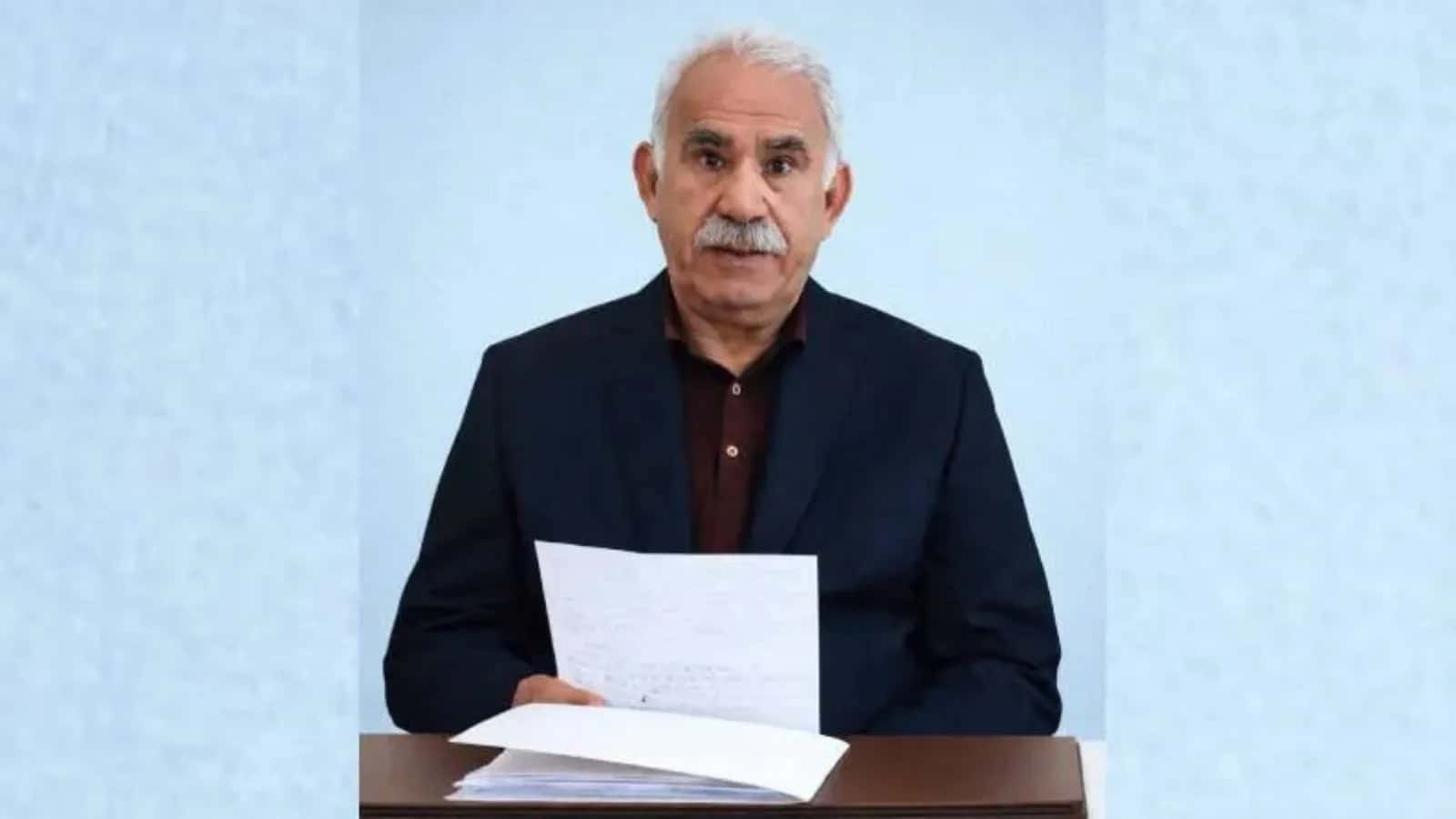
RastinewsMinutes purportedly from Abdullah Öcalan's August 2 meeting have leaked online.
Texts said to be a full transcript of Abdullah Öcalan's August 2 meeting with the DEM Party's İmralı Delegation, held at a critical stage of the framework law process, have begun circulating online.
The authenticity of the texts, and whether they represent a complete record of the meeting, has not yet been verified by independent sources.
Below is the full text purportedly recording the meeting between Öcalan and the İmralı Delegation:
MINUTES OF MEETING WITH ÖCALAN, DATED 02.08.2026
Chairman: Welcome. (Noticing the neck brace on comrade P.) What happened to you? P: I've got a problem with crystals in my ear, Chairman. It's making me dizzy. Chairman: I get dizzy sometimes too, get well soon. M: And you, are you well? Chairman: My condition never changes. We die on our feet — we don't get the chance to die in bed. People ask how Öcalan is, how his health is. Revolutionaries die on their feet. We carry a great responsibility, and that responsibility doesn't allow for any illness, for saying this or that part of me hurts. You have to stay alive and alert at all times.
Official: We always put your health first. First of all, on behalf of Mr. Abdullah, as your host, we welcome you all.
Chairman: (Laughing) I am the host, aren't I? I've earned that role. For 30 years, since Özal, my position has been clear: end the armed struggle, continue the political struggle. That's how we've carried this forward. We prepared those in the mountains for peace. …. I exist as a Kurdish strategist, a political solver. I called for an end to the war, and I responded with respect to the demand for integration with the state. We've been carrying this forward for two years now. I consider myself competent for this process. There is a key element to getting this law passed. For this process to move forward, a monitoring board would also ensure transparency toward the Turkish public. It absolutely needs to be part of this, through parliament. We cannot do this against parliament. The Middle East is going through a turbulent period. Every day, the regional war tied to Iran flares up and dies down again. And there is also the Kurdish reality here — a huge one, 60 million people. The British upended the Middle East by playing the Kurdish card. The same game is being played again this century. Back then they divided us, tore us apart, and left us — in their own words — full of wounds and scars. Now there are some who claim to speak for the Kurds. They say, "Apo is selling out the cause; just as our historical aspirations were about to be realized, Apo is making a deal with the state and has destroyed all our dreams." There is a front like that. They used Kurds both inside and outside the PKK. We know what happened to both Kurds and Turks when this was done at the end of the First World War. We know what was sacrificed for the sake of a small republic. Afterward they'll try to do the same thing to the republic through groups like FETÖ. They used to say there was a fascist strain among us; we barely escaped it. Now, ever since Özal, I have wanted to put out this fire. Since Koçgiri, thirty uprisings have broken out. Hundreds of thousands have died. The president himself said the economy lost 2.3 trillion, causing a loss of 60 billion dollars. If we act irresponsibly and light the fuse of pointless clashes, we will end up in a state worse than Gaza. Talk alone won't get us through this. The only thing this law will give me is more room to work. We are at the most important threshold of reconciliation in the republic's history. The Islamists are in power, but they are still up against the nationalists. A small step is opening the door. Through that door, we will introduce the Kurds to the republic. A journey of a thousand kilometers begins with a small step. Thirty uprisings have broken out. In the republic, everyone is still an enemy to everyone else. But this is our own republic too. We have as much of a stake in this state as the Turks do. Step by step, we too will start saying this state is ours. When you say state against state, that equals war. When I started out, I began by talking about Turkish colonialism. I was extremely well hidden — it took them five years to notice me. I asked people who came here when they had realized it, and they said five years. A state official once told me, while we were talking, "I admire your ability to reverse your own mistakes." He said that about academia — how rare it is in the academic world to see one's mistakes and turn back from them. But I did. Since the founding of the state, no Kurd within it has managed to break it apart or found another state. No one has tried and pushed as hard as I have. That's why I am changing strategy. If you insist on a wrong position, you lose. The state may look at us as terrorists today, but tomorrow we will be as solid a pillar of this state as the MHP. Let's argue about it for three months, and you'll see the state's door will open wide. Because we are turning the most strategic of peoples into an ally of the state. Yavuz gave İdris-i Bitlisi a blank sheet of paper and told him to write whatever he wanted. The result opened the door to the Middle East. None of this means sacrificing the status of the Kurds.
I will unmask those who say, "The Kurds struggled for a hundred years, then Apo left and sold out the Kurds' status to the state" — that is the real betrayal. Bahçeli understood this. There's Çakıroğlu, an ülkücü nationalist, one of those who understand it best. For two years now I've been clearing the air a little. I've tried to persuade you on one side and the other side too. I called it one-man chess. There's a book about it too. That's how I operate. It's difficult. I'm carefully formulating this for both sides.
Official: You mentioned mc² for the formula.
Chairman: That's the transformation. It matters. It changed our whole understanding of the universe. But it took a long time to be accepted. It applies not only to the universe and physics but to society too. For the sun to turn hydrogen into helium takes tremendous heat and pressure. That produces a great transformation. Society is a universe of its own. If we don't apply the formula correctly, we will burn society down. I told the state official: if both sides win, it's a Pyrrhic victory. Epirus won every battle it fought against Rome starting in 276 BC, but within two years it had lost everything. This is a people sixty million strong. If it wanted to fight, it could reduce everything to rubble. This work isn't just about preventing bloodshed. There will be a Kurdish-Turkish democratic alliance — what we call democratic integration. Once that happens, we will win the way Yavuz won the Middle East through the Kurdish principalities. If Bahçeli understood this, why wouldn't the others? They want us to go for each other's throats right away. There's no history in that, no sociology — just "that's what I feel like." Özal gave his life to this cause; he told his son Ahmet that no one could use elections or party interests as a tool against us. I have influence over the PKK, over the Kurds. No one has led as many uprisings as I have. But in the end I found the formula for democratic integration, and I want to achieve it together with the state. We spoke of two pillars: a Kurdish pillar and a Turkish pillar. If you want to open up to the Turkic world, to the Middle East, to Pakistan, to India, the Kurdish pillar matters. That is why every empire in history has collapsed. The Mitanni and the Hittites collapsed around 1200 BC because they failed to build that alliance. Every process since has followed the same pattern. You know how, in the First World War, Lawrence pulled the Arabs out of Jerusalem, Amman and Damascus.
If this had succeeded in Anatolia too, would anything of Turkishness have survived? The same strategy is at work. It's aimed at making the Kurds here anti-republican. In '93, the Greeks were coming, the Europeans were coming. They praised me heavily; I became almost intoxicated by it. Then, when Özal's call came into play and I said I would reach an agreement with Özal, they suddenly turned ice cold. I asked myself what was going on. I'm telling this for the first time. I would only understand it later. In Rome they said, 'Since he's set on reaching an agreement with the Turks, let's hand him over to them, let's have him killed.' That was the conspiracy. Michael Rubin said the same thing later. It keeps everyone dependent on itself and says, go ahead, fight. There's just enough support to keep the fighting going. If the law passes, our entire organizational format will have to change. When the HDP was founded, there was no s If the law passes, our entire organizational format will have to change. When the HDP was founded, there was no such situation, this wasn't even conceivable. In 2013 a door to dialogue opened, and it gave birth to the HDP. This process requires a complete review of our organizational structure and our ideological program. After the law, we will hold talks to bring all our movement plans and political work into line with the law. The movement I will now organize is the Democratic Society and Republic movement. You could even prepare a founders' assembly. There was a convening group at the Democratic Republic Conference — I'm not saying it has to be exactly them, but there should be a founders' assembly along similar lines. We will be republicans. In the past we favored independence. We will be republicans with the republic, even if you try to block it. This has both a historical and a social basis, because the Kurds have not yet joined the republic. The leftists still haven't joined the republic either. There's the Mustafa Suphi affair. There are figures like Şefik Hüsnü. The leftists are outside the republic. We will bring such leftist groups in too. There's a need for a movement that answers to both their leftism and their republicanism. Start preparing for this. If the first stage — should the law pass and take effect — goes well, an enormous task inevitably awaits us. We will meet with a great many people. Let Metiner and Altan Tan come too. I will meet with Ahmet Davutoğlu. Let secular intellectuals come too. Rıza Türmen, for example. You should invite people like him to the Founders' Assembly — you should have understood that. The Democrat Party did this in the '50s. We are joining a great republican initiative as a people — not just as a people, but as a culture. The leftists don't understand it either; in the republic's first century they all went through torture. In this century we are integrating with the democratic republic. This is also an opportunity for the leftists, an honorable partnership. As a movement that both secures proper integration with the republic and, through the democratic society, leaves no place for arms as a matter of principle, it meets all our needs. The CHP and any new party want to do this, but their structure won't allow it. We need this the most. We are joining a great republican initiative as a people, as a culture. The leftists don't understand. In the first century they all went through torture. In this century we are integrating with the democratic republic. This is an opportunity among these leftists too, an honorable partnership.
Delegation: Özgür Özel made a statement. He was expressing support for the process. He said the Kurdish issue is a strategic matter for them, but that they want to see the law first.
Chairman: Special greetings to Mr. Özgür. One of their officials should join the Parliamentary Monitoring Committee. I insisted on this committee for the CHP's sake. They keep saying, 'Are they sidelining us, have they merged with the People's Alliance, are they going to eliminate us' — while talking about law and democracy every day. The way to that runs through this effort. We are discussing a democratic legal solution not with the AKP but with the state. Opening the channel for law and democracy matters for everyone, and you especially should call this a final chance. The road to democracy does not run through Silivri, it runs through İmralı.
Delegation: We are on the threshold of an important meeting and an important law. Do you have a message for the public after this meeting?
Chairman: I am waiting for the law to pass. Once it passes, everyone will hear from me. I promise a democratic-republic effort at least equal to the work and sacrifice that went into founding the republic — after all, the republic was not founded without the Kurds. I promise work for a democratic republic at least equal to that at the outset. This is needed for the 86 million, for everyone. It is a great service to be rendered to 86 million people. It will affect the fate of the region and the country, open the way to a democratic constitution, and open the way to a process that will expand economic opportunities. The door to a democratic republic is being opened all the way. This can be approached with the joy of a holiday. It is the first step of a thousand-kilometer road. We are taking the first step of a thousand-kilometer road. We are taking a step toward democracy for everyone. What else is there?
Ö: Chairman, we've been making prison visits. Everyone is following you, asking about you — let us pass on their regards.
Chairman: Yes, there's the situation in the prisons. There are a lot of sick people, aren't there? We need to look after them.
Note: At the end of the meeting, when told how women would take part in the legal process, the Chairman said, "We have begun the women's manifesto — when it's finished, you will be shocked. Also, women should take part in the monitoring committee under a women's quota, or a separate women's monitoring committee could exist outside parliament."
Note: The Chairman set out the following position on how the law emerging from this process should be approached: "This is an entry law, a root law. The process that will begin with this law will also involve ongoing legal regulations, democratization, and local-government matters. It needs to be assessed in that light."
What sums up the Chairman's approach to the ongoing legislative process is this: that his own working conditions will take shape after the law passes, secured through the position he will hold on the "politicization and peace committee" to be formed afterward. The sub-committee referred to in the clause included in the law — "assignments may be made to sub-commissions to ensure the process advances on the organization's side" — is the "peace and democratization committee," a body agreed to be formed once the law passes. This is the committee that defines the essence of the law and that the Chairman considers important.
July 20 Meeting:
We were given the following information about the law. The law reportedly sets up a Coordination Committee, run under the direction of a Vice President. This committee may also include representatives of the Justice Ministry, the Interior Ministry, and intelligence agencies. A "Disarmament and Politicization Committee" will be formed as a sub-committee under this Coordination Committee. I will also hold a clearly defined status on that committee. According to the calculations, 80 percent of those currently in prison — that is, 3,900 of 4,700 people — will be released under this law. With the law, the charge of organizational membership reportedly falls away. There is a group of roughly 814 people in total. Their situation will become clear over the course of the process. These are people serving aggravated life sentences. The committee will carry out a periodic assessment of this group. I said there was no need to set a time limit for this assessment period. But according to projections, this group's situation will also be resolved within a year to a year and a half after the law passes. I have no demand to be released tomorrow. Let the process move forward — they don't want to keep me here anyway.
How will my situation fit into the law? That remains the core question. According to the information given, our situation is a matter that will become clear within the committee's four- or six-month periodic assessments. In practical terms, a new period will begin once the law passes.
Traffic for meetings here on the island will also pick up. Politicians and journalists will come. This matters, because with the law we are, in effect, starting anew. It will be an ongoing process. For the period after the law, there is a Kurdish dynamic I need to persuade, and there is Turkish society. It's important to pass the law as soon as possible. Even if there isn't time, parliament's session could be extended by a week or ten days if necessary.
Trust and assurance. Assurance strengthens trust, and trust strengthens assurance. It's clear the state is basing itself on this. Who would have believed it, a few years ago, if told that Baathist rule in Syria would collapse, the country would not fall apart, and someone named al-Sharaa would come to power? Or, again a few years ago, who would have believed that Bahçeli would call Öcalan the 'Founding Leader'? These examples show how quickly everything can change. Within this process, the law forms a first step; other laws will be needed afterward.
We are witnessing a historic moment. We spoke with our friends here. There are a few points on the legal matter that we need to clarify.
You're aware of this, aren't you? I made it clear that the PKK is a result of Western modernity's intervention in the Middle East. Real socialism accounted for a third of the world. It wasn't possible for us to go beyond it; we didn't carry out their orders, but we appeared as if we were subordinate to them. The republic's founding cadres, and those NATO-aligned cadres, are the same way. They did what the West, what NATO, told them to do.
Change began with Özal. One of the most historic steps in the state's transformation is being taken. When you first raised this step, it was I, not you, who spoke of the PKK's dissolution. I had already reached that conclusion long ago. Things whose time has passed must be overcome. If this isn't done, it forces the future's hand. That's also the matter with the CHP. Its historical role has run its course. I once called the relationship between M. Kemal and İnönü a Turkish-Kurdish relationship. Now look at the relationship between Özel and Kemal — one Turkish, the other Kurdish. In fact, one is from Salonika, the other from the same sectarian region, namely Dersim. What's happening within the CHP is the dialectic at the republic's foundation speaking through itself. They actually got along very well with each other — so why did it turn out this way? It's about the dialectic underneath.
The potential I rely on, and its historical language. Bahçeli put forward a historic statesman's persona; mine turned out more or less the same. In the end, we're heading toward something historic. The century-old divide-and-rule stones of Western hegemony are being pulled out, dismantled. I don't know how long it will take, but it's historic, without question. Alp Arslan had a Kurd at his side. Do you like the ballad of Kiziroğlu Mustafa Bey? He's a Kurd from Şırnak who came to Kars and was loved there. Across the north, the Serhat region, Erzurum and Van included, whatever role the Seljuks played in Turkish history, the Shaddadid dynasty played the same role among the Kurds. There are three hundred years of Seljuk history and three hundred years of Shaddadid history. They give Ani to Manucher — a Shaddadid. They give Kars to the Turks. There was joint resistance against Crusader and Mongol attacks.
The Battle of Ayn Jalut is famous. Had it not succeeded, there would be nothing left called Islam. He links the Ottoman Empire's dissolution in the 19th century to its relations with the Kurds and to the rebellions. I thought about it — it's true. The first rebellion was in the early 1800s, the Babanzades.
The CHP has to understand this — dozens of people were purged over the hat and similar matters. It's an imitation of the French Revolution; I call this Robespierrism. They think a great revolution requires slaughtering and purging many people. They did this to Sheikh Said and Seyit Rıza too, calling them feudal and reactionary. None of that is right. I don't want to say anything against M. Kemal — he is the founder of the republic. The CHP must not stand in the way of this process. By the end of the century its gunpowder had run down somewhat. Just as we are transforming, they must transform too. Tell them when you meet them: the step we're taking here will open the way to a new constitution and to a democratic republic. They hung all sorts of labels on it — second republic, third republic. The French founded five republics. There are fascist veins on both the right and the left. There's even a fascist vein in today's technology and artificial intelligence. The way artificial intelligence is being imposed is in the form of 'only I know best, only I do it'... If I talk about artificial intelligence, hateful words come out of my mouth. I'm not against technology, but it is the most dangerous and fascist movement aimed at humanity. It will kill creativity.
Nobody in Turkey knows the history that made settlement in this land possible. Ziya Gökalp's saying, "There is no Kurd without a Turk, no Turk without a Kurd," is famous. I took it up dialectically. Wherever I turn, Kurds are present in the Turks' fundamental affairs, and Turks are present in all the Kurds' great affairs. Right now Kurds are in a state of being despised, of not being treated as human. They couldn't even speak their own language.
State officials say: "These conditions are long behind us now, but still — that was the work of a nationalist, fascist vein. Today, being Kurdish in Turkey, Kurdish-language broadcasting, and works of art are widespread, and there are fine examples of them."
Yet a great price was paid for this. The law should also have a compensatory dimension. It's not only one side that has veterans and wounded. Reading Bejan Matur's book "Looking Behind the Mountains" is moving. The stories of the women in it… So much suffering happened. A terrible war took place. Young women, young men. Historic steps are being taken so these sufferings can be left behind. This isn't a give-and-take matter. It's about bringing about a true meeting in the present. Tomorrow the law will pass, and a great burden will fall on me. The transformation of the Kurds is a major issue — transforming both the Kurdish side, the organization's side, and explaining it to the Turkish side, persuading them. In the contacts I'll have with journalists after the law, I need to be able to explain this. This transformation will transform the Turkish left and the Turkish right too, and may open the door to changes in Kemalist historical theses — provided they don't stand entirely against it. When I said "Lausanne," when I said "the first constitution," certain circles jumped up...
Some don't understand the negotiations here. There were those who said I was working against Kurdish history. Yet Turkish-Kurdish brotherhood is being revived, and this will change the dynamics of the Middle East. Nobody sees it this way — only we do.
As for my role, it's not self-interest at all. I don't like praising myself either, but this is a burden I must certainly take on. Özal and others called me to this dialogue back in their time. I'm taking on this historic role. An early death here, or some other removal, would set off two hundred years of dark warfare. That's why caution is essential. What did the British say when they first heard of the talks? It appeared in a newspaper back then — they said the balances of the Middle East would be turned upside down.
The timeline for the senior leadership and similar comrades shouldn't drag on. It could be 3 years, it could take 5 years, or perhaps through negotiation they may not come at all. These are people wanted and targeted at the international level. Their defense is essential. I'm not saying they should come right away, but once public opinion has been prepared — let's say 6 months to a year — they should at least come one by one. We'll see how it goes in the coming process; public opinion can be prepared. I'm not saying they should come and go into parliament — they need to be able to carry out democratic politics at the local level. A periodic assessment should be made for them. That flexibility should be granted without setting a time limit.
I read the summary of Duran Kalkan's interview with Ruşen Çakır — it was positive. It was an inclusive, positive interview. His earlier analysis about the national team was also important. He said, "The children couldn't play because of nationalist pressure." Despite my criticisms, comrade Abbas has a devoted, hard-working side.
After the law, there will be a three-T formula: verification, determination, commitment. The state mechanism will carry out the verification. We will carry out the commitment. One leg will be the National Security Council (MGK), the other the parliament. The MGK will issue a report stating that the PKK has laid down its arms. The MGK will make a decision on this and it will go to parliament. It will proceed through a solid, three-part mechanism. The commitment part is my job. I need to be involved.
The draft will also need a monitoring board. A Monitoring Commission will follow up on the decision taken by the Parliamentary Commission. There will be a Coordination Board and a Politicization Board — a board to which the parties represented on the parliamentary Commission can appoint members. The parliamentary board should be established not as a subordinate board but as an independent, separate board. Since the legislature will not be subordinate to the executive, there should be a monitoring board with members from every party.
We'll discuss together when forming the first group to come. It'll be something like 300 people — a third from Europe, a third from prisons, a third from Kandil, something like that. These are details; we'll talk about them later. Our work matters. If the work moves quickly, the timeline could come down to a year, even six months.
I have strong ideas about economics and agriculture. Developing Mesopotamian agriculture is on my mind. That's what I mean by "commune" — developing the most productive farms. This matters more than Middle Eastern oil.
The Kurds' founding role in the Republic is no less than the Turks'. The Kurds didn't do what Lawrence and the Arabs did. So this is a corrective movement today. After Kirkuk, there could be a Turkmen governor in Aleppo. A Turkmen governor for Aleppo would mean peace for Syria. It's very important. The practice of a rotating governorship in Kirkuk was a good idea — rotating year by year among Kurds, Arabs and Turkmens.
Aleppo has a strategic significance. I lived there first. We had a fine building there. Aram Tigran was there. He's magnificent. He sent his regards before he died. His influence on me is great. At the Land Registry and Cadastre high school in Ankara, there was İsmail Aslan from Ceylanpınar. He later became mayor. I went to his house. I noticed a Kurdish melody — Aram was playing, and I listened. I said this voice must not die, this melody must live on forever.
Aleppo, and the Kamishli side. The Turkmen ballad Ezo Gelin, and Barak melodies, are traced back to Aleppo. I grew up with Barak melodies in Nizip. Aleppo is the center of this culture. Arabs are part of it too, of course. That's what a thousand years of history looks like. For this foundation, al-Sharaa also needs to be prepared for democracy, to some extent. Local democracy and democratization would save al-Sharaa too. If he doesn't do this, nobody can save him — within a year he'll suffer a coup, and there will be massacre in Syria.
Iran can't be left as it is. Just as Syria was living through its final period, this Shia regime is living through its final period too. A move needs to be launched that includes Nechirvan and Bafel, and that will transform PJAK as well. Turkey should play a positive role. Let's develop a historic move of brotherhood without needing America or Britain. This is brotherly cooperation, support. Together, transforming PJAK too, bringing it onto a suitable line. Otherwise thousands will be executed, and there will be a sea of blood. The US can't get past this. The Shia regime is locked up too — it can't solve it.
Nothing can be done without embracing Middle Eastern culture. For a hundred years, without knowing this history, they have fought under the name of leftism for every outdated Western idea there is. What is called the ummah is Islamic and Middle Eastern internationalism. In the Middle East, there has been a unity since the Hittites, even since Sargon. There is an imperial unity, and beneath it a cultural unity of peoples. Over the last two hundred years, nationalism and modernity have torn it apart, and it has become alienated from itself. Then, in its most collaborationist form, it turned to the British and said, 'come and save me.'
Whether right or left, it must follow the culture of this land. For two hundred years, they have turned this into a practice of divide and rule. You have noticed this, and you want to overcome it. I will help. To the extent it deals with Iran, the greatest accumulated strength lies in Turkey. As these strengths combine, they will bring us to a Middle Eastern unity, an internationalism. Attacks on the Kurdish region have increased. It used to strike Erbil; now it has begun striking Sulaymaniyah too. Groups from within Iran, and Iraqi groups tied to it, are carrying this out. Clashes with PJAK are occurring here and there. PJAK issued a statement. They said they are not a party to the war, but they will not accept these attacks on Kurds, and that if they continue, they will protect the people.
If Iran is to be resolved, it will be resolved from here. Israel and the US cannot resolve it. It will be a reflection of the democratic integration move. But no ground should be given to Iran's attacks — they could even expand their reach. Persian nationalism should not be taken lightly. The Iranians may want to seize the whole of Iraq. We must not hand that country over to Iran entirely. If it settles in, it will take Iraq first, then Syria. Iran will fight from Lebanon to Afghanistan. The commander of the Revolutionary Guards was Jafari. He was the first to visit me, in 1985. They do not easily abandon their aims.
The Americans made three demands of Iraq's new Prime Minister, Ali Zeydi. One, reduce Iran's influence. Two, integrate the Shiite militia forces into the army. Three, corruption. Terrible corruption is taking place, and they are using that money to finance the militias. Ali Zeydi launched a corruption operation against fifty people. He also gave the militias until September 30. The Sadr group agreed. Groups like Kataib refused. Those attacking the Kurdish region are these militia forces, every bit as much as Iran. The Iranians must not attack the Kurds.
Kurdish lawyers held a conference. How did it go — was there a strong debate? The legalization of Kurdish jurists... Should I call it alienation from the Kurds? The history of the Republic is a history of pushing Kurds outside the law. The bill now on the agenda should be valued as gold — a root law of peace, the first law of inclusion into the legal system.
After this law, the PKK will have completed its full dissolution. As a strategy and as an organization, it has been superseded. But it leaves behind a legacy of cadres numbering in the hundreds of thousands. Political parties are also splitting; there are many intellectuals within both right- and left-wing structures who want to talk. Just as a party like the People's Party (Halk Fırkası) emerged at the founding of the first republic... The AKP already says, "we have re-founded the republic." That's not wrong. They turned the rigid ground into a republic. But if it remains standing on one leg, the CHP wants to break that. A republic cannot stand on one leg. There can be no single-pillar republic built on conservative democracy or on CHP-ism alone. They want to go into the constitution on this single-pillar basis, but such a constitution cannot be democratic. To avoid this danger, a republic built on at least two pillars is needed. That is the Democratic Republic. The single-pillar republic's life passed in coups and executions. Let us also remember Menderes here. At least two main pillars are needed. There could be a third, a fourth, but at least two main pillars are required. I have said this before. When the Hittites could not establish the Mittani pillar in Mesopotamia, Assyria came and swallowed both.
The Republic rests on two fundamental cultural centers: Mesopotamian culture and Anatolian culture. In the broad sense, this also includes Syria and Iraq.
If we leave it in this state, the second century will be born crippled, through the sterile Kemal-Özel disputes within the CHP. Through coups and counter-coups... The Kurdish issue is the same — if it is not resolved, rebellion will come again. This is not a threat. Five hundred thousand people could rise up, get behind America, and become a real headache. The way out is to build the Turkish Republic on two pillars. I am not calling for a separate Kurdish law. Why have I never discussed the Turkish nation's sovereignty over the state? In the February 27 Declaration, I did not discuss the form of the state. I have no right to that. Even if I had the right, I don't have the power. I left it — let the Turks discuss that.
This process will bring me to a certain point. The constitution will come off the shelf — nationalize it or Islamize it as much as you like, where will you put these Kurds? In the Middle East there is a mass of 60 million, and it is dynamic. What does dynamic mean? A mass that has begun to move. Alongside this historic process, I will begin this work.
I will embark on a great enlightenment effort. There is a great dynamic mass here, and I will ask what we are going to do with it. I will tell those who govern the state that a way out must be shown in the constitution for this enormous mass. There can be no Kurdish law or Turkish law — law is universal, but the constitution must take into account that the Kurd exists too. Kurdish jurists held a congress, but they have no legitimacy whatsoever. If a coup comes tomorrow, they will lock all of them up, because they have no grounding.
So we will take our place in the constitution. Kurds have no legal infrastructure. Kurds need to become a subject of law. Kurds need to become a subject of law through the constitution. The constitution will be strengthened by this.
My February 27 program is the same. It is freedom for three identities. First, "freedom for identity," without naming any ethnicity at all. Kurd, Alevi, and woman are all identities — you cannot give each one a place in the constitution. It is enough to say, "identity is free." Second, "freedom of thought and belief." Third, "systemic freedom" — freedom of systemic expression and organization. These can even be fit into a single article. It already says democratic, secular, social state of law — all three can go together. There are so many academics, so many jurists, and it makes me very angry.
Let me underline this again. There is a lot of speculation. We are becoming a Board at the highest level. Everyone should understand this. This is the solution Öcalan found, and the responsibility he has taken on. There are Boards, we will work — it is not that we will suddenly be free just like that. These Boards will determine the status of every person under every heading, right down to when they should come, even where they should settle. I am taking on this responsibility myself. I believe we will succeed at least 90 percent of the time. Since this law does not contain the kind of solution the DEM Party and Kandil had in mind, they should not raise a storm over it. Yes, this law does not give me freedom right away, but it does give the possibility of a periodic evaluation for those, like me, left for the second stage. We will work in such a way that a moment will come when they tell me, "you need to come out right away." Some ill-intentioned people will call it weakness. This law gives those outside my situation the chance to come out right away, and gives those in my situation the possibility of periodic evaluation.
I will prepare the conditions for my own release myself. It will happen in such a way that they themselves will let me out. When I leave this place will be for me to decide. Suppose it doesn't work out, suppose they liquidate all of us here too — even then, we lose nothing. None of you can be more of an Apoist than I am. You cannot know me better than I know myself. I have had a sustaining project going for 50 years. Should this fail, a separate strategy of mine comes into play. We have been struggling for 50 years. Let's say it doesn't work out — there are those we want to stay outside for a long time; if anyone says 'we put Apo to sleep,' they will have dealt the state its greatest blow. I have my strategy — even if I were in my grave, I would still play my role
A chicken-and-egg deadlock has been created. To overcome this, I think it is right to subject my own situation to a periodic evaluation. Of course, someone may emerge who wants to keep me here — that would deal the process its greatest blow.
The movement and the people want my freedom. No one is telling them to change their view on Öcalan. What I am saying is, there is no need to raise hell over why Öcalan is not in the law. I have spoken of dividing the stages into periods. Approval is needed from the verification commission, from the National Security Council (MGK), from the President. The law does not bring me freedom, but it opens a door, and leaves it open. A law that settles my freedom in a single day cannot be made anyway. In my view, it is valuable to leave this door ajar for now. They should not raise hell. They should not raise hell just because the law reads a certain way.
As for the restructuring of democratic politics, I want to say this;
After this law, the PKK and all its affiliates, the DEM Party and all its affiliates, the HDK, the TJA, and a great many organizations will come together under one roof, and I want to give it a name like the Democratic Society and Republic Movement. Just as the HDK was founded after the 2012 talks and negotiation process, the party of today's legal ground also goes beyond the DEM Party. The HDP is already before the courts, defunct. The CHP is divided, with a great many objections. A new constitution is on the horizon. In order to work out the new election calculations, to enter the new constitutional debates... As the PKK dissolves, its cadres are being decriminalized. All of this needs a legal organization, a new movement. Heading toward the congress, I have found it fitting to give a common name to everything on our side. It is right to bring all of it together under a political party.
The Democratic Society and Republic Movement. This name could change. We'll need to give a name to those coming forward, and put a committee at their head. The Democratic Society and Republic Movement preparatory committee will convene immediately and prepare the Congress — for the new Congress's program, its foundation. We are already preparing ourselves for the Democratic Republic on legal ground. A Preparatory group must be formed quickly. It should include prominent intellectuals and writers, even people who were previously in the AKP. It should be a broad preparation drawing from Islamist intellectuals and the left. The difference from the HDK is this: there, the goal was a Congress. Now, with this, we will join the republic.
This Board is a historic one. In return, armed, separatist theses are being set aside, and we are becoming the most democratic, republican team. With the D. Society we will organize society; with the D. Republic we will democratize the state. A convening group like the one for the Democratic Republic conference could issue the call for this movement's founding.
There's apparently a timing problem. Isn't the Congress set for September 20? I don't know if a legal postponement is possible, but as things stand, there won't be enough time.
This is a historic process. There is the law, then the constitution, then the election process. We are building the real democratic republic with our own hands. The PKK is not just ceasing to be a problem — it is becoming a constructive element. This is very important work, not half-finished like in 2015. This work will shape the constitution, the elections, the presidency. And I am part of it. We will work together. In practice, I am becoming the head of this movement. Otherwise I cannot honor our commitment. Look, the Turkish left is approaching this in a fragmented way. Given my historic character, I will not let it fragment. The work we do vis-à-vis the state will be the democratic republic; the work vis-à-vis society will be the democratic society; the work carried out together, all of it, will be Democratic Integration. You need to believe this, and trust it.
The state is the summary of society. If it does not fully reflect its society, it is a deficient state. The more it reflects it, the more it is a real state, a norm state. Failing to reflect part of its society is hypocrisy. We are turning this state into our own state. This is how I see it coming, and it is a historic development. I work with enthusiasm. So explain this well to the pessimists abroad, to those in Europe.
I repeat: let the political Party Congress Preparatory Commission include representatives from all of them. Let there be representatives from the HDK and all the others. Let it also encompass the existing commission. There was a list of Democratic Republic convenors. There should be a convening group as strong as that one — work that many people will be part of. As the new D. Republic and Society Movement, let them take the most inclusive approach.
July 20