
Masrour Barzani: We Won't Let Kurdistan Become Part of the War
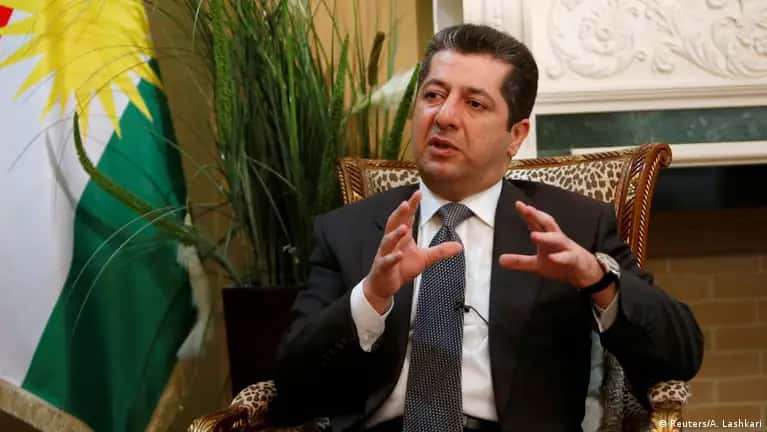
RastinewsMasrour Barzani, prime minister of Iraq's Kurdistan Region, said the region's wars have upended its political and economic balance. "From day one, we said we would not be part of any conflict," he said. Barzani called more than 1,000 missile and drone strikes on the Kurdistan Region "baseless," and said foreign trade had fallen 70 percent because of the US-Iran war.
Barzani made the remarks in an August 8 interview with Al Jazeera that ranged across regional wars, Baghdad-Erbil relations, Iran and Turkey, and the future of Kurds in Syria.
He summed up Erbil's core policy as keeping the Kurdistan Region out of wars and refusing to let its territory be used against neighboring countries.
"We've been hit by more than 1,000 missile and drone strikes"
Barzani said the Kurdistan Region has been targeted by more than 1,000 missile and drone attacks launched from Iran or by armed groups in Iraq, killing civilians and damaging infrastructure.
He argued the stated justifications for the attacks do not reflect reality, and denied claims that US troops are stationed at Harir Air Base:
"Harir Air Base has been empty for ten years. A base without a single American soldier in it is being attacked."
Kurdish groups from Rojhilat: We inherited this problem
On the Kurdish opposition groups from Rojhilat, Iran's Kurdish region, based in the Kurdistan Region, Barzani said these groups had been present there as refugees even before 1991.
"We didn't create this problem — it was handed down to us as a historical legacy," Barzani said, stressing that Erbil will not allow Kurdistan Region territory to become a threat to the security of neighboring states.
"Kurds should not be second-class citizens"
Turning to the situation of Kurds in Iran, Barzani said Kurdish participation in state administration remains limited.
"We support Kurds having equal rights wherever they live, and not being treated as second-class citizens," Barzani said.
He said the Kurdish issue in regional countries should be addressed through dialogue and political solutions rather than military means, adding that Kurds are "ancient and integral" to the countries where they live.
"Resolving Turkey's Kurdish issue is critical for the whole region"
Barzani described Ankara-Erbil relations as "quite good," and said nearly 800 villages in the Kurdistan Region lie in ruins because of fighting along the border.
Voicing clear support for the ongoing process in Turkey, Barzani said:
"Resolving Turkey's Kurdish issue is extremely critical to reaching a final settlement of the Kurdish issue across the whole region."
Message on Syria: dialogue between Damascus and the Kurds
Barzani said they support the talks under way between Kurds and Damascus in Syria, and noted that Erbil's own relationship with Damascus is developing.
He stressed the importance of Kurds being included in Syria's new political and administrative structure, saying mutual trust could open the door to more comprehensive agreements.
The cost of war: trade down 70 percent
The most striking economic figure in Barzani's interview concerned the Kurdistan Region's trade volume.
Barzani said the US-Iran war has hit the economies of Iraq and the Kurdistan Region directly:
"Our trade with neighboring countries has fallen sharply. I can say our trade volume is down 70 percent compared with the previous period."
Barzani said Iraq's oil exports have taken a heavy hit because of the situation in the Strait of Hormuz, and that the Kurdistan Region's current production capacity is not enough to make up for Baghdad's losses.
Criticism of Baghdad over federalism
Barzani argued that the root of Erbil-Baghdad disputes is not the federal system itself but Baghdad's failure to implement the Iraqi constitution, pointing in particular to Article 140 and the Oil and Gas Law, both left unresolved for years.
"There is still a faction in Baghdad that doesn't believe in the federal system — or doesn't even understand it," Barzani said.
Criticizing the fact that Iraq still relies on oil legislation dating from 1975, Barzani called for a modern Oil and Gas Law suited to the country's federal structure.
"Iraq should be independent in its decisions"
Addressing Iran's influence over Iraq, Barzani said they support Baghdad building good relations with all its neighbors, including Tehran, but that this should rest on sovereignty and mutual respect.
Barzani closed with this message:
"Iraq should be fully independent in its decisions; it must put the interests of its people and its country above all else."