
SDF's Kobani Chief: 'We Will Announce the Dissolution of the YPG-SDF'
Mahmud Berkhodan, SDF's official in Kobani, told Turkish daily Türkiye that a dissolution announcement would come within days and that autonomous administration would end, as troops integrate into a single Syrian army.
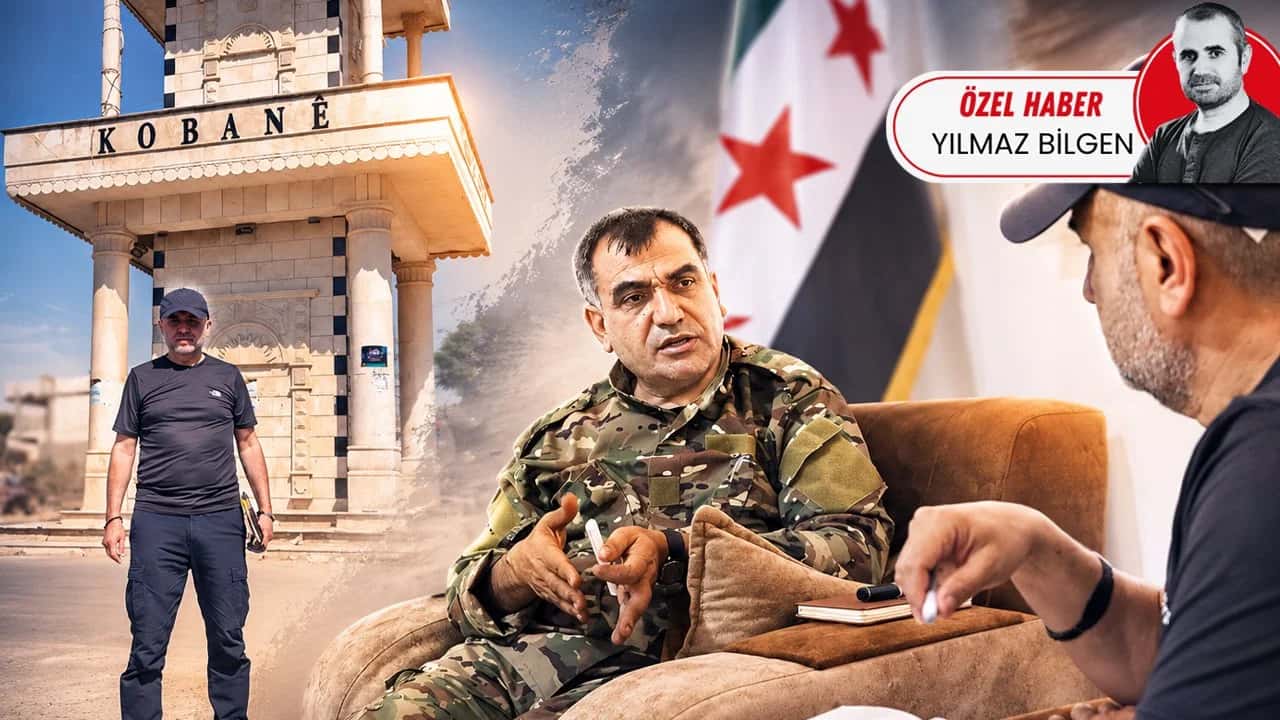
RastinewsMahmud Berkhodan, the SDF's official in Kobani, told Türkiye newspaper columnist Yılmaz Bilgen that a dissolution announcement was coming within days and that the autonomous administration structure would end.
Berkhodan praised President Recep Tayyip Erdoğan and Nationalist Movement Party (MHP) leader Devlet Bahçeli, calling their approach "the move of a thousand years" and "a work of genius." He also said Kurds were not seeking a separate Kurdistan and had "buried our weapons," adding that a framework built around the Islamic ummah "would not trouble any Kurd" — striking notes for the new phase ahead.
One of the most striking statements yet on the Syrian track of Turkey's "Terror-Free Turkey" process came from Kobani.
Mahmud Berkhodan, the PYD-SDF's official in Kobani, spoke to Türkiye newspaper columnist Yılmaz Bilgen there on subjects ranging from the SDF's integration into the Syrian army and the future of autonomous administration to the fate of the YPG and his views on Erdoğan and Bahçeli.
At the center of his remarks was a clear message: the current military and administrative structure would be dissolved.
"We will announce the dissolution of the YPG-SDF within days"
Berkhodan said 99 percent of the problems in integration talks with the Damascus government had been resolved.
He said the YPG-SDF would not continue in its current form, adding:
"In the coming days we will announce the dissolution of the YPG-SDF. The autonomous administration structure will also come to an end. We will build the new Syria hand in hand, within the framework of one army, one state, one flag and a shared homeland."
His comments opened a new debate over the future of the autonomous administration model built over years in northern and eastern Syria.
"We've buried our weapons — there's no turning back"
Berkhodan, one of the figures present at the YPG's founding in 2012, said military integration was theoretically complete.
He said the status of the YPJ and of YPG members holding Turkish citizenship remained to be resolved, but argued neither issue could halt the process.
Berkhodan said:
"For us, there is no turning back from this point. We've buried our weapons. From now on we will carry on our existence in unity, as part and parcel of Syria."
From autonomous rule to "one state"
One of the most notable shifts in Berkhodan's remarks was in the political language itself.
In place of years of talk about "autonomous administration," decentralization and a local-governance model, Berkhodan spoke plainly of "one state, one army and one flag."
In return, though, he demanded a new, inclusive constitution from Damascus.
Berkhodan said the rights of Kurds, along with Turkmens, Arabs, Assyrians, Yazidis, Armenians, Druze and Alawites, must be constitutionally guaranteed, and called for the Baathist model of governance to be dismantled entirely.
Unusual praise for Erdoğan and Bahçeli: "the move of a thousand years"
The remarks most likely to stir debate in Turkey concerned President Recep Tayyip Erdoğan and MHP leader Devlet Bahçeli.
Berkhodan argued that Turkey's "Terror-Free Turkey" process and developments in Syria could not be viewed separately, and used striking language about the two leaders:
"President Erdoğan and MHP leader Bahçeli took on great risk, but perhaps made the move of a thousand years."
He did not stop there.
He described the role the two men had taken on as "a genuine act of patriotic responsibility," adding:
"They produced a work of genius. There was no other solution anyway."
Berkhodan said Erdoğan and Bahçeli understood that the region's crisis could not be resolved by ignoring the Kurds, saying: "Only great statesmen can take such a step, and go down in history for it."
The remarks mark a striking shift in political tone, given the years of sharp conflict and mutual accusations between Ankara and the YPG-SDF.
Berkhodan: We are not seeking a separate Kurdistan
Asked about Kobani's future, Berkhodan said they were not seeking an independent Kurdish state within Syria.
"We have no demand for a separate state, for a Kurdistan," Berkhodan said, adding that this had never been their goal.
"Saying Kobani will become an independent state is an irrational fantasy," Berkhodan said, noting that Syrian Kurds are spread across different parts of the country and are an inseparable part of Syrian society.
He said the same held true for Turkey, noting he has many relatives there and that borders sever the ties between people.
"The Brussels line cut us apart like a knife"
Referring to the history of the Turkey-Syria border, Berkhodan said Kurds had been split apart by borders.
"The 1926 Brussels line cut us apart like a knife," Berkhodan said, arguing that this chapter must now be closed:
"Now is the time to close this parenthesis and make peace."
Berkhodan recalled that during ISIS's assault on Kobani, residents crossed into Turkey, and said Kurds had not forgotten the support they received there.
Berkhodan also acknowledged mistakes over the past 15 years, saying: "We now have to talk about peace, unity and building our future together."
"A framework of Islamic ummah would not trouble Kurds"
One of the most contentious parts of the interview was Berkhodan's framing of Kurdish identity in relation to Islam.
Noting that the handover of public institutions and oil fields to the Damascus government was also nearing completion, Berkhodan said:
"Kurds are, by their nature, a Muslim community, and a framework of Islamic ummah, in Syria or wherever we live, would not trouble any Kurd."
Berkhodan described this as the Kurds' "natural sociology."
Given the PYD's long-standing emphasis on secular governance and shared representation for different faith communities, the remarks are likely to fuel a fresh ideological debate.
Oil wells, public institutions also to be handed to Damascus
Berkhodan said the change would not be confined to the military sphere.
He said that alongside military integration, the handover of public institutions and oil wells to the Damascus government was also in its final stage.
By Berkhodan's account, then, the dissolution of the YPG-SDF's military structure, the end of autonomous administration, the absorption of fighters into the Syrian army and the transfer of strategic economic assets to the central government are all part of the same process.
SDF's real fighter numbers, also disclosed
Berkhodan also dismissed figures long cited for the SDF-YPG's fighting strength.
He said estimates of a force numbering 70,000, 80,000, 100,000 or even 130,000 did not reflect reality, and said roughly 10,000 fighters had so far been integrated into the Syrian army.
He said that number could reach 12,000, adding:
"Past estimates putting our force at 70,000 to 100,000 do not reflect reality."
Berkhodan also said few Arab fighters remained within the current structure, with only a limited Arab presence possibly remaining in the Qamishli-Jazira area.
Does Kobani's message signal a new era?
If Berkhodan's statements are borne out, it would mark one of the most sweeping transformations of the political and military structure built in northern and eastern Syria since 2012.
The dissolution of the YPG-SDF, the end of autonomous administration, the transfer of oil resources and public institutions to Damascus, and the integration of armed forces into the Syrian army all point to a redefinition of the core elements of the current governing model.
But Berkhodan is also setting a significant condition for Damascus: a new, "fair" constitution guaranteeing the rights of all of Syria's ethnic and religious communities, Kurds included.
The message from Kobani, then, is not simply that "the YPG is being dissolved."
The real question, once weapons and institutions are handed to Damascus, is what constitutional and political status Kurds will hold in the new Syria.
Source: Türkiye