
Kurtulmuş Spells Out Framework Law Limits: Öcalan, Top Commanders Excluded
Parliament Speaker Numan Kurtulmuş offered new detail on how the Framework Law passed under Turkey's 'Terror-Free Turkey' initiative will actually be applied.
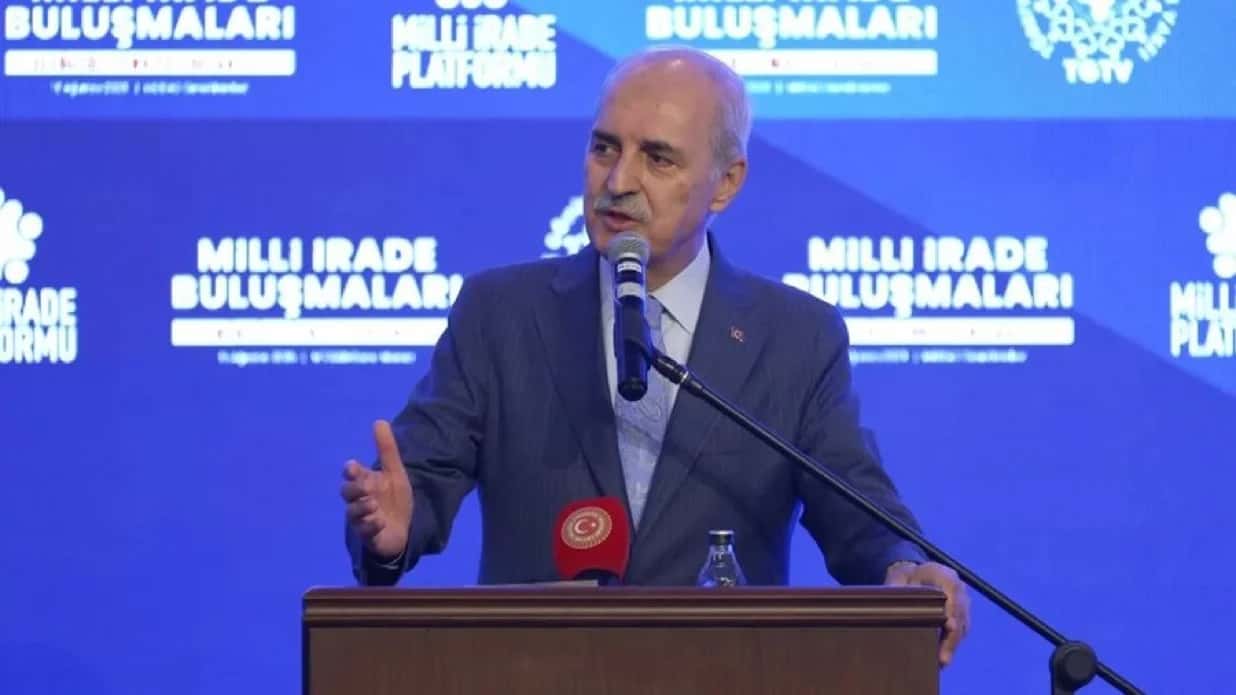
RastinewsParliament Speaker Numan Kurtulmuş has offered new detail on how the Framework Law passed under Turkey's "Terror-Free Turkey" initiative will be applied. The law was drafted solely for the PKK, the PYD and the KCK, he said, and none of the groups' senior leadership, including Öcalan, will be able to benefit from it. Kurtulmuş said the process can only begin once security agencies confirm disarmament and organizational dissolution, and the National Security Council (MGK) signs off on that finding.
Kurtulmuş spoke at the 17th National Will Gathering, titled "Terror-Free Turkey," held at MÜSİAD's headquarters.
His remarks centered on the "Terror-Free Turkey" process and the Framework Law enacted as part of it.
Addressing who the law covers, under what conditions it applies and how the process will be monitored, Kurtulmuş said it is not a general, permanent measure but one written for specific groups over a specific period.
"There are three safeguards built into the law"
Kurtulmuş said the Framework Law will not apply directly or unconditionally, describing "three safeguards" written into the measure.
Under the first, the organization must dissolve itself in full, with all its components, and lay down its weapons.
A declaration from the group alone will not suffice, Kurtulmuş said — the state's relevant security agencies must first confirm the dissolution and disarmament.
The next step requires the National Security Council to adopt and approve that finding.
Kurtulmuş described this mechanism as one of the law's core safeguards.
Kurtulmuş: the law applies only to the PKK, PYD and KCK
Turning to questions over the law's scope, Kurtulmuş said it will not be extended to any other organization.
He said the law was drafted for the PKK, the PYD and the KCK, stressing that it is temporary in nature.
Once the conditions for implementation are confirmed, a six-month window will open, Kurtulmuş said, during which members who leave the organization and disarm can benefit from the law under set conditions.
Under those terms, an individual must not only lay down weapons but also declare an end to organizational activity.
Door closed to top leadership, including Öcalan
The most notable part of Kurtulmuş's remarks concerned the organization's senior ranks.
The Parliament Speaker said plainly that the Framework Law, as it stands, does not cover top leadership.
Kurtulmuş put it this way:
"It is not possible for any senior official of the organization, including İmralı, to benefit from the law in its current form. Senior leadership is excluded from this."
With that, Kurtulmuş made clear that Abdullah Öcalan, along with other senior figures in the organization's leadership, will remain outside the scope of the current measure.
"Someone says they'll lay down their weapon — were we supposed to tell them not to?"
Responding to criticism of the disarmament process, Kurtulmuş argued it is natural for the state to weigh a disarmament offer from a group that has fought the Turkish Republic for roughly 40 years.
Kurtulmuş said:
"An armed organization that has fought the Republic of Turkey for more than 40 years says, 'I will lay down my weapon.' Were we supposed to say, 'Don't lay down your weapons'? If you're going to disarm, come — this is the way, this is the method."
Kurtulmuş said the process aims at more than dismantling the current armed structure — it must also build the political and social conditions that ensure no Kurdish citizen in Turkey ever again takes up arms and heads to the mountains for any reason.
"Terrorism has cost Turkey $3 trillion"
Kurtulmuş said the roughly half-century of conflict has carried a heavy economic cost for Turkey, beyond its human toll.
Tens of thousands of people have died and cities and villages have suffered damage, Kurtulmuş said, citing figures for the conflict's economic toll.
He put the "alternative cost" of the conflict to Turkey at roughly $3 trillion by even the most conservative estimate.
Kurtulmuş noted that a 2013 calculation had put the figure at $1.3 trillion, saying it has climbed far higher in the years since.
Kurtulmuş: parliamentary vote reflects social consensus
Turning to the Framework Law's backing in parliament, Kurtulmuş said it mattered that parties across the political spectrum had converged around the goal of a "Terror-Free Turkey."
He described the parliamentary vote as evidence of social consensus, saying:
"A law that 467 lawmakers voted for is, in fact, a direct reflection of the nation's consensus."
Kurtulmuş argued that regional developments were also opening new opportunities for Turkey.
"Let there be no gunfire on any mountain, in any plain"
Kurtulmuş said the process moves forward on the strength of "state reason and the nation's conscience" acting together, adding that the goal is to end armed conflict entirely.
Kurtulmuş continued:
"Let there be no more gunfire anywhere in this country, on any mountain, in any plain. Let no bombs go off in any of its cities. Let no one, anywhere, fall victim to terrorism, and let the people of this country move forward together in unity."
Kurtulmuş's remarks stood out for spelling out, more clearly than before, the boundaries Ankara has set for the Framework Law's implementation.
Members who disarm and end organizational activity within a six-month window will have a path to benefit from the law, he said — while top leadership, including İmralı, will remain outside its reach.
The event closed with Bilal Erdoğan, chairman of the board of trustees of the Turkey Voluntary Organizations Foundation, presenting Kurtulmuş with a calligraphy panel inscribed with verse 40 of Surah Ibrahim, followed by a group photograph.