
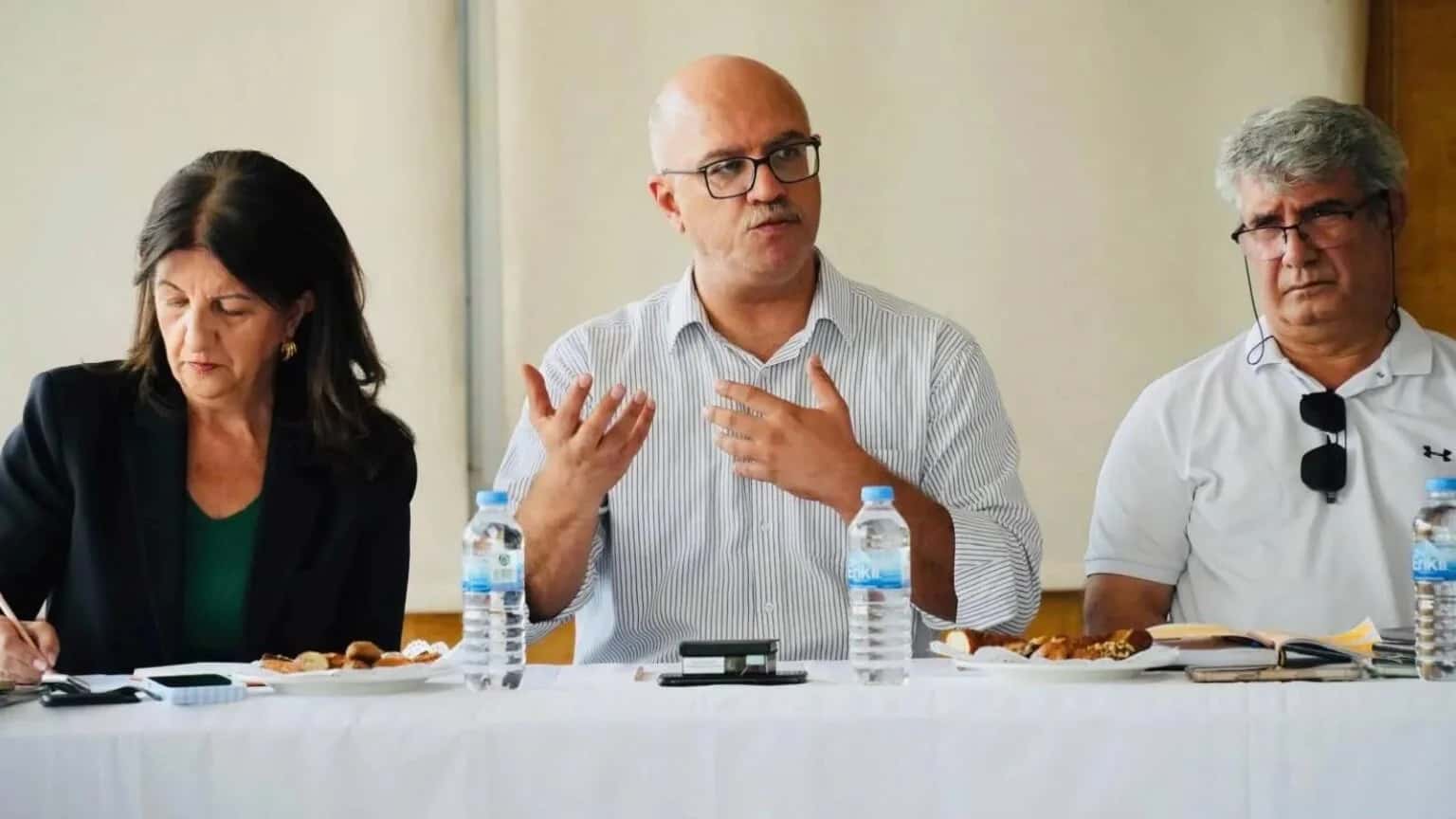
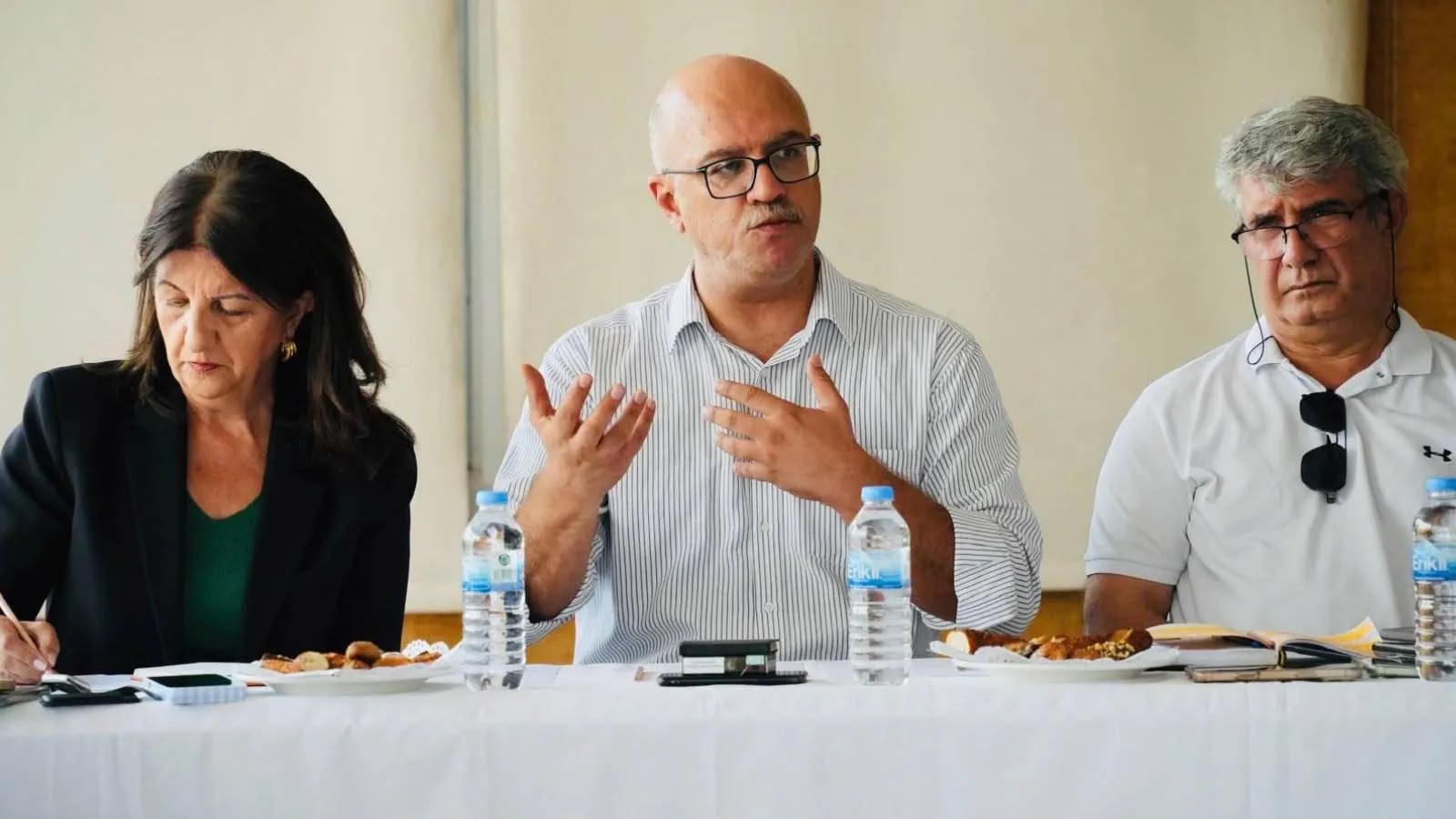
DEM Party lawmaker and İmralı Delegation member Pervin Buldan, İmralı Delegation member and Öcalan's lawyer Faik Özgür Erol, and Veysi Aktaş — who spent ten years and four months alongside Öcalan in İmralı Prison and was released in July 2025 after 31 years behind bars — met with reporters in Istanbul's Taksim Square.
Pervin Buldan described the subcommittee Öcalan will chair:
"Two boards will be set up: a senior board and a subcommittee beneath it. The senior board is already settled. It will be chaired by Vice President Cevdet Yılmaz and include the justice, interior, foreign and defense ministers, along with MİT (Turkey's National Intelligence Organization) chief İbrahim Kalın.
A subcommittee will be established under it. There will be no civilians on that subcommittee.
But Mr. Öcalan will head that board.
He'll head what we call the Disarmament and Politicization Board. It will likely include state officials — a board made up of officials versed in verification and monitoring. The coordination of returns will be managed from here.
We have a separate request. We'll keep pushing for a civilian board to be formed. There also appears to be a need for a women's board and one made up of civil society organizations.
For now, only the senior board's meeting date is set — Monday, August 24.
That board can set the subcommittee's meeting date at its first session."
"A parliamentary monitoring board could be set up immediately, with representatives from every party"
A monitoring board will be set up in parliament. Like the commission already formed, it will be made up solely of lawmakers — one or two from each party. Parliament is currently in recess, but Speaker Numan Kurtulmuş can oversee this process and establish the monitoring board; we know preparations for that are already underway.
There's a great need for this. Mr. Öcalan has said so himself. Including every party matters for transparency — each party's member can brief their own party on the process. Every party should provide a member to this monitoring board. We expect that even parties that didn't send a member to the commission will send one to this board.
I criticize Yeni Parti's stance when it voted on the recent law. This issue is no longer just a Kurdish matter, or just a DEM Party matter. It's a Turkish matter. I believe all 86 million people need to be part of it, because it concerns every one of us closely. So I think it's problematic for parties to approach this process through their own interests, their own futures, a calculation of votes. Within Yeni Parti, we respect those who voted yes and those who voted no alike. But this concerns all of us, which is why we find that wrong. Opposing this process doesn't mean opposing peace. There was an interview recently — the same people who once criticized why are you fighting are now asking why are you making peace. Yet this is a matter for all of us."
"We weren't given the bill until the last moment — we were told it 'wasn't ready yet'"
"We honestly don't know why we weren't given the bill until the last day. We pressed hard to see it. Their explanation was that it wasn't ready yet — that work on it was still ongoing, and once it was finished they'd share it with us. That was their reasoning right up to the final day. We got it on the last day. We formed a board, made our proposals, held talks and made changes to it."
"Bahçeli started the process — there was nothing before it"
"The process began with Bahçeli shaking hands with our co-chairs and the calls he made within his parliamentary group. We all witnessed that. There was nothing before it. We had no knowledge of it, no contact."
"Chairman Selahattin's release will come after the verification and monitoring process advances"
"We raised the enforcement of the ECHR and Constitutional Court rulings again in our last meeting with the president. He listened but offered no comment — that's generally his style, he listens. He has a delegation with him. At the end of the meeting, after we state our views, he gives the floor to his own delegation. The president then gives a brief assessment at the close. But they don't go into this issue in much depth. Here's my own reading: we expect the Constitutional Court and ECHR rulings to come onto the agenda once the verification and monitoring process advances. From the statements of state officials, we understand that the release of Chairman Selahattin, Chairwoman Figen and political prisoners will come after that process moves forward."
"Journalists will go to İmralı, but we have no timetable for it yet"
"We're working to make it possible both for a delegation including our co-chairs to travel to İmralı Island and for journalists to meet with Mr. Öcalan. Yes, the press — journalists — will go, but we have no timetable for it. We don't yet know who will go either. But work on this is underway, and we're continuing talks to make it happen as soon as possible. It isn't only the press — academics, women's organizations and civil society groups have also expressed strong interest in visiting İmralı, and we'll work on arranging that too. Whenever we raised these requests before, we were always pointed to the bill: 'Once the law passes, we'll arrange these visits.' Now the law has passed, so there's no obstacle left in our way."
Veysi Aktaş: "Before the process began, Öcalan was moved to a different cell"
Veysi Aktaş also answered the question, "Did the process begin with Devlet Bahçeli's speech in October 2024, or was there groundwork beforehand?"
"The process began with Devlet Bahçeli's statement. Before that, there was no meeting at all on İmralı. Contact with the state was established after that statement. There was no meeting beforehand. Some people say there was — no, there wasn't. There definitely wasn't. Maybe one day this will be written down. But there was no meeting at all. On the contrary, we lived through a very harsh isolation for ten years. Just as there was a war process here, there was isolation there. So the process definitely developed out of Bahçeli's call.
When you heard Bahçeli's call on İmralı, what did you discuss among yourselves?
"The Chairman was waiting for it. He was waiting for an initiative to develop within the state. He even said it had been delayed. 'This initiative should actually have started in 2023,' he said. That would have been correct.
There was in fact a faction within the state that wanted to launch this initiative. For example, in 2023 Mr. Öcalan's location was changed. His cell was changed. He was moved from one place to another. At the time, he said, 'Mandela's location was changed first too. Is a process like that starting? Is something like that beginning?' He later found out it was true. A faction within the state had wanted to launch such talks. But it was blocked — by what we describe as forces outside the norm."
"The Kurds must recognize the state, and the state must recognize the Kurds"
"The Kurds have been pushed outside the law. They have been pushed outside the state as well. This process is one of bringing the Kurds inside the law and inside the state. This process needs to be completed, including its constitutional stage. Both sides must recognize each other. That is, the Kurds must recognize the state, and the state must recognize the Kurds. That is how democratic integration happens."
"Israel needed a Kurdistan in the Middle East to sustain its existence. Öcalan rejected this"
"Resolving the Kurdish issue isn't something Turkey can achieve alone, either. I say alone because no problem in the Middle East has just one actor. No single capital directs the problems of the Middle East.
Israel can't do it alone. Britain doesn't do it alone. Ankara can't direct it alone either. In that sense, the Kurdish issue is not just a matter of Turkey's domestic politics. It is a regional issue, even a global one.
Unfortunately, it has come to this point. If Turkey fails to resolve this problem, other powers will step in, and political developments in the region have played a direct role in starting this process. The Leadership put it this way. He defined it as the theory of proto-Israel and post-Israel. It was a very important theory. Why did the state reach this point? It didn't come to this point entirely of its own will. The Israel factor is an important factor.
Öcalan theorizes this as proto-Israel and post-Israel.
The first stage was proto-Israel.
For Israel to be accepted and established in the Middle East, the Republic of Turkey was needed.
But that need no longer exists today. The main actor was Britain, the British. And in building their own system, the British needed a 'wounded Kurd.' This is a saying of Churchill's. In other words, if you want to govern the Middle East, you keep the Kurds wounded. You neither let them live nor kill them. You keep them wounded.
The Kurds became a subject in their own right and broke up this system.
Post-Israel is this: today, for Israel to sustain its existence, it needs a Kurdistan in the Middle East — it needs a second Israel.
The PKK did not accept this. Öcalan rejected it.
In other words, it needs a nationalist nation-state. This is not accepted. This needs to be understood.
This is exactly what the Leadership has always opposed. He opposes every form of nationalism. This was in fact one of the reasons this process developed."
Will Mazlum Abdi and İlhan Amed of the SDF come to Turkey to meet Öcalan on İmralı?
"There is such a request from both sides. It's already known. Conditions will change. Mr. Öcalan will move to his new location. He will be able to meet with whoever he wants, as much as he wants. I think Mazlum Abdi's visit is somewhat tied to developments in Turkey — that is, to this process. If the process advances, his visit becomes easier. If it evolves in a positive direction, his visit becomes easier."
Faik Özgür Erol: "Within the rules, Öcalan's role is to fulfill the commitment dimension"
Öcalan's lawyer Faik Özgür Erol also gave information about the Disarmament and Politicization Board:
"Under the law, the Executive Board has the authority to make administrative, judicial and legal arrangements. There is no exception within the scope of the law. The law permits this.
There are three legs to the boards.
"The Executive Board — we call it the Peace and Politicization Board, but they may also define it as the Disarmament and Politicization Board. And there will also be Parliament's Monitoring Commission, making three boards in all. They are three boards that will work in coordination and complement one another.
Within these rules, let me say plainly, without dragging it out — Mr. Öcalan's first role within these boards is to fulfill the commitment dimension of the process of disarming those who come in and the organization as a whole.
In other words, the dimension of this work directed at the state is taking on responsibility for the commitment. That is Öcalan's dimension.
The dimension of this work directed at its own structure and organization, meanwhile, is managing this process of coming in. One side is commitment, the other is managing this process.
Of course, after this process is managed, it must also carry content covering the other legal arrangements that will proceed in parallel with it.
The boards may establish various structures in the Kurdistan region. We cannot know what those will be right now."
"Trust produces assurance, assurance produces trust"
"The country was already dragged toward authoritarianism because of this problem. We're missing this point. We need to correctly analyze the process after 2015. This is our 100-year-old gangrene.
Yes, this country can become more democratic through this issue. The chance of opening the door to law and democracy does not shrink when armed violence disappears — it grows.
Is there a guarantee of this? If no step is taken, what will Kurdish politics do? Kurdish politics will not wrap up and go home. What Mr. Öcalan says is this: I have been at the same point for 30 years. An end to armed struggle, continuation of political struggle. So the political struggle will continue. The armed struggle is ending.
In the progress of the process, we are trying to establish the equation of trust and assurance. This is what we've been trying to do for two years. Trust produces assurance, assurance produces trust.
We know this very well. Even if you draft the most ideal law imaginable, under this country's conditions, if there is no political and administrative decision and will, that law is void. That law has no effect whatsoever. It can easily be circumvented. That is why Mr. Öcalan defined this process as a gentlemen's agreement. What matters is not this law but the gentlemen's agreement. This is an agreement based on trust. Not everything in an agreement is put in writing. It rests essentially on the parties' trust in one another and on gentlemanly conduct. This is the main track on which this process can move forward.
"The role Bahçeli played has to do with this process being a decision and project of the state"
"We are very well aware that this process developed alongside undemocratic practices. Before March 19, the actual date planned for the February 27 call was February 15 — that call was going to be made, and on that very day a trustee was appointed to Van Municipality. At the time, we debated seriously whether to continue. Did that stop us? It did not. Because today's process is not disconnected from the process of 2015.
In 2006, 2008, 2015, that table was always there. What mattered was finding the right interlocutor. As of today, that is the strong possibility. The role Bahçeli played is not only about the nationalist segment. It has directly to do with this process being a decision and project of the state. The government and Mr. Bahçeli himself have stated this too. What matters here is the state acting as interlocutor."
"On the KYK issue too, this law will become a reference law"
"Our priority is a reference law that will eliminate negative regulations. The trustee issue, for example. The KYK issue, for example. Returning to public service those dismissed from public institutions over PKK/KCK links. From the Academics for Peace to teachers to prosecutors. This law will become the reference law for that."
"There are few examples of a peace process getting this little intellectual support"
"We all suffer from this, and years from now we'll talk about it. I have seen few examples anywhere in the world where an effort to end a war that caused such heavy suffering met with so little intellectual support. That, too, is not a picture we should be proud of."
Source: Serbestiyet