
Fidan on Mecca Agreement: 'Any country that doesn't attack us isn't our target'
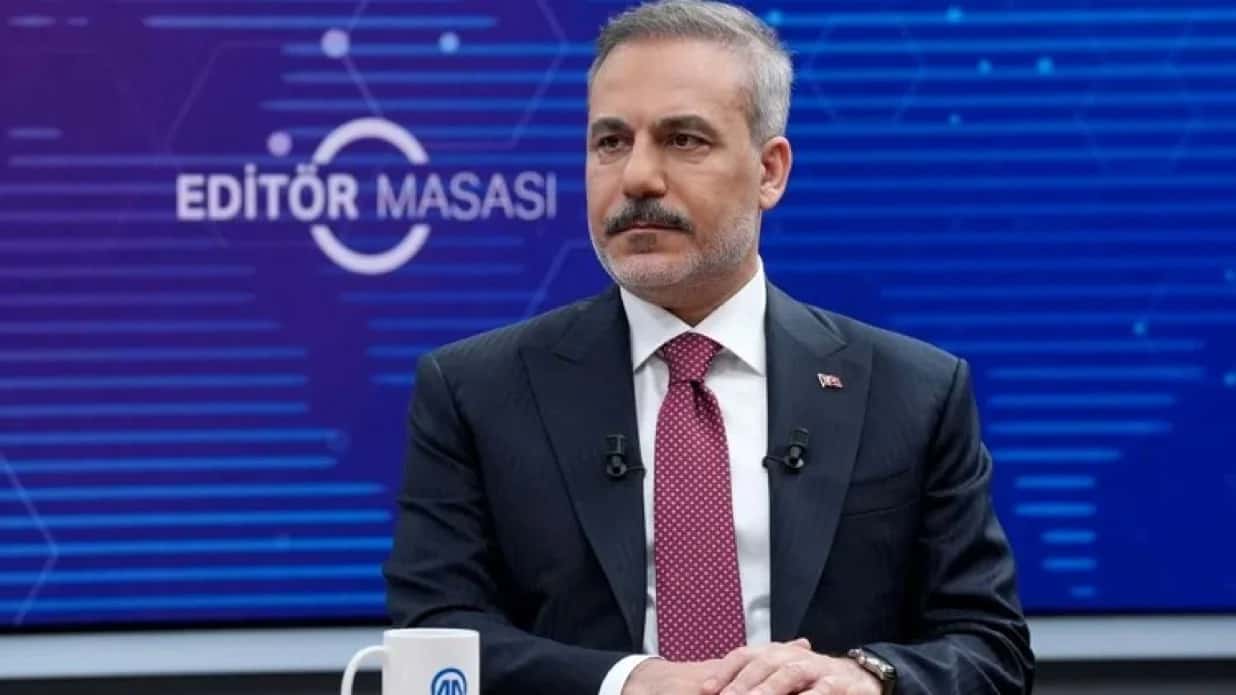
RastinewsTurkish Foreign Minister Hakan Fidan discussed foreign policy issues in a television appearance.
Speaking about the Mecca Agreement, Fidan said: "Our foreign policy, carried out under the leadership of our President, rests on certain cornerstones. We have just witnessed the realization of one of them." He noted that the agreement had been in preparation for two years.
Fidan said the Mecca Agreement is technically equivalent to Article 5 of the NATO treaty on collective defense. Of the countries signing the pact, he said: "Any country that doesn't attack us isn't our target."
Highlights from Minister Fidan's remarks:
"Our foreign policy, carried out under the leadership of our President, rests on certain cornerstones. We have just witnessed the realization of one of them.
Strengthening regional ownership matters. Outside hegemons don't solve problems — they make them more acute. There is a will to end regional instability, to halt it, and to advance the welfare of the region's peoples through greater integration. This agreement has been two years in the making.
"On Iran, too, Turkey can serve as mediator whenever the parties need one"
Asked whether the agreement would affect talks with Iran, Fidan continued:
"Russia has an allergy to NATO and is at war with Ukraine. But Turkey is able to mediate. On Iran, too, Turkey can serve as mediator in the best possible way whenever the parties need one. No war in the region keeps you safe from harm. Saudi Arabia and Iran have had problems, but relations between them haven't broken down. The rift with the US came because of Israel. There have been periods when we discussed these matters with the Iranians as well. The Iranians are no strangers to this issue."
"Technically identical to NATO's Article 5"
Asked about NATO's Article 5, Minister Fidan said:
It is technically identical to Article 5 of the North Atlantic Treaty on collective defense. We haven't put a shared threat in writing. What we are guaranteeing now is that we will look after each other's security more closely.
What is Article 5?
Article 5 of the North Atlantic Treaty, the alliance's principle of collective defense under which an attack on one member is treated as an attack on all, reads as follows:
"The Parties agree that an armed attack against one or more of them in Europe or North America shall be considered an attack against them all and consequently they agree that, if such an armed attack occurs, each of them, in exercise of the right of individual or collective self-defense recognized by Article 51 of the Charter of the United Nations, will assist the Party or Parties so attacked by taking forthwith, individually and in concert with the other Parties, such action as it deems necessary, including the use of armed force, to restore and maintain the security of the North Atlantic area.
"Any such armed attack and all measures taken as a result thereof shall immediately be reported to the Security Council."
There is a will to end regional instability, to halt it, and to advance the welfare of the region's peoples through greater integration. This agreement has been two years in the making.
"Any country that doesn't attack us isn't our target"
The countries signing this alliance are pledging not to threaten one another's security. We are now in solidarity internally, not against any outside actor. Any country that doesn't attack us isn't our target.
As long as it isn't attacked, whether from within or outside the region, this alliance has no quarrel with any country. We will not, under any circumstances, keep different geographies and different priorities in conflict with one another.
Saudi Arabia, Pakistan and Turkey are not expansionist countries. Yesterday, the topic leaders discussed most was cooperation in the defense industry. If necessary, we can bring every country in the region under this umbrella.
"The secretariat will be headquartered in Saudi Arabia"
We will of course draw lessons from our experience with NATO. The secretariat will be headquartered in Saudi Arabia. There will be joint exercises. It is currently being referred to as the Mecca Alliance.
"The top priority is reopening the Strait of Hormuz"
Commenting on the US-Iran war, Minister Fidan said:
"Right now the top priority everyone is working on is reaching an arrangement — even a temporary one, being described as 60 days — that reopens the strait. Countries in the region, the United States, the West, Europe, Asia are all demanding that the strait be reopened as soon as possible. There is major pressure on this."
"What Israel fears most is international isolation"
Saying peace must be secured in Gaza, Minister Fidan said:
"Hamas's approach of putting the Palestinian people first is commendable; the Palestinian people will certainly reward this. Israel hesitated over the second phase. There isn't a single voice left willing to back Israel. This will continue as long as Israel's core aim is to Palestinianize Gaza out of Gaza. What Israel fears most is international isolation."
"The framework law is very well written, with strong safeguarding provisions"
Speaking about the framework law passed by parliament's Justice Committee, Minister Fidan said:
"The framework law is very well written, with strong safeguarding provisions. The organization will not be able to benefit from what this law provides unless it lays down its own weapons. They can see that the regional and global conjuncture is no longer very much in their favor. God willing, this time they will take the hand extended to them."
"For us, the real solution is a two-state settlement"
Turning to Cyprus, Minister Fidan continued:
"For us, the real solution is the realization of a two-state settlement — that is the ideal outcome. That is where we stand. When solution proposals come in, we look at who they come from. When they come from the UN, we look at them. We support dialogue that includes Turkish Cypriots. We don't need to wait for permanent solutions to secure certain interests. Both the north and the south of the island need water and energy. The geographic positions of the parties are now well established. Turkish Cypriots' means are more limited. We do not recognize the Greek Cypriot side as a state. If you don't recognize the rights of Turkish Cypriots, I won't recognize your existence as a state either. You are not the state that was founded in 1960. That, in turn, brings certain disadvantages for the Greek Cypriot side as well. Cooperation on energy is possible, cooperation on water is possible, and everyone can come out ahead. The status quo has stayed the same for 50 years; stability and peace on the island exist for one reason alone — the presence of Turkish troops on the island. As long as both sides refuse to consent to a lasting agreement, you cannot expect the presence of Turkish troops to change. The current status quo does not allow for change."
Source: T24