
Bakırhan sets timeline for peace process: late September or October
DEM Party Co-Chair Tuncer Bakırhan says he expects the official steps for PKK members' return to Turkey to be completed by late September or October.
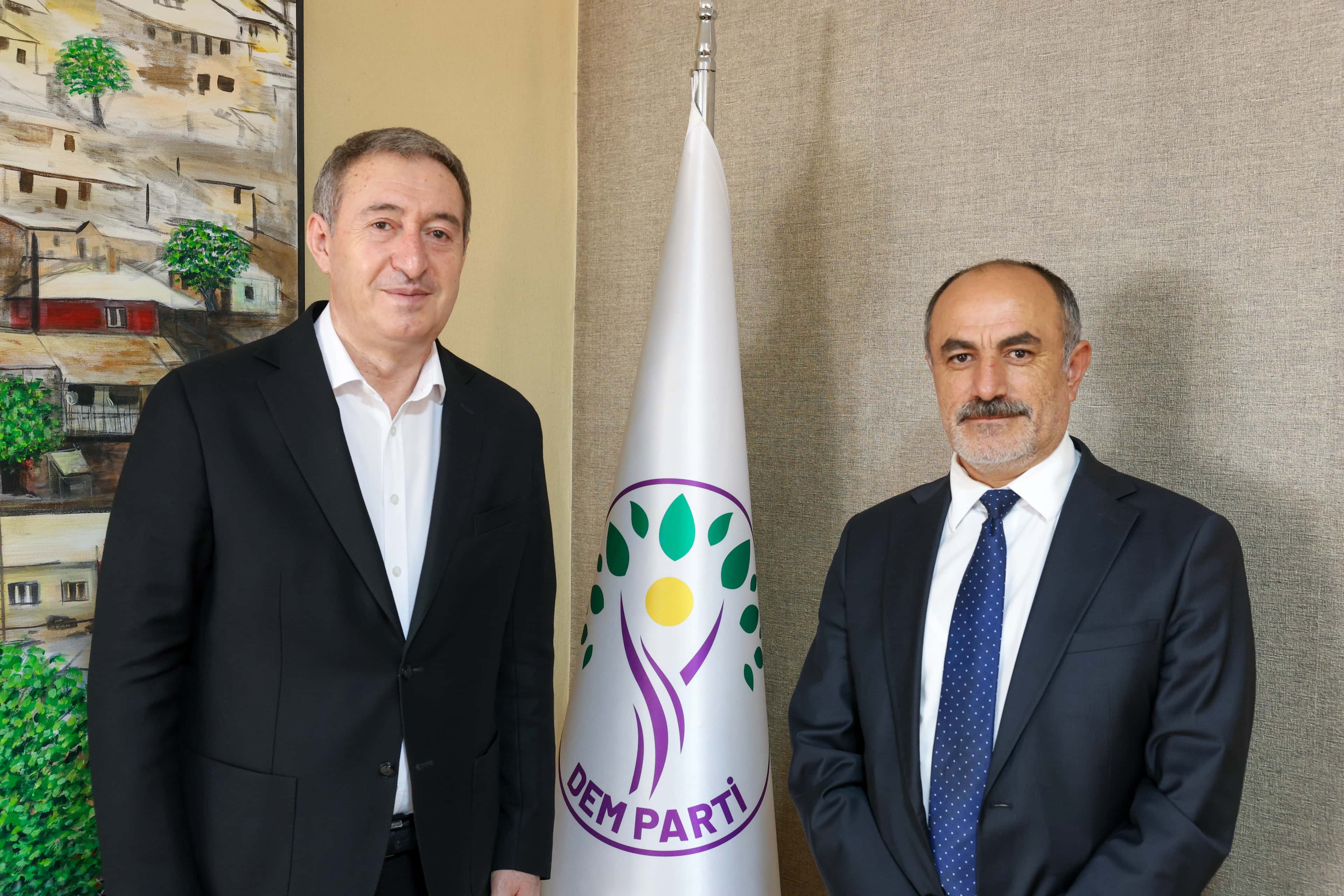
RastinewsDEM Party Co-Chair Tuncer Bakırhan said he expects the official steps for PKK members' return to Turkey to be completed by late September or October. Calling for the swift formation of the Peace and Political Integration Commission, in which Öcalan is expected to play an active role, Bakırhan said, "Once this commission is formed, we can say that arrivals from both the mountains and Europe could begin."
DEM Party Co-Chair Tuncer Bakırhan spoke to Rûdaw about a wide range of topics — from the necessary legal steps and timeline expected under Turkey's ongoing peace process for PKK members' return, and Abdullah Öcalan's role, to the impact of the Iran war on the region, unity between Rojava and the Kurds, the role of the Kurdistan Region, and DEM Party's congress process.
Answering questions from Rûdaw's Ankara bureau chief Şevket Herki, Bakırhan said that regarding the timeline set for PKK members' return to Turkey, they expect the official steps to be completed by late September or October.
Bakırhan said Abdullah Öcalan needed to be actively involved for the process to move forward soundly, calling for the swift formation of the Peace and Political Integration Commission.
"Popularizing peace cannot be our job alone"
Bakırhan said that rather than new legislation, some existing practices needed to be implemented for the process to advance.
Bakırhan said dismissed mayors could be reinstated in place of government-appointed trustees, that the language used in the media needed to change, and that rulings by the European Court of Human Rights (ECtHR) needed to be implemented. "Popularizing peace cannot be our job alone; we can't reach every corner. The state also needs to persuade people, reach out, and talk to them," he said.
"Both the Kurds' demand for freedom and the Turks' security concerns matter"
Bakırhan stressed that the concerns of different segments of society needed to be taken into account during the process, saying the Kurds' demand for freedom and Turkish society's security concerns needed to be addressed together.
Bakırhan said, "Both the Kurds' demand for freedom and the Turks' security concerns are important items on this process's agenda. Without taking both seriously, this won't work."
Kürdistan Bölgesi'nin rolü
Bakırhan, Kürdistan Bölgesi Hükümeti'nin PKK'lilerindönüş sürecinde önemli bir rol üstlenmesi gerektiğinibelirtti.
Bakırhan, sürecin hukuki, idari, lojistik ve insaniboyutlarının Erbil, Süleymaniye ve Ankara'yıilgilendirdiğini söyledi.
"Suriye'de Kürtlerin hakları Türkiye tarafından dadesteklenmeli"
Rojava ve Suriye'deki gelişmelere de değinen Bakırhan,Suriye hükümeti ile Kürtler arasındaki diyaloğundesteklenmesi gerektiğini belirtti.
Bakırhan, "Müzakere ve diyalogdan hem Şam kazançlıhem Kürtler kazançlı çıkar" dedi.
Öcalan'ın Kürdistan Bölgesi ve İran için dört başlığı
Bakırhan, Öcalan'ın DEM Parti heyetiylegörüşmelerinde Kürdistan Bölgesi'ne ilişkin aktardığıgörüşleri dört başlıkta topladı.
Buna göre Öcalan'ın mesajları; Erbil ve Süleymaniyearasındaki parçalı yapının sona ermesi, KürdistanBölgesi'ndeki tüm siyasi güçlerin kurulacak bölgeselhükümette söz sahibi olması, İran'ın KürdistanBölgesi'ne yönelik saldırılarını ve idamları durdurmasıve İran'ın Kürtlerin haklarını tanıması olarak sıralandı.
DEM Parti kongresi 6 Eylül'de
DEM Parti'nin 6 Eylül'de gerçekleştireceği kongreyeilişkin de konuşan Bakırhan, kongrenin yeni dönemeuygun kadro ve yapının ortaya çıkarılması açısındanönemli olduğunu söyledi.
Çerçeve yasanın uygulanmasıyla birlikte SelahattinDemirtaş, Figen Yüksekdağ ve çok sayıda siyasetçininyeniden siyasi hayata katılacağını belirten Bakırhan,sürgünden dönecek isimler ve farklı mücadelealanlarından kişilerin de sürece dahil olacağını ifadeetti.
DEM Parti Eş Genel Başkanı Tuncer Bakırhan'ın RûdawAnkara Temsilcisi Şevket Herki'ye verdiği özelröportajın tamamı şöyle:
ENGLISH:The role of the Kurdistan Region
Bakırhan said the Kurdistan Regional Government should take on an important role in the return process for PKK members.
He said the legal, administrative, logistical and humanitarian dimensions of the process concern Erbil, Sulaymaniyah and Ankara.
"Turkey should also support Kurdish rights in Syria"
Turning to developments in Rojava and Syria, Bakırhan said dialogue between the Syrian government and the Kurds should be supported.
"Both Damascus and the Kurds gain from negotiation and dialogue," Bakırhan said.
Öcalan's four points on the Kurdistan Region and Iran
Bakırhan grouped into four points the views Öcalan conveyed on the Kurdistan Region during his meetings with the DEM Party delegation.
According to this, Öcalan's messages were: ending the fragmented structure between Erbil and Sulaymaniyah; giving all political forces in the Kurdistan Region a say in the regional government to be formed; Iran halting its attacks on the Kurdistan Region and its executions; and Iran recognizing the rights of Kurds.
DEM Party congress on September 6
Speaking about the congress the DEM Party will hold on September 6, Bakırhan said it is important for producing a staff and structure suited to the new period.
Bakırhan said that with the implementation of the framework law, Selahattin Demirtaş, Figen Yüksekdağ and many other politicians will return to political life, adding that figures returning from exile and people from different fields of struggle will also join the process.
The full interview DEM Party Co-Chair Tuncer Bakırhan gave to Rûdaw's Ankara Representative Şevket Herki follows:
Rudaw: What timeline is envisioned for implementing the law drafted as part of the process to resolve Turkey's Kurdish issue? One of the questions the public is most curious about is the return of PKK members; if the process moves forward this way, when might the first returns begin?
Tuncer Bakırhan: The process is now moving forward within an official framework. The decision was published in the Official Gazette, and the commission envisioned under the law was formed under the chairmanship of the Vice President. Now there is one more important stage: the National Security Council's "confirmation-determination" decision. The moment that decision is published in the Official Gazette, the law will fully enter into force.
It would not be right to give a firm date for the returns at this stage. It is difficult to lay out the timeline of such a sensitive process day by day. But all the signs indicate that these official stages will be completed, and the law will take effect, by the end of September or in October. The answer to the question everyone wants to know — "when will the first returns begin" — depends on this timeline.
I want to underline one point here in particular. For this process to run smoothly, and for the returns to be safe and orderly, it is essential that Öcalan be actively involved. We are not the only ones saying this. Leaders of the now-dissolved PKK keep repeating the same point: they say they cannot call on any of their comrades to "lay down arms and return" without Öcalan's involvement. Anyone familiar with the bond between the PKK and Öcalan knows this is not said just for the sake of saying it.
The problem is this: Mr. Öcalan is currently trying to play this role under extremely limited conditions. Our proposal on this is clear: the Peace and Politicization Board, through which Mr. Öcalan could play his role, should be established as soon as possible. This is the way for Mr. Öcalan to be genuinely involved. We can say with confidence that from the moment this board is formed, arrivals could begin from both the mountains and Europe.
Rûdaw: What steps need to be taken so that the process is not limited to political statements alone and produces concrete results? Do you find the steps the government has taken so far sufficient? Can we say that sufficient legal grounds have been established, particularly for PKK members planned to return? Is there a need for new legal regulations?
Tuncer Bakırhan: First of all, it must be said that statements are understandable up to a point. But we also know this: statements are like bread. It holds up while fresh, but if left too long its structure deteriorates and no one eats it. I think we have partly moved past the stage of statements. The law adopted in parliament by a large majority is very important in this respect. I now find it valuable in terms of moving from intention to practice.
Most of the concrete steps to be taken fall under the political, legal, social and psychological spheres, and for a significant portion of them, not even a single comma needs to be written. For instance, trustees could be handed back. The media's language could change. ECHR rulings could be implemented; a ruling left on the shelf is not a ruling, it is a postponed injustice, and hundreds of our friends' names sit on that shelf. Likewise, socializing peace cannot be our job alone; our hand cannot reach every corner, the state also needs to persuade, to go out, to talk. If these things are done, be certain the process will gain more momentum.
There is a legal status defined for those who will return, and the state has its preparations; our preparations lie more on the political-social ground. But law on paper is like learning to swim from a book. Can one learn to swim without entering the water? Whether a bridge holds is understood not by looking at its blueprint, but when the first convoy crosses it. Once the implementation phase begins, most of today's uncertainties will disperse on their own; what remains will be discussed at the table. What I mean is, once people start returning, we will see more clearly which provision is working and where the breakdowns are. Some articles will change where needed, some gaps will be closed with new regulations.
Again, within the scope of your question, of course new regulations will be needed under any circumstance. As the process moves forward, needs will show themselves and will be addressed over time. What matters is moving forward; I mean moving forward in good faith and knowing that this is truly for the good of the country. The rest will follow.
Rudaw: How do you assess the approach of the New Party and especially the CHP in the framework law talks? Do you think the opposition appears to have sufficiently owned this process?
Tuncer Bakırhan: Most of the opposition supportsthe process and the law. This provides importantground for requirements such as passinglegal regulations with broad consensus andbuilding social support for peace. The CHP'sdecision to co-sign the bill and to back itwith a large yes vote in the generalassembly is valuable. Yeni Parti'ssupport for the bill at the party chair level is also an importantshow of backing worth noting. But both thenumber of no votes from Yeni Parti MPs and theway they justified voting no point to a lackof political sense. Voting no on thegrounds of the province one represents is unfair both tothat province and to the country. Anyone lookingfor a single province or street in Turkey thatopposes peace, that rejects the call of "letno one die", will not find one. Despite thisnegative picture, Yeni Parti's central stance andits contribution of a yes vote for the lawis hopeful for the future. But as long as theline Özgür Özel defends does not acquire institutionaland political coherence, there will be swings. Anopposition party split down the middle on thesolution to Turkey's core issue has, in myview, also damaged its claim to be fit togovern the country in the first place.
Rudaw: Looking at the nextyear, what do you see as the mostcritical threshold for the process tosucceed? What basic responsibilities fall on thegovernment, the opposition and the DEM Partito keep the process from failing?
Tuncer Bakırhan: The most critical threshold of this process is managing social psychology correctly. Turkey has a painful history of more than forty years on this issue; that history has left deep scars on both sides of the country. Today there are still families of soldiers who lost their children, as well as families whose children died in the mountains, or who are waiting for children in the mountains, in prison, or in exile.
In this country, no one has the luxury of dismissing the other's concern. The Kurds' demand for freedom and the Turks' security concern are both important items on this process's agenda. This will not work without taking both seriously. This is not just the job of politicians. I'm talking about a broad area of responsibility, from the language used by the media to the word choices of columnists, from the tone of debate on social media to the debates in parliament. This responsibility belongs to all of us.
Beyond that, we need to do three things over the next year. Take the steps required by law fully and on time. Make the channels of dialogue and negotiation between the parties genuinely functional. And most importantly, arrange the working and communication conditions in which Mr. Öcalan will personally be involved. I explained this in detail in the previous question.
This process has its own stages. Everyone needs to approach these stages and this reality with patience and responsibility appropriate to them.
Rûdaw: What are these responsibilities?
Tuncer Bakırhan: I can summarize the responsibilities as follows: It falls to the government to create the political climate that will make peace permanent, and to take the steps that fall to it on time. It falls to the opposition to stop treating peace and democracy as preconditions for one another; these should be seen not as two headings waiting on each other, but as two main headings that feed each other.
But what I really need to talk about is the responsibility that falls to the DEM Party. We too must now act with a constructive mind, not an activist language. We must stop being a party that only demands and waits, and become a subject that organizes and champions the democratic demands needed to solve the Kurdish issue.
I especially want to underline one point here. Our concern is not a position that says "we want this, we want that" and thereby ceases to be a subject. As democratic demands are organized, their legal counterpart emerges in one way or another. Matters like local governments gaining a democratic character, and the right to education and organization in one's mother tongue, do not fall from the sky; these are matters of struggle and construction. On this front, a great deal of the task falls to us.
Rûdaw: The Kurdistan Regional Government's role in the process has often been emphasized. What are the expectations from the Kurdistan Region in the coming stages? At one point, scenarios also emerged in public discourse suggesting that PKK members who laid down arms would settle in this region. What is your assessment of this?
Tuncer Bakırhan: The Kurdistan Regional Government's role is not secondary, it is very important. We stress this often. Because the Kurdistan Region also occupies such a position in terms of its geographic location, historical ties, political channels and capacities on the ground.
I can say this: there is agreement that the Regional Government should both be included in the process and take on a facilitating role so that mechanisms function during the return. This will have legal, administrative, logistical and humanitarian dimensions. All these dimensions concern Erbil, Sulaymaniyah and Ankara simultaneously.
As for the scenarios: the public does not like a vacuum, and if there is one, it fills it with a story. We too read narratives like "they will settle here, they will be sent there." This is precisely where I want to make a point in light of experiences with conflict and resolution: the details are technical, the mechanisms are defined, but politics has to rise above the noise. That is why I favor waiting for implementation. As implementation begins, many issues that seem unclear today will also become concrete.
Rûdaw: The future of Rojava and the talks with the Damascus administration are among the most important issues on the Kurdish agenda. What kind of status do you think Kurds should have in Syria's new structuring? As a reflection of the current process in Turkey, do you expect a change in Turkey's Rojava policy?
Tuncer Bakırhan: Syria's future can bewon through a democraticregime. Building a democratic Syriadepends on recognizing andguaranteeing the rights of all peoplesand faiths in Syria, Kurds included. Thisdoes not dissolve the Kurds; it strengthens theirpolitical agency. Let us say it plainly:the rights the Kurdish people gain takenothing away from the rights of otherpeoples. On the contrary, a greaterbreadth of rights benefits everyone. The region'scountries should read this fact the same way. It is the Kurds living in Syria and their own dynamics who will decide what structure and form Kurds take in Syria. On a matter of principle, we are not in a position to dictate how the Kurdish people or any other people should live. But we must stress this: Turkey too should support Kurds winning their rights in Syria.
Rudaw: The war in Iran and the developmentsin the region are reshaping the balance of power in the Middle East. What are the biggest risks this war and a possible regional spillover could pose for Kurds? What policy should be pursued so Kurds do not once again end up caught in the middle of regional conflicts?
Tuncer Bakırhan: The war in Iran andthe developments in the regionare overturning the balance in theMiddle East. If this war turns into aregional conflict and you ask who wouldbe hit hardest, my answer is clear:nearly every area where Kurds live, startingwith Iran, Iraq and Syria, falls atrisk. We have already seen this since thewar's first days. The Iranian regime andthe forces tied to it have targeted KurdistanRegional Government territory, sometimes directlyand sometimes through Iran-aligned groups in Iraq.Despite all this, Kurds insist they will notbe part of a regional war and will notserve as a battering ram for any power.
So what will Kurds do if attacks continue dayafter day? They will not wait quietlylike sacrificial lambs. Let me be clear:like anyone under attack, Kurds have the rightto defend themselves, and no Kurdish forcewould hesitate on that. But Kurds have neverfallen for other powers' games; they have builttheir stance on dialogue and negotiation, andthey continue on that line. I think Iranshould take Syria as an example. For allits shortcomings, Damascus now has a governmentthat has chosen dialogue with the Kurds.In Syria, Kurds are trying to resolve issues withthe central government through talks. Whichwould be more stable: a Damascus at war withthe Kurds, or a Damascus trying to resolveits problems through negotiation? The answer isobvious. Negotiation and dialogue benefit both Damascusand the Kurds.
In Iraq too, tensions flare from time totime, but Baghdad and Erbil recognize each otherand maintain dialogue. That is the right approach.
Iran, meanwhile, is still trying to silence and eliminate Kurds through repression and executions. It must abandon this stance immediately. Iran should recognize the democratic rights of different peoples and faiths, Kurds above all, living within its own borders. That is the best path forward. If it continues with executions and attacks, it will suffer a major rupture of its own. Kurds, too, will not hold back from defending themselves. That would not be a choice Kurds make themselves, but a forced outcome imposed on them. What the region needs is not a new war, but a lasting peace and a foundation for dialogue.
Rûdaw: Looking at relations among Kurds and the debate on national unity, how do you assess the current divisions between Kurdish political movements and different political structures? What steps do you think need to be taken for Kurds to converge further around a common national perspective?
Tuncer Bakırhan: The debate on national unity among Kurds never ended, but it was mostly treated as an agenda item rather than as a historical consciousness. The debate on national unity among Kurds is not new; it has been a pursuit that has grown stronger at times and receded at others for many years. Yet national unity carries separate meanings at the level of mindset, at the level of politics, and at the historical level. Let me say it plainly: I don't believe its importance has been fully understood.
National unity is not merely a feeling. It is not enough for siblings sharing the same house to love one another; if they have not agreed on who opens the door, who pays the bills, or who speaks when a guest arrives, that house is in disarray. The late establishment of a common language among Kurds is one of the real tragedies in our history. Each time, everyone has been right, but no one has won. Kurdish politics must now look not only at today's problems, but at how the next fifty years will be built.
I want to issue a clear call here. One of the first steps toward the national unity the Kurdish people long for is for the KDP and the PUK to show a strong will to cooperate. Why can two major political forces, with years of experience, institutions and social standing, not build a stronger political line on shared issues? Why can they not defend a common future together? Is the dispute between them bigger than a people's future? Isn't it time to produce a new politics? Wouldn't a stronger political ground emerge in the region they are in? The reason attacks on Kurds are easy today is division among Kurds themselves.
This is an open call. Please, take the lead, take the first step. Give Kurds a celebration with this honorable step. The tensions that periodically surface between Erbil and Sulaymaniyah, and the state of division, pain our hearts.
Because the national perspective is now imposing itself. The world is changing, the Middle East is being redesigned; we are in an era where those not seated at the table find their name on the menu. In such periods, petty calculations come at a heavy cost.
We need unity; but more than that, we need to think together. We need common sense, and while doing all this, it is possible to live together without dissolving our differences. National unity is not everyone thinking the same way; it is those who think differently being able to act together on common issues.
Rûdaw: Some circles feel uneasy when they hear "national unity"? How do you interpret this?
Tuncer Bakırhan: Now, I know there may be circles who get alarmed on hearing these words of mine, looking on anxiously and asking "what does he mean." I want to say openly, with all sincerity: the unity we mean here is not a unity built against anyone.
National unity must first be defined. Unity among Kurds does not mean that all Kurds join the same party, the same organization or the same ideological line. On the contrary; it means that while preserving their differences, Kurds display a common stance on basic issues such as their existence, language, rights, gains and future. This right, which is not denied to any people in the world — namely the right to act together — cannot be denied to Kurds either. There is no need to worry about this.
As Kurds living in Turkey, our stance is clear and unchanged: the address where we will resolve our problem is Ankara; we are seeking the solution here, on this soil. We consider every inch of Turkey our own homeland. Political, cultural and economic interaction that will grow stronger with our brothers and sisters beyond the borders is a gain for everyone, at no one's expense. Even today, Turkey benefits most from the Habur border crossing; there are thousands of people from Turkey, from Trabzon to Diyarbakır, working and investing in the territory of the Kurdistan Regional Government. When the Qamishlo-Nusaybin border crossing opens tomorrow, we will all be winners together again: Damascus, Ankara and Qamishlo. Unity and peace among Kurds themselves strengthens stability in the region; and stability in the region directly serves Turkey's security and prosperity. So this matter of unity is not a threat — it is common ground that benefits Turkey too, one where everyone wins.
Rudaw: In this context, did Öcalan share with you any assessment regarding Iran's attacks? Does he have a proposal, a call, specifically directed at the Kurdistan Regional Government in Iraq, which has been the focus of the attacks?
Tuncer Bakırhan: In his meeting with our İmralı delegation, Öcalan made very important assessments that address this question as well. I can summarize Mr. Öcalan's views under four headings. He says:
First; the fragmented state of affairs between Sulaymaniyah and Erbil must end. Problems should be resolved around democratic principles, and a central regional government should emerge.
Second; in this regional government to be formed, all forces and dynamics in the Kurdistan Region should have a voice and a role in politics. Because every fragmented stance leaves the region more exposed to attacks.
Third, Iran must immediately halt its attacks on the territories of the Kurdistan Region, particularly Sulaymaniyah and Erbil, and end executions.
Fourth, Iran must recognize Kurdish rights and adopt a democratic approach. Turkey, too, should play a positive role in this process. If Iran does not change its policy of attacks on Kurds and does not end executions, Kurds will have no choice but to defend themselves in a spirit of national unity. Kurds should of course do this of their own will, without becoming any other power's battering ram. Indeed, the stance Kurdish organizations have shown so far against Iran's attacks has been in this direction. Iran should act with this reality in mind.
Rûdaw: The DEM Party is entering a congress process. What kind of DEM Party do you aim to emerge from the congress? Should we expect a significant change in the party's political line, organization, or approach to Turkish politics? You also said in a statement that Demirtaş would be at the congress — is that a wish, or is there actual planning in that direction?
Tuncer Bakırhan: We will hold a congress on September 6. Starting September 7, we will begin preparing for a major transformation congress. We will renew ourselves and grow stronger as soon as possible — in our program, our language, our politics, and our cadre alike.
The congress on September 6 matters for this reason: it will be a congress that produces a leadership and a new structure suited to the new period. This administration will prepare a strong bid. But let me be clear about one thing: our real goal is not to make the next congress just another party congress. We want to turn it into a congress of the democratic republic movement and expand that movement across all of Turkey.
Rudaw: You called it "the congress of the democratic republic movement." How does that differ from an ordinary party congress?
Tuncer Bakırhan: It falls short to describe this process only in terms of silencing weapons and a few legal steps. This process will change a great deal in Turkey. I think it will bring serious change across a wide field, from the language and dynamics of politics to social life. Whoever reads this change correctly will move forward; whoever gets stuck on day-to-day issues will fall behind. I'm sure many people will rightly point to negative examples from the current moment when I say this. I never treat those as unimportant. We will of course object to them, but fundamentally we must also read correctly the changing reality of the world, the region and Turkey.
We are now entering a period without weapons, without clashes. From now on, our task is not just to resist but to build something. It is to put forward the idea of a new order, a new future. We cannot continue as before; we need a new language and a new path. From now on, whoever is building something, whoever shows the public a real future, will hold the say in politics.
For years they called it a "security matter," narrowed the democratic space, presented repression as legitimate, and kept postponing a solution. Now that pretext is disappearing. Only one path remains: democratic politics and the people's will to resolve it. This gives us a great opportunity, but it also places a great responsibility on us. We are entering a period in which our word, our program and our capacity to solve problems will be tested. We view the Congress through this same lens.
On the other hand, once the framework law is implemented, Demirtaş, Yüksekdağ and thousands of our friends — those who will return from exile and many other friends from various fields of struggle — will join political life. We will continue to fulfill our responsibility to society by walking shoulder to shoulder.