
Bahçeli Widens 'Terror-Free Turkey': Not Just Fighters in the Mountains, Radicalized Networks Too
Nationalist Movement Party (MHP) leader Devlet Bahçeli, outlining the boundaries of the "Terror-Free Turkey" process, signaled that laying down arms alone will not be enough.
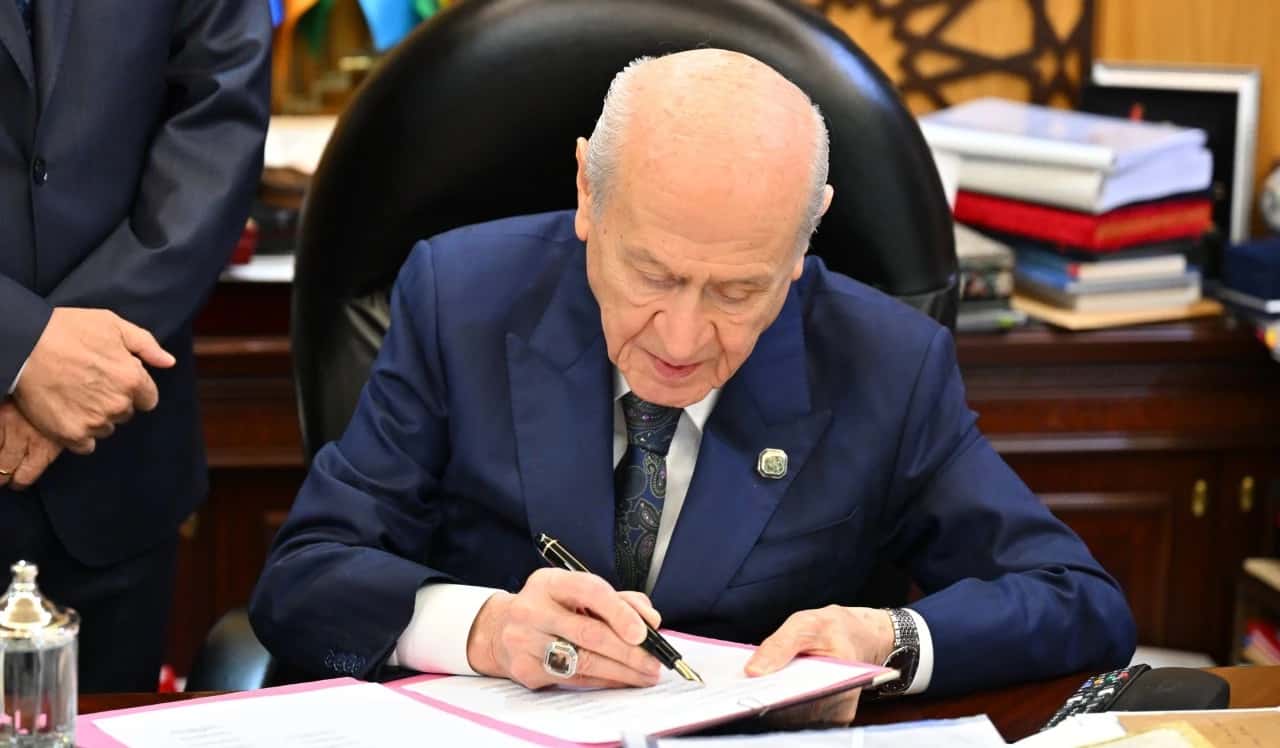
RastinewsNationalist Movement Party (MHP) leader Devlet Bahçeli said laying down arms alone would not be enough, as he described the scope of the "Terror-Free Turkey" process. Bahçeli said the process carries a broader vision of regional security spanning Syria, Iraq and Lebanon along with the strengthening of central governments, adding that the goal is "the elimination not only of terrorist elements in the mountains, but also of radicalized and marginalized structures." Bahçeli also argued that individual rights and freedoms could be expanded further, while ruling out any collective rights claims made on ethnic or religious grounds.
After the framework law passed parliament and was published in the Official Gazette, attention turned to the PKK's disarmament timeline.
About 3,800 PKK members based in 18 camps in Kandil are expected to lay down their arms gradually by the end of September. A timetable of one and a half to two months has been set for surrendering weapons, vacating caves and handing over logistics materiel, with the process expected to culminate in October, once the National Security Council confirms implementation of the framework law.
MHP leader Devlet Bahçeli assessed the current stage of the process for his party's deputy chairman, İsmail Özdemir. In remarks published in the newspaper Türkgün, Bahçeli repeatedly stressed regional peace and stability, arguing that the "Terror-Free Turkey" process would also expand Turkey's room for maneuver in foreign policy.
'We broke the new Sykes-Picot order'
Bahçeli said the first phase of "Terror-Free Turkey" was the organization's disarmament and the clearing of the region of armed elements.
But he said the goal does not stop there. He listed the process's aims as Turkey acting more independently in foreign policy, strengthening peace and stability in the surrounding region, and expanding Turkey's influence across a broad geography stretching from the Eastern Mediterranean to the Caucasus and from the Middle East to Europe.
Bahçeli said the region is witnessing an attempt to stage "the second act of the Eastern Question," adding:
"In fact, in our region, it appears that a second act of the 'Eastern Question' is being staged. The target is fragmented and divided sovereign states. But Turkey has broken the new Sykes-Picot order and the covert plans of Balfour through its goal of a 'Terror-Free Turkey,' dealing a blow to imperialism's ambitions in this geography by fostering a region free of terror."
Bahçeli argued that dividing six ethnic, religious and sectarian groups into "manageable autonomous regions," along with the armed organizations operating in those regions, threatens Turkey's security. He said political instability in Lebanon, Iraq and Syria has a direct bearing on Turkey's border security, sovereignty and social fabric.
Bahçeli floats a 'Turkish peace'
Bahçeli said the MHP wants to build a "Turkish peace" that would extend across the region as well.
He said this approach rests on order, justice and stability, arguing that the model he calls "Turkish peace" would serve as a guarantor of "a just and shared model of peace and prosperity" for both Turkey and the region.
Bahçeli continued:
"Turkish peace aims to strengthen central authorities in regional countries, above all Syria, as well as Iraq and Lebanon, to preserve their national unity and territorial integrity, and to establish a democratic system based on the rule of law. For that, illegal armed structures and terrorist organizations must first be eliminated."
Message on Syria, Iraq and Lebanon
For Bahçeli, security and political instability rank among the region's foremost problems.
He argued that radicalized armed organizations are blocking the establishment of stable political systems in regional countries, creating an environment open to outside intervention.
Bahçeli said the war between the US and Israel on one side and Iran on the other has dragged the region into a new cycle of chaos, and that a war centered on oil and arms trade is affecting regional populations, the global economy and Turkey alike.
Turning to Gaza, Bahçeli said Israel's attacks there and its actions against Al-Aqsa Mosque were unacceptable.
He argued that Syria, after years under Baath rule, is moving toward becoming a stable country.
"The era of tampering with the region's fate from thousands of kilometers away must end"
Bahçeli said the "Terror-Free Turkey" process should not be seen only as targeting Turkey's domestic security, but should be viewed as a regional stability model.
He said "Turkish peace" should take shape on the basis of respect for countries' internal affairs and territorial integrity, and called for the region's resources to be used for the development of its peoples.
Bahçeli said: "The era of coming from thousands of kilometers away to tamper with the fate of the region's peoples must now be behind us. That is where one should look for the truth that keeps those who oppose a Terror-Free Turkey up at night."
He said Turkey sits at the crossroads of energy, transport and trade corridors between Asia and Europe, noting that the Middle Corridor, the Development Road Project, the Turan Corridor and energy transmission lines all depend on an environment of security and stability.
According to Bahçeli, once the PKK disarms, part of the resources currently allocated to security could be redirected toward education, technology, production, infrastructure and social development.
Message on rights and freedoms
Bahçeli also gave a detailed answer to a question on the relationship between "Terror-Free Turkey" and fundamental rights and freedoms.
He said Turkey is a democratic, secular and social state governed by the rule of law, in which fundamental rights and freedoms are constitutionally guaranteed, and that individual rights and freedoms should be developed further.
Bahçeli said rights tied to the individual are inalienable and non-negotiable, but took a different approach on collective rights.
He argued that collective rights defined along ethnic, gender, religious or sectarian lines produce divisive outcomes within the nation-state, and said the MHP's position is centered on expanding individual rights and freedoms.
Door closed on collective rights
Bahçeli said the state must apply rights and freedoms on an individual basis, without regard to language, religion, race, sex, color, sect, ethnicity or wealth.
He said the scope of individual rights and freedoms could be expanded in the republic's new century, and that new regulations at the level of legislation and institutions could be introduced to resolve problems in practice.
Bahçeli argued that the common ground should be the existing constitutional definition of citizenship:
"This common ground is Turkish citizenship, formed through the Turkish nation's historical and political consensus and expressed in our constitution. The way for all of us to be Turkey together is the will to live together under the state's unitary and national framework, in a spirit of national unity and solidarity, and with a desire for social cohesion and togetherness."
'Either terror or democracy, either arms or politics'
Bahçeli said another core theme of the process is "reinforcing the home front."
He stressed the importance of building a society in which every segment feels equal, respected and secure, arguing this would narrow the space for terrorist organizations' propaganda.
Bahçeli said democratic politics shrinks wherever terror and violence are present:
"Where there is terror and violence, it is not possible to speak of people's free will, human rights or democracy. In the shadow of terror and violence, democratic politics narrows, alternative paths to resolution close off, and processes of political participation cannot proceed on healthy ground. That is why we said 'either terror or democracy, either arms or politics,' and called on everyone to unite for Turkey."
'It matters that there's no federation, autonomy or culturalist demands'
Bahçeli said it was significant that statements on the PKK's dissolution and disarmament decision made no mention of a separate state, federation, autonomy or "culturalist demands," calling this "a new beginning" for Turkey.
He argued this would also roll back identity politics based on ethnicity and sect in Turkey.
Describing identity politics as "divisive rather than unifying," Bahçeli argued that democratic politics should be built around individual rights and freedoms.
'Not just those in the mountains'
One of the most striking parts of Bahçeli's remarks concerned extending the process beyond the disarmament of armed PKK elements.
Bahçeli said the terror group's disarmament alone would not be enough to complete the process. He added:
"Where terror, violence and vandalism exist, democratic culture cannot flourish, and state institutions weaken along with it. For this reason, the process can only fully succeed once the terror group lays down its arms — and beyond that, once any political outlook that legitimizes terrorism in any way, or leans on terror or vandalism, along with the separatist mindset behind it, passes into history."
Bahçeli continued:
"In this context, 'Turkey Without Terror' aims to eliminate not only terrorist elements in the mountains, but also radicalized and marginalized structures, ending violence altogether."
Bahçeli described Turkish citizenship as a framework uniting different ethnic groups under a shared political belonging.
Citizenship should be judged on political belonging rather than ethnic origin, Bahçeli said, arguing that Turkish citizenship serves as the unifying element of democratic politics.