
Report: 193 Workers Killed on the Job in October, Child Deaths Surge
At least 193 workers died on the job in Turkey in October. The Workers' Health and Safety Assembly's report put the death toll for the first ten months of the year at 1,930. Production never stopped at the HABAŞ factory in Aliağa, even after an explosion there killed 17 workers.

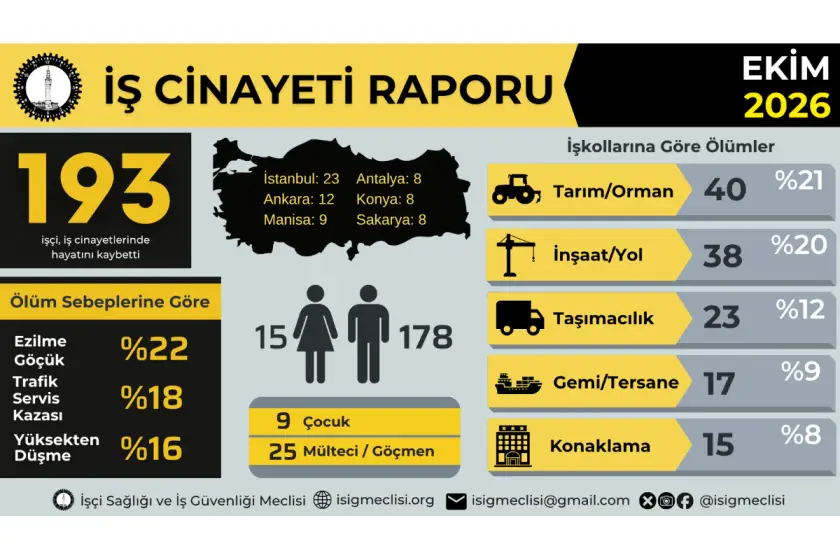
RastinewsAt least 193 workers died on the job in October, according to the October 2026 Workplace Murders Report published by the Workers' Health and Safety Assembly (İSİG). The death toll for the first ten months of the year reached at least 1,930. On the day the report was released, the death toll from an explosion at the HABAŞ Iron and Steel Factory in Aliağa, İzmir, rose to 17.
The HABAŞ Massacre: "The Soma of the Factory Exploitation System"
The report noted that explosions and a fire at the HABAŞ Iron and Steel Factory in Aliağa, İzmir, killed 17 workers and injured 12 others, one of them seriously. The İSİG Assembly said the disaster could not be dismissed as an accidental technical fault, stating: "If, after this massacre, we repeat stock phrases like 'the causes of the incident should be investigated,' 'an effective inquiry should be carried out,' 'those responsible should be found,' we will only be papering over the problem. This massacre is the Soma of the exploitation system in factories."
The report, which drew attention to the scale of exploitation and repression at the plant, highlighted the following facts:
Workers at the plant have for years been put through grueling 12-hour daily shifts, a system the report said was encouraged by the absence of inspection.
Two other workers, Hakan Doğan and Eyüp Eğinli, had already been killed on the job at the plant in the two weeks before the massacre, yet production continued without interruption.
The explosion was powerful enough to be felt by striking Smart Solar workers elsewhere in the area, yet the factory's machinery kept running even after 17 workers died.
Shortly before the disaster, management hastily took down a banner hung on the factory wall by the Aegean Workers' Union reading "Workplace murder at HABAŞ! Enough is enough! Organize and fight to live!" After the explosion, worker representatives who protested outside Aliağa State Hospital were detained by anti-terror police.
The statement read: "Our problem is the capitalist system that turns miners into coal underground and turns metalworkers into molten metal inside factories. We have to demand that, at the very least, the boss who has grown as rich as Croesus off this system be put on trial, and that the ministers who sustain this system, starting with the labor minister, resign. To hold people accountable, to live, we have to organize and resist." The İSİG Assembly called for those responsible to be prosecuted under provisions covering constructive intent (olası kast).
Deaths Under 14 Quadruple, Retirees Working Themselves to Death
October's figures point to a deep structural split in the age breakdown of workplace deaths. Of the 175 workers whose ages could be determined, 68 — roughly 39 percent — belonged to the two most vulnerable groups at either end of the working-age spectrum: children aged 0 to 17 and workers aged 50 and over. Compared with October 2025, the total number of workplace deaths rose 14.2 percent, from 169 to 193.

Total child worker deaths rose from 8 in October 2025 to 9 in October 2026, but the real break came within the age bracket itself: deaths of children aged 14 and under quadrupled, from 1 to 4. Five children and young workers aged 15 to 17 died. The report stressed that beyond the child exploitation legitimized through vocational training centers (MESEM), the deaths of unregistered migrant children working in agriculture and construction were being covered up with claims such as "he was playing on the construction site" or "he had come to visit his father."
Deaths among workers aged 50 and over accounted for roughly a third of the total in both years. 60 workers over 50 died in October 2025, compared with 59 in October 2026. Deaths in the 50-64 age group alone rose from 46 to 51 — confirmation, the report said, that millions of citizens are forced to keep working in heavy industry, agriculture and construction because their pensions fall below the hunger line. Among those 65 and older, 8 workers died on the job.
The sharpest numerical rise came among the core workforce aged 30 to 49, where deaths climbed from 61 to 74, up 21.3 percent. 33 deaths were recorded in the 18-29 age group. The number of workers whose identity or age could not be determined jumped from 8 to 18, a 125 percent increase that the report said exposed the scale of unregulated migrant labor.
94 Percent of the Dead Had No Union
Industry recorded the most workplace deaths in October with 74, followed by construction with 42, agriculture with 40 and the services sector with 37. By line of work, 40 workers died in agriculture and forestry (19 wage workers, 21 farmers), 38 in construction and road work, 23 in transport, 17 in shipping, shipyards and ports, 15 in hospitality and entertainment, 12 in mining, 12 in metalworking and 10 in municipal and general services. The report said long working hours and poorly maintained vehicles were driving up deaths in transport, and noted that 13 maritime workers died aboard ships operated by Turkey-based companies in the Black Sea war zone.
Crushing and cave-ins (43 deaths), traffic and commuting accidents (35) and falls from height (30) were the leading causes of death. 20 workers died of heart attacks or brain hemorrhages linked to excessive, intense work pace, while 16 died from workplace violence, 9 from explosions and burns and 9 from electrocution.
According to the report, as covered by Evrensel, wage earners — workers and salaried employees — accounted for 167 deaths, or 87 percent, while self-employed farmers and tradespeople made up the remaining 13 percent, or 26 people. The report noted that this balance, which stood at 80 to 20 in the early years the figures were tracked, has shifted against wage earners.
At least 182 of the dead workers, or 94 percent, had no union membership, while only 11, or 6 percent, were unionized. The report also documented 15 women workers who died in unregistered agricultural and cleaning jobs, and at least 25 migrant workers, 17 of them Syrian. Month by month, the death toll for the first ten months of 2026 was recorded as 155 in January, 129 in February, 151 in March, 190 in April, 214 in May, 228 in June, 216 in July, 227 in August, 227 in September and 193 in October.