
Eleven years after Tahir Elçi's killing, his shooter is still unidentified
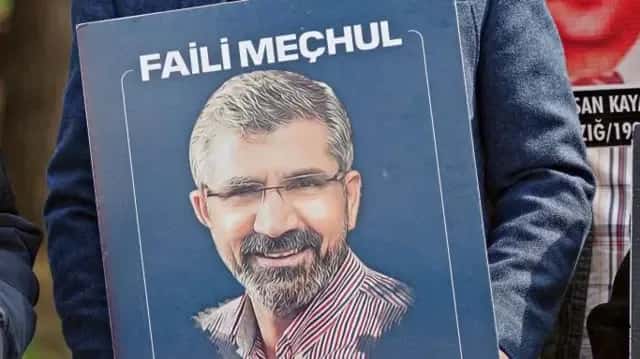
RastinewsThe Diyarbakır Bar Association and the Tahir Elçi Foundation are holding a memorial in Amed today, marking the 11th anniversary of Elçi's death. Lawyers will march in the morning from the Diyarbakır Courthouse to the Four-Legged Minaret in Sur. A ceremony will take place in front of the minaret at 10:53 a.m., and Elçi will be remembered again in the afternoon at his grave.
Eleven years have passed. Whose gun fired the bullet that killed Elçi remains unknown. No defendant in the main case was convicted.
"We don't want weapons, clashes or operations in this ancient region"
On the morning of Nov. 28, 2015, Elçi was giving a press statement in front of the Four-Legged Minaret to draw attention to damage inflicted on Sur's historic buildings during clashes. Speaking out against the fighting, he said: "We don't want weapons, clashes or operations in this ancient region."
As he spoke, a gun battle broke out nearby between police and armed individuals. The clash spread to Yenikapı Street. A single bullet struck Elçi in the head, killing him. Police officers Ahmet Çiftaslan and Cengiz Erdur also died in the same clashes.
Tens of thousands of people attended Elçi's funeral the next day.
The missing 13 seconds
A full examination of the scene wasn't carried out until four months later, on March 17, 2016. The bullet that killed Elçi was never found.
Police camera footage showed a roughly 13-second gap at the exact moment Elçi was shot. Footage from a PTT (Turkey's postal service) camera was missing a 17-minute segment.
According to a report by Forensic Architecture, a research agency based at Goldsmiths, University of London, three police officers at the scene were in the line of fire aimed at Elçi. The report was submitted to prosecutors in 2018. The investigation wasn't completed until March 20, 2020 — roughly four and a half years after the killing.
Lawyers for Elçi's family said evidence wasn't collected in time and that their requests to clarify the camera footage went nowhere, arguing no effective investigation was ever carried out.
Davutoğlu never testified
The indictment charged police officers Sinan Tabur, Mesut Sevgi and Fuat Tan, along with fugitive defendant Uğur Yakışır. The three officers were accused of "causing death through conscious negligence." Yakışır was tried over the deaths of Elçi, Çiftaslan and Erdur, as well as attempted murder of a police officer.
Mahsum Gürkan, also named in the case file, was killed during a security operation in Sur while the investigation was ongoing. The investigation against him was dropped as a result.
The trial's first hearing was held on Oct. 21, 2020. Throughout the proceedings, the family's lawyers requested an on-site inspection, examination of the camera footage and witness testimony. They also asked that Ahmet Davutoğlu, prime minister at the time, be called as a witness.
The court ruled in June 2022 that Davutoğlu would testify. At the prosecutor's request, it reversed that decision on Sept. 19, 2022. Davutoğlu was never heard as a witness during the trial.
Yakışır's file was separated from the main case in November 2023. The fugitive defendant's trial continues under a separate case file.
Acquittal finalized, case now before the Constitutional Court
At a hearing on April 29, 2024, the prosecutor requested the acquittal of the three police officers. The Diyarbakır 10th Heavy Penal Court announced its verdict on June 12, 2024. The court found it could not be determined with certainty which weapon fired the shot that killed Elçi, or who fired it. Tabur, Sevgi and Tan were acquitted.
The Diyarbakır Regional Court of Appeal's 10th Criminal Chamber rejected an appeal filed by the family and the Diyarbakır Bar Association on Jan. 4, 2025. Because the ruling was not open to further appeal, the case could not go to the Court of Cassation, and the acquittal became final.
The family's lawyers filed an individual application with the Constitutional Court on Jan. 24, 2025. Nearly two years later, the application still hasn't been resolved.
A lawyer for victims of unsolved killings
Tahir Elçi was born in 1966 in the Cizre district of Şırnak. He graduated from Diyarbakır University's Faculty of Law in 1991 and began practicing law in Amed a year later.
Through the 1990s, he represented victims in cases involving extrajudicial killings, unsolved murders and village burnings. He represented families in the case over the 1994 bombing of the villages of Kuşkonar and Koçağılı, in which 26 people died, as well as in the Lice and Temizöz cases and the Roboski massacre file.
He paid an early price for that work. In November 1993, he was detained and tortured in an operation targeting lawyers who were pursuing cases over village evacuations. The European Court of Human Rights ruled against Turkey in the case, known as "Elçi and Others v. Turkey."
He sat on the Scientific Advisory Board of the Human Rights Association (İHD) and the Union of Turkish Bar Associations' Human Rights Center, and was among the founders of the Human Rights Foundation of Turkey (TİHV). At the time of his death, he was serving his second term as head of the Diyarbakır Bar Association.
A case had been opened against him before his death
Shortly before he died, Elçi appeared on CNN Türk's "Tarafsız Bölge" ("Neutral Zone") program. "The PKK is not a terrorist organization," he said. "Even if some of its actions amount to terrorism, the PKK is an armed political movement."
The remarks made him a target. He was detained on charges of "making propaganda for a terrorist organization" and released under judicial supervision. Prosecutors sought a sentence of one and a half to seven and a half years in prison.
Elçi is remembered every year in front of the Four-Legged Minaret, where he died.