
After Houthi advances, Turkey, Saudi Arabia and Pakistan to hold emergency military talks
Turkey, Saudi Arabia and Pakistan have moved into action after Houthi forces advanced along Yemen's Bab el-Mandeb and Red Sea coastline and stepped up missile and drone attacks on Saudi Arabia. The three countries' chiefs of general staff will hold an emergency meeting to discuss what support could be extended to Saudi Arabia under the Mecca Joint Defense Agreement.
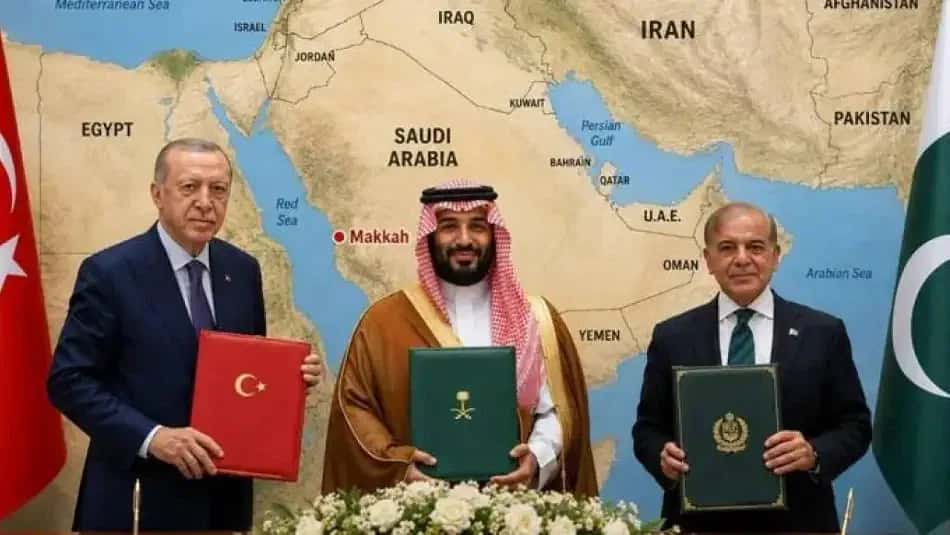
RastinewsEscalating clashes between Iran-backed Ansar Allah, or the Houthis, and Saudi-backed government forces in Yemen have put regional security back at the top of the agenda.
Saudi Foreign Minister Faisal bin Farhan, Turkish Foreign Minister Hakan Fidan and Pakistani Deputy Prime Minister and Foreign Minister Ishaq Dar met in New York.
The three agreed to prepare for an emergency meeting of their countries' chiefs of general staff.
The talks are expected to address what support Riyadh could receive under the Mecca Joint Defense Agreement in response to Houthi attacks on Saudi Arabia.
No date has been set for the meeting, and the scope of any potential military support to Saudi Arabia has not been disclosed.
Mecca agreement faces its first major test
Turkey, Saudi Arabia and Pakistan signed the Mecca Joint Defense Agreement in Mecca on August 7, 2026.
The pact, signed by President Recep Tayyip Erdoğan, Saudi Crown Prince Mohammed bin Salman and Pakistani Prime Minister Shehbaz Sharif, establishes a collective defense mechanism among the three countries.
Under its most notable provision, an armed attack on any one signatory is to be treated as an attack on all three.
The agreement also calls for deeper military cooperation, stronger collective deterrence and closer defense coordination.
The latest Houthi attacks on Saudi Arabia have brought the agreement's collective defense clause to the table at the military level for the first time.
Missile and drone strikes on Saudi Arabia
Tensions have risen as the Houthis step up missile and drone attacks on Saudi Arabia.
The Saudi-led coalition said on September 24 that its air defenses had intercepted six ballistic missiles aimed at Taif and the strategic Red Sea city of Yanbu.
The Houthis said they had struck a "sensitive target" in Riyadh and Saudi Aramco facilities in Yanbu with missiles and drones.
Saudi authorities issued security alerts for several regions, including Mecca, Jeddah, Yanbu, Tabuk and Taif.
Yanbu carries strategic weight as one of the outlets of the East-West pipeline, which carries oil from Saudi Arabia's eastern fields to the Red Sea.
Houthis advance on Bab el-Mandeb
Saudi Arabia is also facing mounting pressure from the front line in Yemen.
In September, the Houthis seized the strategic Red Sea city of Mokha, then took control of Perim Island in the middle of the Bab el-Mandeb Strait along with the Greater and Lesser Hanish islands.
The advances have significantly strengthened the Houthis' grip on Bab el-Mandeb, one of the key maritime passages between the Red Sea and the Gulf of Aden.
Bab el-Mandeb is regarded as one of the world's most critical chokepoints for maritime trade and energy shipments between Europe and Asia.
Saudi grand mufti calls on troops
Amid the rising military tension, Saudi Arabia's Grand Mufti, Sheikh Saleh bin Fawzan al-Fawzan, issued a notable statement addressed to troops stationed along the border.
Fawzan said defending the country's territory was among the foremost duties, and that soldiers must be "ready to sacrifice their lives and souls" for that cause.
The grand mufti called for the fight against the Houthis to continue and for the internationally recognized government's authority in Yemen to be restored.
All eyes on the chiefs of staff meeting
No date has been announced for the meeting of the chiefs of general staff of Turkey, Saudi Arabia and Pakistan.
The meeting's significance extends beyond the latest developments in Yemen. It will be among the first critical military-level contacts to address how the collective defense provisions of the Mecca Joint Defense Agreement, signed on August 7, would be applied amid an active security crisis.
The central question facing the three chiefs of staff will be what kind of support, and how much of it, Saudi Arabia should receive in the face of Houthi attacks.