
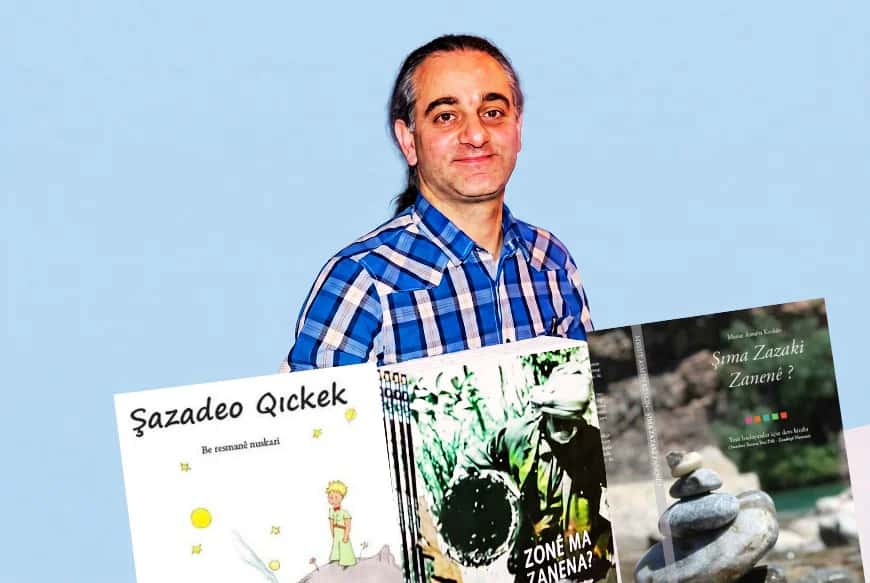
Could you introduce yourself briefly for our readers?
Ma be xêr di, hello! I was delighted by your interest and your wish to do this interview with me. I also read your previous interviews with real enthusiasm. Thank you for your effort and dedication.
I was born in Istanbul to a family from Pülümür. I have lived in Germany since I was two. I began engaging seriously with my mother tongue, Zazaki, in 1993. At first, in an amateur capacity, I took part in research on Zazaki, as well as spelling and dictionary work, carried out at Goethe University Frankfurt.
Between 1995 and 2000 I sat on the editorial board of Ware, a language and culture magazine published in Zazaki, Turkish and German. In 1999, together with a few other writers and university students, we founded the website www.zazaki.de. Writing under the pen name Asmêno Bêwayir, I published articles, translations and compilations focused mainly on Zazaki in Ware, Tija Sodıri, ZazaPress, Miraz, Piltan and various other magazines and websites. I also edited a number of Zazaki poetry, short-story and novel titles.
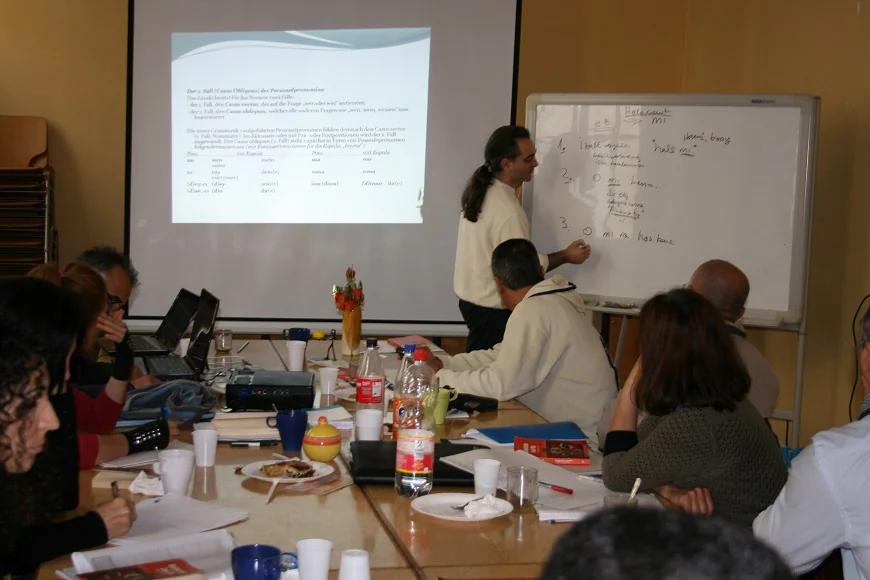
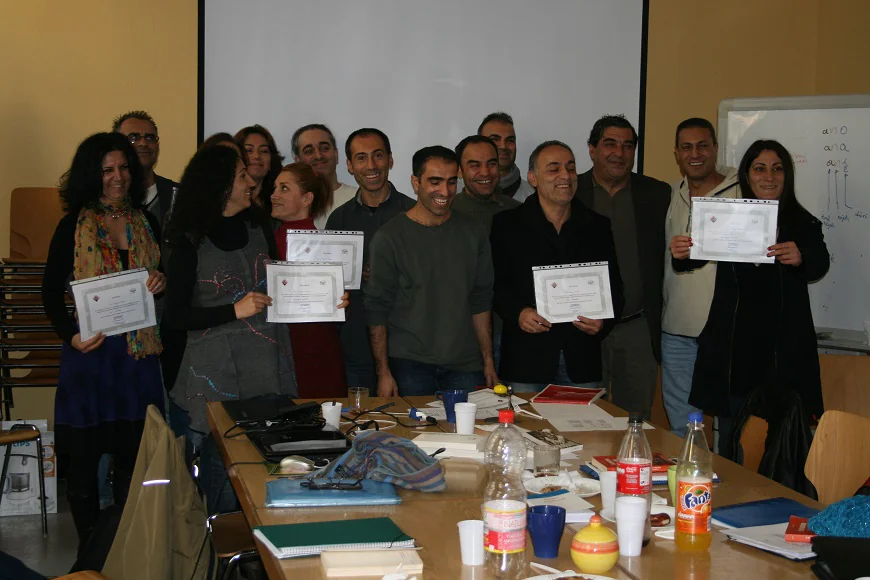
I am a founding member of the Enstitüyê Zazaki, established in Frankfurt in 2002, and I still serve on its board. I have taught Zazaki at associations since 1999, at Goethe University Frankfurt between 2006 and 2020, and online in the years since. Since 2020 I have continued teaching online. I have also taught German at C1 level to foreign dentists and pharmacists since 2019.
During my mechanical engineering studies, after finishing an associate degree, I transferred in 2005 to the Comparative Indo-European Linguistics program at Goethe University Frankfurt, graduating in 2009 with a master's thesis titled "On the Dialectal Structure of Zazaki." I later worked as a research assistant in the same department. I have presented papers at symposiums, conferences and other events on Zazaki held in Germany, Austria, Dersim, Bingöl, Yerevan and Paris.
I translated Antoine de Saint-Exupéry's The Little Prince into Zazaki as Şazadeo Qıckek (2009). I have also published the Zazaki textbooks Zonê Ma Zanena? (2012), with explanations in German, and Şıma Zazaki zanenê? (2017), written in Turkish with an approach aimed at a shared written language across the dialects.
Over the years I sat on the editorial boards of MA, Vengê Welatê Zazayan, Piltan and Zaza u Zazaki magazines. I still edit www.zazaki.de and, at times, the Zazaki Wikipedia, and I take part in editing the Zazaki-Turkish dictionary prepared by the Enstitüyê Zazaki. Our dictionary was published in 2025; a Turkish-Zazaki edition is now in preparation.
I am continuing my doctoral and etymological research at Goethe University Frankfurt. My book on sociolinguistics and ethnology, Identitätsdynamik und Ethnizität der Zaza-sprachigen Bevölkerung zwischen Fremdzuschreibung und Selbstverortung ("Identity Dynamics and Ethnicity of the Zazaki-Speaking Population: Between External Ascription and Self-Positioning"), was published in 2025.
Shall we try to map out a Zaza geography through the language? Can you tell us about the earliest known Zaza geography and its state today? People speak of Northern Zazaki, Central Zazaki and so on — what are the differences and the common ground between them?
Zazaki is spoken in the Upper Euphrates and Tigris basin of eastern Anatolia, by an estimated 4 to 6 million speakers. Numerically, it can be considered the third most widely spoken language in Anatolia after Turkish and Kurdish. Thanks to internal migration over the past fifty years, and to migration and asylum to Europe, particularly Germany, it is also kept alive today by a significant diaspora community.
Zazaki forms a geographically continuous area where it is spoken. It is spoken most densely in Inner Dersim, Bingöl, Elazığ, Erzincan and the northern parts of Diyarbakır. Beyond that, various sub-dialects are also found across a wider area stretching from Sivas to Erzurum and from Muş to Adıyaman.
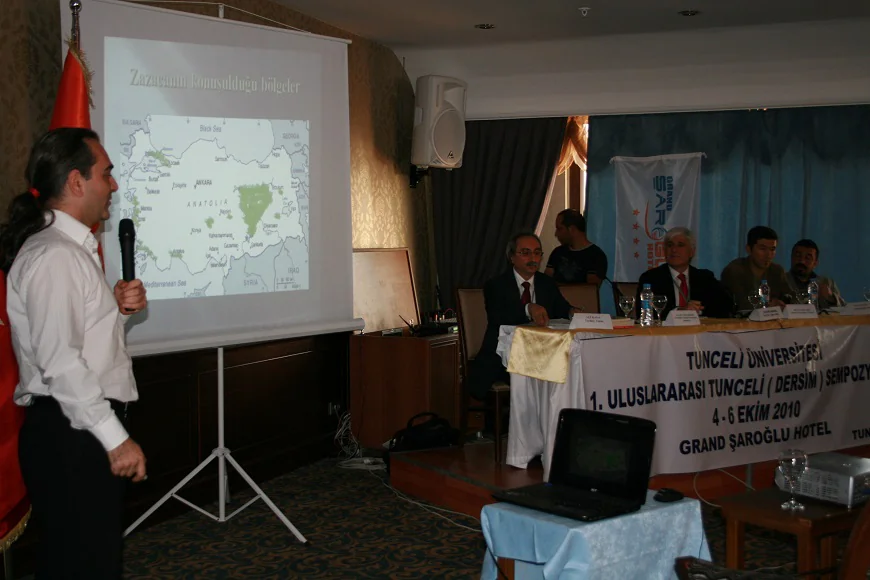
A significant part of my academic work concerns the historical development of Zazaki. Linguistic research shows that Zazaki occupies a distinct place among the New Iranian languages. It is generally held to have particularly close historical ties to Parthian, while retaining, in some respects, quite archaic features. That said, identifying Zazaki directly with Avestan — or presenting it as derived from Avestan, even as a related language, as is sometimes claimed — is not scientifically accurate.
Zazaki shares important features with Northwest Iranian languages such as Balochi, Gorani, Southern Tati, Sangsari, Mazanderani, Gilaki, Talysh and Semnani. These similarities are among the linguistic evidence cited in support of the Daylam theory of Zaza origins. Even so, we cannot say with certainty exactly when Zazaki reached its present-day geography. It may have been present in the region since the Parthian Empire — that is, for at least 2,200 years — or it may have spread through a migration from the Daylam region in the 9th century. In my view, the considerable diversity among Zazaki's dialects and sub-dialects, and the substantial differences between them, show that the language has occupied this mountainous geography for a long time.
Structurally, together with its transitional and peripheral sub-dialects, Zazaki divides into three main dialects: Northern, Central and Southern Zazaki. This division corresponds not only to phonological and grammatical features but also, in part, to historical and sociocultural differences. Although there are certain differences between the dialects, people who know the language well can largely understand one another in everyday communication. Mutual intelligibility is especially high among speakers familiar with the different sub-dialects.
From a linguistic standpoint, what are the key features that distinguish Zazaki from its related languages? What can Zazaki's vocabulary and grammar tell us about how its speakers perceive and express the world?
The method used to classify the Iranian languages as distinct members of the same language family does not rest on their synchronic relationships in sound, form and vocabulary, but on their diachronic — that is, historical — development: distinguishing features, especially phonological ones, are traced through different historical stages by comparing isoglosses drawn from written Old and Middle Iranian languages, together with the distinguishing sounds, sound clusters, morphemes and vocabulary that have survived into the present. This is also the approach used to establish Zazaki's relationship with other Iranian languages known in our region, chiefly Persian and Kurdish. Some notable linguistic features, with examples, are as follows (a similar picture emerges when Zazaki is compared with other Iranian languages such as Gorani, Talysh, Luri, Balochi or Southern Tati):
| Old Iranian | Zazaki /linguistic transcription/ |
Kurdish /linguistic transcription/ |
Persian | ||
| *xv- | *xvahar-
xvan- |
wae
wendene ; wan- |
xweh
xwendin ; xwîn- |
xwāhar خواهر
xwāndan خواندن ; xwān- |
sister
to read |
| v- | vāta- | va | ba | bād باد | wind |
| x- | xara- | her | ker | xar خر | Donkey |
| -θr- | θri- | hirê /hirē/ | sê /sē/ | se سه | 3 |
| z- | zānā- | zan- | zan- | dān- دان | to know |
| -ǰ- | *ǰani- | ceniye /ǰeníye/ | jin /žɨn/ | zan زن | woman |
| -č- | *rauča- | roc /r̄oǰ/ | roj /r̄ož/ | rūz روز | day(sun) |
Historical and general linguistics engages with a living being's body, anatomy, tissue and functioning much as medicine does. But the extralinguistic qualities that dwell in languages — spirit, feeling, worldview — cannot be explained by linguistics alone. Speakers shape their language according to their needs. As Schiller put it, "You can dissect a language anatomically; but all that is left in your hand is its corpse. Its soul and life slip away from the crude scalpel." (Friedrich Schiller, Xenien und Votivtafeln, 1797).
What changes has the Zaza alphabet undergone? Which alphabet is used today?
Zazaki was first written down by its own speakers in 1899. That year, Eḥmedê Xaṣi (Mela Eḥmed bin Ḥesen el-Xaṣi), a religious scholar from Lice in Diyarbakır, published a work called Mewlıd in the Arabic alphabet, which became widely known among Sunni Zazas. Another work, a Mewlıd written in the Siverek dialect of Zazaki, also in Arabic script, by mufti ˁUsman Esˁad Efendiyo Babıc in 1906, was not published until years later, in 1933 in Damascus.
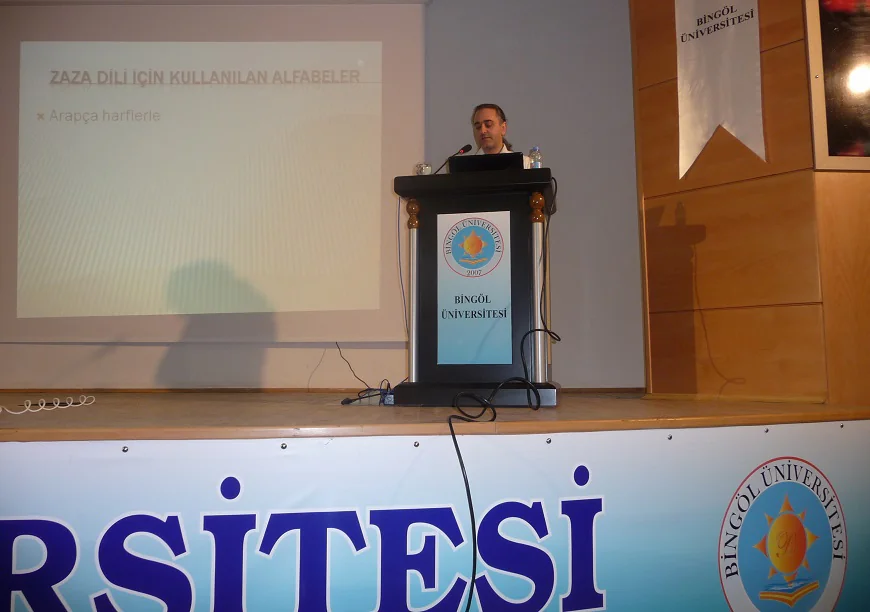
After a silence that lasted until the sixties, some Kurdish-language newspapers and magazines published until the early eighties carried occasional Zazaki texts written in Latin script, based on the Kurmanji alphabet used for Northern Kurdish. Steps to develop a distinct alphabet and spelling system for Zazaki itself began after the 1990s, led especially by multilingual magazines launched after 1985 with the aim of turning Zazaki into a written language. In those years, books on Zazaki spelling and the alphabet were finally published, writers and linguists carried out studies, and articles began appearing in magazines. This period also saw the first magazines published entirely in Zazaki. After the 1990s, as pressure on local languages in Turkey eased, the first Zazaki publishing house was founded, notably in Istanbul, and Zazaki books, magazines and dictionaries began to be printed in the country.
There is still no single agreed standard for writing Zazaki today. In religious circles, mevlids continue to be published mostly in the Arabic alphabet, while works written in Latin script follow one of two main spelling systems. In the magazines, books and online material generally in circulation, two distinct Zazaki alphabets exist, each combining letters not found in the Turkish alphabet — ê, q, w, x — with Latin letters and, variously, ı : i, i : î, ü : û, and letters or digraphs such as ğ, çh, kh, ph, th (', 'h, dh, lh, sh, ö).
The approach I belong to treats Zazaki as an independent language and uses the Ware/Jacobson alphabet, which rests on linguistic criteria and aims to represent all the sounds of the language as accurately as possible. The other approach, though linguistically unfounded, treats Zazaki as a branch of Kurdish and so relies on the Bedirxan alphabet developed for Kurmanji.
The dispute between these two approaches is not only about the alphabet; it also concerns the linguistic status of Zazaki. Circles that argue Zazaki is an independent language have taken significant steps toward standardization through etymological studies, seminars and projects such as Zazaki Wikipedia, aiming to build a common written language. While the standardization effort long pursued by the circle that considers Zazaki part of Kurdish deserves respect, it is unfortunately problematic in terms of linguistic method and approach, since it has been carried out by people around a magazine rather than by a language institute or academic linguists. Under today's conditions, standardization and normalization of the language should be handled by linguists who are genuinely versed in the subject.
Beyond these, there is a third alphabet developed by Dr. Zülfü Selcan and used in particular at Munzur University. But technical difficulties in using it kept it from spreading, and only a limited number of works have been published in this writing system.
In which neighboring regional languages do we find Zaza words and expressions?
Because Zazaki in its current form does not, as a written language, influence neighboring or other languages, and is not the officially dominant language anywhere in its own geography, it is not really possible to find words of Zaza origin in the written form of other languages. Still, in areas where Zazaki is numerically the dominant language, or in neighboring regions, Zaza words have certainly passed into languages such as Kurdish, Turkish, and probably Syriac and Armenian — for example kutık, "dog," or gındır-lanmak, "to roll." In Turkish's Derleme Sözlüğü [Compilation Dictionary] (my colleague, the Turkologist Uwe Bläsing, has written two German-language articles on this) or in the Kurmanji spoken in the Zaza region (Northern Kurdish, e.g. in İzolî's dictionary), one can find Zaza words and traces of Zazaki's phonetic and emotional character — words that do not appear in official Turkish or Kurmanji.
More broadly, Western Iranian languages such as Persian, Kurdish, Gorani, Balochi, Talysh and Semnani share many cognate words with Zazaki with a common root, since related languages share a large part of their vocabulary and grammar from a common origin — which is why these languages are grouped together among the more than forty Iranian languages.
Much of the debate around Zazaki centers on a standard written language. In your view, how should the effort to build a common written language be balanced against preserving local dialect diversity?
I believe linguistic principles should be the basic criterion when building a common written language. In choosing words and grammatical forms, the forms that best reflect historical development — that is, the most etymologically preserved forms — should be taken as the basis, and it can be argued that these are also the variants most easily understood by the majority.
For me, etymology functions here as a neutral criterion. It makes it possible to build a common written language on the basis of scientific data, without privileging the dialect of any one region over the others. This approach can also head off unnecessary disputes between dialects.
At the same time, building a common written language should not mean pushing local dialects into the background. On the contrary, dialects should continue to exist in writing and in daily life. As in Switzerland, a supra-dialectal common written language used in education, science and official correspondence can coexist with local dialects that remain very much alive. We see this coexistence of local dialects with a written standard among ordinary speakers in languages such as Persian or Arabic as well: written and official Classical Arabic has not been a spoken language for 1,400 years, and instead of the official Fārsī-ye kitābī, people speak Fārsī-ye moḥāvere, "colloquial Persian," which is also used in correspondence and film subtitles.
In short, I think the healthiest model for Zazaki is a two-variant structure — a kind of diglossia — in which a shared standard written language coexists with local dialects.
Artificial intelligence, large language models and digital language technologies are advancing rapidly. How ready do you think Zazaki is for this transformation? Are language technologies an opportunity for the future of Zazaki, or do they also carry new risks?
Zazaki does not yet have a corpus large enough to say it is ready for this transformation at the level of world languages, but judged against its own living conditions and formation, it has a considerable body of writing. For this reason, it has already begun adapting to the transformation. Even if amateurish, Zazaki reels, short dialogues and even songs, kılams, are being produced successfully on social media. I believe artificial intelligence is an opportunity for the language's future, as long as it is used to keep Zazaki naturally alive, to teach it and to develop it. The language's natural form can be preserved without distortion from Turkish and other languages — distortion that stems especially from ideology or lack of knowledge — by taking as a basis and example the speech and vocabulary of the oldest speakers who do not know Turkish. Unfortunately, this presents a difficulty.
In recent years important dictionaries, grammar studies and academic publications have appeared on Zazaki. In which areas do you think Zazaki linguistics has made significant progress, and which topics are still waiting to be studied enough?
Yes, the appearance and growth in number of dictionaries and grammar studies is of course positive and necessary. Linguists can be asked for support on this, and they should also take up these studies themselves, because it is linguists who can do justice to this work from a scientific standpoint.
Although Zazaki is not as widely recognized or known as an Iranian language as, for example, Persian or Kurdish, I can say that significant progress has been made on it, particularly in German linguistics and Iranology, in grammar, its position among languages and dialectology, dictionaries, language-course curricula, etymology, and also in literary studies. Even so, it would not be wrong to say we are still at the very beginning. I think the following areas still await work: professionalizing curricula aimed especially at children and young people with games and applications, adapting them attractively to the age of computers and mobile phones in ways that also make it possible to preserve local dialects; beyond that, etymological studies; recording, through long-term projects, all spoken dialects and variants while they have not yet disappeared; and recording old tales and stories, cultural life — in short, everything the language contains — not only in writing but also in audio and video with their pronunciation.
Source: Zaza Culture Center